

Why AI Stalls Tackling AI Fear Sharpen AI Focus Escaping Gerbil Trap
Six months after the deployment, you are in front of the senior leaders explaining why the productivity gains have not shown up in the numbers and the return on investment the business case promised has not arrived. The platform shipped on time. Training was delivered. License utilization is “trending in the right direction.” The implementation team is being congratulated for hitting milestones. And somehow, the operating result the organization counted on is nowhere to be found.
If you are a Chief Transformation Officer, a CIO, a COO, or a Chief HR Officer in 2026, this scene is familiar. Not because your team is bad at execution. Because the dominant model of enterprise AI adoption is structurally incapable of producing the behavior change the business case and ROI depend on.
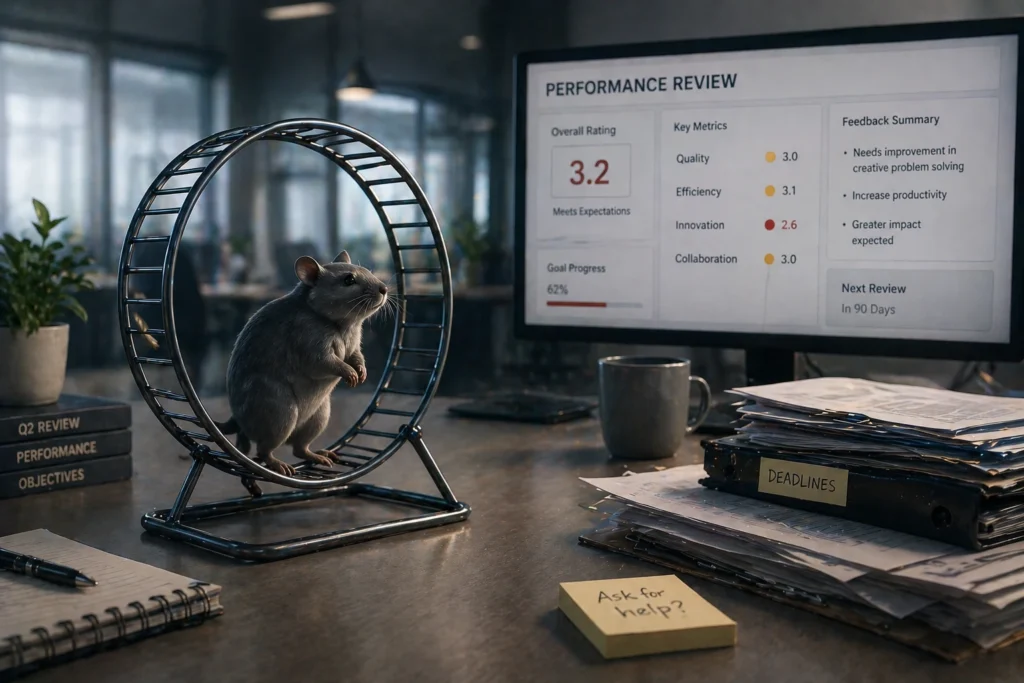
The reason is not the tools. It is rarely the tools. Most AI rollouts succeed at deployment and fail at adoption because we are handing a faster wheel to people who are already running fast and getting nowhere. The investment is real. The workflow change that would justify the investment is not. This is the central problem in change management for the artificial intelligence era.
Most enterprise AI rollouts fail to produce the promised productivity gains and return on investment because they do not address three structural blockers: fear, focus, and the gerbil track of running faster without real progress. Fear comes from real concerns about job security and performance evaluation. Focus is impossible without reducing existing workload. The gerbil track is the unchanged structural deal where artificial intelligence gets added on top of the same KPIs, the same deadlines, and the same definition of done. Successful enterprise AI adoption requires executives to make a clear structural deal upfront: specify what AI replaces, what it frees time for, and redefine progress from activity to outcome. Without that, training and communication alone cannot drive adoption. This is the work of change management, not L&D. And as the organization moves toward agentic AI, the gap between investment and ROI widens, not narrows.
What does the gerbil track look like in practice? It looks like the TPS report from Office Space (Mike Judge, 1999). Employees used to spend hours producing them. The reports were never useful, but the productivity score depended on producing them, so they got produced. Now they spend the same hours and burn AI tokens on top, because the cover sheet still has to be right. And they are expected to produce more of them, because AI made each one faster. The wheel just spins faster. The TPS report is still pointless.
Why AI rollouts fail at adoption
Adoption is not happening because of three reasons, and they are rarely the ones executives name. The first is fear. The second is focus. The third is what I call the gerbil track. Each of them is real. Each of them is structural. None of them is solved by a better training program.
This is the central diagnosis at the heart of any honest AI change management conversation: deployment is not adoption, training is not real change, and license utilization is not productivity. Honest change management for AI starts here.
Blocker one: Fear
Employees are afraid of what AI use will mean for their performance evaluation. They are afraid that asking for help to learn the tools will be read as incompetence. They are afraid that AI will replace them. None of those fears are unreasonable. None of them are paranoid. And none of them get fixed by training.
Most “AI change management” responds to fear with information: explainer sessions, FAQ documents, “AI literacy” workshops, reassurance from L&D that “AI is here to help, not replace.” This treats fear as a knowledge gap. It is not a knowledge gap. It is a workplace signal that employees are reading their environment accurately.
The fear gets fixed when sponsors do three specific things, in this order.
First, sponsors must Express that AI experimentation is safe. Not in an all-hands. In writing, in the performance review framework. The criteria for “exceeds expectations” must explicitly include AI experimentation, not just AI proficiency. If managers can dock employees for awkward early AI use, fear is rational and stays.
Second, sponsors must Model AI use themselves, and they must do it visibly while still learning. This is the part most senior executives get wrong. They want to be seen as artificial intelligence experts. The signal that fixes fear is the opposite. Executives publicly fumbling with new tools, acknowledging what they do not understand, asking junior employees how they would approach a use case. The vulnerability of public learning is the protection that lets others learn.
Third, sponsors must Reinforce by recognizing experimentation, not just outcomes. Most enterprise reward systems measure delivery and license utilization. Both are wrong inputs for early AI adoption. The right input is the volume and variety of experiments, regardless of whether they worked. Employees who watch their peers get rewarded for “AI productivity wins” while their own experiments produce nothing publishable will quietly stop experimenting.
This is the Express, Model, Reinforce sponsor playbook applied to AI. Without it, fear stays. No amount of training overcomes it. This is change management at the executive tier, not at the L&D tier.
Blocker two: Focus

Workers cannot add new behaviors when nothing has been removed from their workload.
This is mathematically obvious and operationally invisible. Most enterprises run the AI rollout as an addition: same KPIs, same deadlines, same meeting load, plus AI fluency expectations on top. The “find time to learn AI” pitch lands on calendars that are already 95 percent committed. There is no time to find. The time has to be cut. The tasks that fill that time have to be cut.
Focus is not a personal trait. It is a structural condition organizations either create or do not. The cleanest test of whether your organization has created the condition for AI focus is the calendar audit. In the last quarter, what work, meetings, tasks, or KPIs were explicitly removed from someone’s load to make room for AI experimentation?
In most organizations the answer is none. The dedicated AI exploration time is announced and never actually subtracted from the 100 percent of existing work. The “AI sprint” gets scheduled on top of existing sprints. The “AI office hours” sit at 4:30 p.m. Friday after the existing 9-to-5 has run twelve hours over.
The fix is structural and visible. Workload audits. Meeting cancellations. KPI changes that explicitly down-weight throughput in exchange for AI experimentation outputs. Definition of done changes that include “tested AI option” as a precondition for closing certain task categories. None of this is comfortable. None of it is L&D work. All of it is change management work.
Focus is the second blocker that most “change management for AI” programs leave unaddressed because addressing it is uncomfortable for the executives who own workload, not the executives who own change.
Blocker three: The gerbil track

This is the third blocker and the most contrarian, so I will be direct. Most enterprise AI strategies are not transparent about what they are asking.
The pitch is consistent. AI is a productivity multiplier. Artificial intelligence will free up your people to do higher-value work. AI handles the routine so humans can focus on creativity. The narrative is so universal it has become category default.
Employees hear something different. They hear “same headcount, same deadlines, with AI fluency added on top.” They hear the layoff announcement that landed in the same week as the AI investment announcement. They hear the productivity studies measuring license utilization and assume their next performance review will include the same number. They hear extraction.
They are not wrong. They are reading the environment correctly. Most organizations are using AI as a way to do more with less, not as a way to do different. AI gets handed to employees who are already running fast and getting nowhere, and the structural deal stays the same. The wheel just spins faster. Same direction. More exhausted. No actual progress. No real efficiency gain.
The gerbil track is the third blocker that the rest of the change management field will not name. It is also the one that determines whether the other two blockers can be fixed at all. You cannot address fear when the layoff math implies fear is rational. You cannot create focus when the workload math implies workload reduction is fictional. The gerbil track is the structural reality the other two blockers operate inside.
Why AI rollouts fail: how the three blockers connect
The three blockers reinforce each other in a way that is worth naming. Fear is rational because the gerbil track is real. Focus is impossible because workload reduction is fictional. The gerbil track persists because executives are unwilling to make the structural changes that would address fear and focus directly. Each blocker reinforces the others.
This is why “AI change management” programs that treat the three as separate problems, addressable through training and communication, do not work. The three blockers are facets of the same structural problem. Executives have not changed the shape of the wheel.
Enterprise AI adoption: the structural deal
For enterprise AI adoption to produce real change, executives have to make a real structural deal before the rollout, not after. The deal has three components.
First, name what AI replaces. Not abstractly. Specifically. Which task categories, which deliverables, which meeting types, which approval workflows, which workflow steps, which tasks are being subtracted from the workload because AI is now expected to handle them? This is especially urgent as enterprises move from chat-and-copilot tools toward agentic AI. Agentic AI does not just generate output. Agentic AI takes action inside workflows. The structural deal matters even more for agentic AI, because autonomous agents will act on the workflows the organization has, not the workflows the organization wishes it had. If the answer to “what is AI replacing” is none, the deal is not real and the investment will not produce return on investment.
Second, name what AI frees time for. The freed time has to land somewhere. If the freed time produces only “more output of the same kind,” employees will read the deal as extraction. If the freed time enables a specific category of higher-value work, whether that is strategy time, customer engagement, product innovation, deep work, knowledge transfer, or learning, employees will read the deal as exchange. The exchange is what produces willing adoption. Without that exchange, the investment in artificial intelligence buys efficiency on paper that never materializes in the numbers.
Third, change the definition of progress. The legacy KPI set measures activity: hours, throughput, tickets closed, items shipped, tasks completed. Those metrics were built for a world where activity tracked outcomes. AI breaks that link. An employee who uses AI to deliver the same throughput in half the time is not adopting AI. They are extracting it. An employee who uses the freed time to deliver a different kind of output is. The KPI set has to recognize the difference, and the change management program has to surface it.
This is structural change management work. It is not L&D work. It is not communications work. It is the kind of work that requires AIM-grade methodology, behavior-first design, two-tier sponsorship, day-one reinforcement architecture, principle-based application, paired with the iterative cadence of SAFe-grade delivery. Most change management voices do not have the agile credibility to carry the iterative half. Most agile voices do not have the structural change management credibility to carry the change half. AI rollouts need both.
AI change management starts with the right metric

The metric most enterprises are using to measure AI adoption is license utilization. It is the wrong metric. License utilization measures whether employees are spinning the wheel faster. Behavior change measures whether the wheel is going somewhere different.
License utilization is the artificial intelligence era’s TPS report. In Office Space (Mike Judge, 1999), Bill Lumbergh repeatedly nags Peter Gibbons about the cover sheets on his TPS reports, a perfect symbol of activity that mistakes form for substance. The TPS report measures whether the procedure was followed. It does not measure whether anything got better. License utilization is the same instinct, twenty-five years later, dressed up in dashboard charts. It measures whether employees are clicking the AI tool. It does not measure whether their workflow has changed. It does not measure whether the organization is operating with more efficiency.
What does the gerbil track look like in practice? It looks like the TPS report. Employees used to spend hours producing them. The reports were never useful, but the productivity score depended on producing them, so they got produced. Now they spend the same hours and burn AI tokens on top, because the cover sheet still has to be right. And they are expected to produce more of them, because AI made each one faster. The wheel just spins faster. The TPS report is still pointless. The investment in AI is bigger. The return on investment is the same.
If your AI investment is six months old and the productivity gains and return on investment have not shown up in the numbers, the question to ask the team is not “are we adopting fast enough?” The question is whether anything was actually subtracted from the workflow before the tools were added. If the answer is no, the rollout is structurally incapable of producing the ROI the business case promised. The deployment was successful. The adoption was never going to happen. And as the organization moves toward agentic AI, the same structural failure in change management will produce more activity at higher cost.
Stop measuring license utilization. Start measuring behavior change. Stop adding load to the gerbil track. Start changing the shape of the wheel.
That is the deal that has to happen before AI sticks. Most organizations have not made it. Most employees know.
About the author
Ann Marvin is the Founder of Peacock Hill Consulting and the steward of IMA Worldwide, which she acquired in 2024. She holds AIM Master and SAFe Advanced Practice Consultant credentials, an unusually practical pairing in a field that often treats structured change methodology and agile delivery as opposites. With 30+ years across telecommunications, insurance, financial services, and professional consulting, Ann diagnoses why enterprise AI rollouts stall and prescribes the structural change-management discipline that closes the gap. Reach her at imaworldwide.com or 513-689-3381.