
Express, Model, Reinforce: What Leaders Reward Wins
Leaders pour their energy into announcements and town halls. AIM's Express, Model, Reinforce framework shows why that is the weakest lever they hold, and where the real leverage lives.
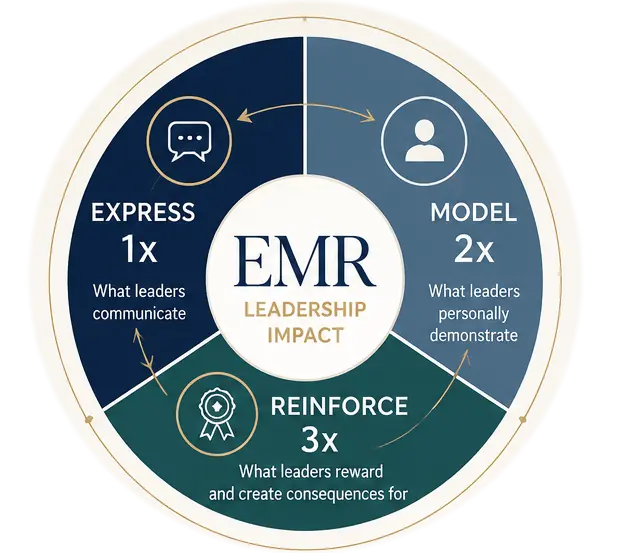
Express, Model, Reinforce (EMR) is IMA Worldwide's AIM framework that quantifies leadership impact on behavior change across three dimensions: Express (1x, what leaders communicate), Model (2x, what leaders demonstrate), and Reinforce (3x, what leaders reward). Unlike communication-heavy approaches, EMR redirects effort toward reinforcement, because people follow what organizations reward, not announcements alone.
The leadership impact formula
EMR assigns a weighted impact to each leadership behavior during change implementation. Roughly 70% of large-scale change programs fail to reach their goals, according to McKinsey & Company, and the failure usually sits at the leadership layer. EMR shows why: organizations that pour effort into communication while neglecting reinforcement are optimizing the weakest lever.
Express
What leaders communicate about the change, verbally and in writing.
Model
What leaders personally demonstrate through their own behavior.
Reinforce
What leaders reward, recognize, measure, and create consequences for.
Express: the communication of commitment
Express is what leaders say about the change. Leaders explain the change, the rationale, and what is expected. Expression creates awareness and sets direction, but it is the first and weakest lever. What leaders express establishes intent; on its own, it rarely changes behavior.
What it includes
- Town halls and presentations
- Newsletters and webinars
- Team meeting announcements
- One-to-one conversations
- Written communications
- Visible training attendance
What it sounds like
- "I am personally committed to making this work."
- "Here is why we are doing this and what it means for you."
- "I expect everyone to adopt this by the target date."
Organizations that invest heavily in communication campaigns often see awareness rise without corresponding adoption. Expression alone is not enough to drive behavior change.
Model: personal demonstration
Model is what leaders personally do. Once leaders have expressed commitment, people look to behavior for confirmation. Modeling doubles impact because people follow what leaders do, not what they say. When leaders visibly adopt new behaviors and prioritize the change in their own decisions, the organization takes it seriously.
What it includes
- Using the new system personally
- Changing own work patterns
- Attending key events visibly
- Prioritizing the initiative in decisions
- Allocating personal time and attention
What it looks like
- A leader adopts the new CRM before asking their team to
- An executive attends training sessions, not just the kickoff
- A manager changes their own meeting practices first
- A leader funds the initiative over competing priorities
When leaders visibly adopt new behaviors before asking others, the gap between what they say and what they do closes. This is the foundation of implementation credibility.
Reinforce: consequences for behavior
Reinforce is what leaders recognize, resource, and apply consequences to. Even strong expression and visible modeling are not enough to sustain change. Reinforcement has the greatest impact because it defines consequences. What gets rewarded, recognized, measured, and addressed sends a clearer signal than any message or example. It is the point where leadership intent turns into organizational reality.
What it includes
- Recognition and rewards for adoption
- Resource allocation decisions
- Performance management alignment
- Career advancement decisions
- Addressing non-adoption directly
- Budget priorities that reflect the change
What it looks like
- Including adoption behaviors in performance reviews
- Publicly recognizing early adopters
- Promoting people who demonstrate new behaviors
- Having direct conversations with those who resist
- Removing barriers and excuses for non-adoption
The reinforcement gap is the distance between what leaders communicate and what organizational systems reward. When leaders never adjust performance criteria, recognition, or consequences, employees rationally conclude the change is not real.
If you do not change the reinforcement, you do not get the change.AIM core implementation principle
Across cultures, reinforcement mechanisms vary by organizational and national culture, but the principle is universal: what leaders reinforce determines what people adopt. The balance between Express, Model, and Reinforce shifts across cultures. In high-context environments, Modeling can carry even greater weight than verbal expression, while reinforcement must align with local recognition norms.
Why reinforcement cannot be delegated
Only leaders control the performance reinforcement of their direct reports. This is not a best practice, it is a structural reality of organizational authority. Change agents can support the process, but they cannot substitute for positional authority. Reinforcement is one of AIM's six non-delegable leadership tasks.
Only leaders control
- Performance reviews
- Bonus decisions
- Promotion recommendations
- Daily recognition
- Resource allocation
- Career development conversations
Change agents can
- Communicate on behalf of leaders
- Remind leaders to be visible
- Coordinate implementation activities
- Design reinforcement strategies
- Coach leaders on EMR behaviors

Before leaders can Express, Model, and Reinforce for their teams, they must first be treated as targets themselves. Every leader goes through their own readiness journey (Information, Willingness, Ability, Confidence, Control) before they can lead others through theirs. A leader who has not personally adopted the change cannot express it authentically, model it convincingly, or reinforce it consistently.
Four common EMR misalignment patterns
Misalignment is not a character flaw. It is diagnostic data pointing to where implementation will stall. Each pattern predicts a specific failure mode, and each has a specific remedy. AIM's Leader 360 Assessment surfaces which pattern a leadership team is in.
Talk No Walk
Inspiring town halls followed by business as usual. "Do as I say, not as I do."
Low trust, minimal adoption. People conclude it is flavor of the month.
Hero Sponsor
The leader is a visible champion and early adopter, but performance reviews and recognition never change.
Admiration without widespread adoption. People respect the leader but do not feel compelled to follow.
Black Hole
The leader delegates everything to the project team. "I am too busy for this."
The change fails at this level. Everything below the Black Hole struggles regardless of effort.
Hammer
Mandates and deadlines without explanation. Punishment for non-compliance without support.
Fear, resentment, hidden resistance. People comply minimally while finding workarounds.
AIM's Leader 360 Assessment evaluates all three EMR dimensions through multi-rater behavioral items, revealing the strongest and weakest dimension and the specific gaps to develop across a leadership team.
More from the AIM framework
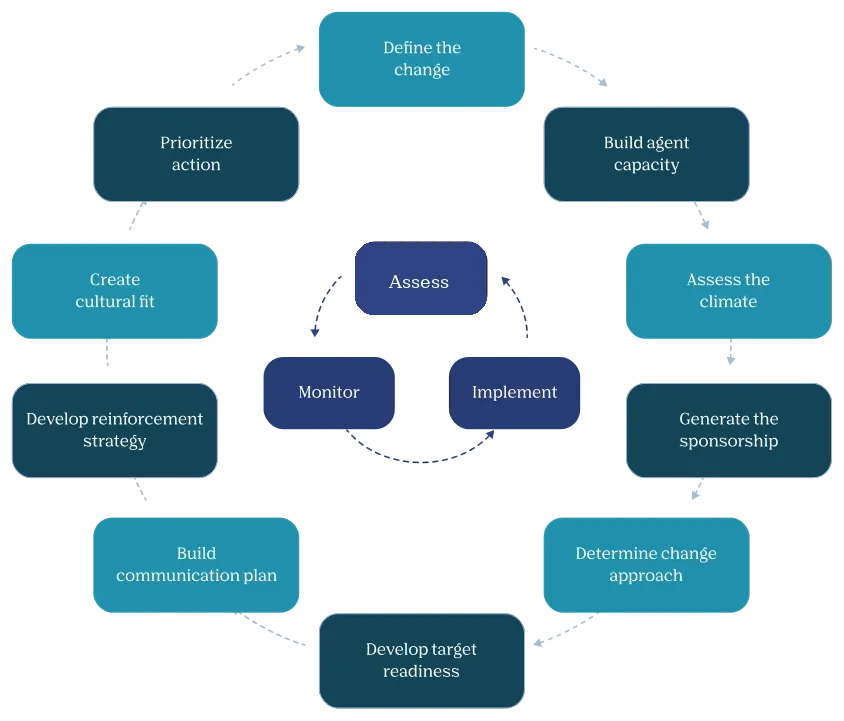
EMR is one component of AIM, a complete methodology for accelerating implementation and sustaining adoption.



Common questions about Express, Model, Reinforce
What is the Express, Model, Reinforce framework in change management?
Express, Model, Reinforce is AIM's framework for understanding and improving leadership impact during change implementation. It assigns relative impact weights: Express (what leaders communicate) carries 1x impact, Model (what leaders personally demonstrate) carries 2x impact, and Reinforce (what leaders reward and create consequences for) carries 3x impact. The framework helps organizations focus leader effort on the behaviors that most influence sustained adoption.
Why does reinforcement have 3x more impact than communication?
People observe what gets rewarded to understand what an organization values. When leaders communicate a change but leave performance criteria, recognition systems, and consequences unchanged, employees rationally conclude the change is not serious. Reinforcement closes the gap between stated intent and organizational reality, making it the most reliable predictor of whether adoption will sustain.
What happens when leaders express support but do not model the change?
This is the Talk No Walk misalignment pattern. When leaders announce commitment but continue old behaviors, people interpret the gap as a signal that the change is not genuine. Trust erodes quietly, and people treat the initiative as a temporary program rather than a real shift. The organization gains awareness but not adoption, the most common change failure.
How do you measure EMR alignment in an organization?
AIM's Leader 360 Assessment evaluates all three EMR dimensions through behavioral items rated by multiple raters, including direct reports, peers, and supervisors. The diagnostic surfaces which dimension is strongest, which has the largest gap, and which specific behaviors require development. This assessment provides a structured foundation for targeted coaching and development planning across a leadership team.
What are the most common EMR misalignment patterns?
AIM identifies four patterns: Talk No Walk (high Express, low Model and Reinforce) produces low trust and minimal adoption. Hero Sponsor (strong Express and Model, weak Reinforce) creates admiration without widespread change. Black Hole (low across all three dimensions) collapses the entire sponsorship cascade below that leader. Hammer (high Reinforce, low Express and Model) generates fear, resentment, and hidden resistance.
How does the EMR framework connect to AIM's 6 non-delegable tasks?
Reinforcement sits at the core of AIM's non-delegable leadership tasks, including aligning reward and recognition systems for direct reports and concentrating leader energy across all three EMR dimensions. These tasks cannot be delegated to change agents because only leaders with direct positional authority can deliver the reinforcement that drives sustained adoption. EMR gives the non-delegable tasks their practical meaning.
Ready to strengthen leadership impact?
EMR turns vague expectations about sponsorship into specific, measurable leader behaviors. Diagnose current alignment gaps or build EMR capability across your leadership team.
Contact us