The methodology leaders use to make change stick: adopted, reinforced, and sustained long after the go-live date.
The Accelerating Implementation Methodology (AIM) is a research-based change management framework that drives sustained behavior change through leadership involvement, reinforcement, and observable behavior. Unlike approaches that stop at communication and training, AIM targets the six non-delegable leadership tasks and the reinforcement gap that stall most transformations after go-live. IMA Worldwide built AIM on 40+ years of field research.
Digital and AI initiatives rarely fail because of technology. They stall when leadership roles are unclear, communication is disconnected from daily work, and reinforcement systems continue to reward old behaviors.
Organizations today are managing multiple, overlapping transformations: AI adoption, operating model shifts, regulatory change. Meanwhile, people remain responsible for delivering day-to-day results. AIM brings structure to the human side of implementation by clarifying who must lead change, what behaviors must shift, and how those behaviors will be reinforced.
The majority of implementation failures trace back to a gap in sponsor involvement. AIM addresses this directly through the six non-delegable leadership tasks and the Express, Model, Reinforce framework. Today, IMA Worldwide continues this work under the leadership of Ann Marvin, applying AIM across healthcare, technology, financial services, government, and other sectors.
Most change efforts measure abstract concepts. AIM measures observable behaviors: actions you can see from across the room, that can be measured, reinforced, and sustained without relying on self-reported attitudes or surveys.
AIM draws a critical distinction. Installation is putting a new system, process, or policy in place. Implementation is achieving sustained behavior change and measurable results after go-live. Organizations do not get ROI from installation alone. Results come only when people adopt and consistently use the new way of working.

If you cannot observe it, you cannot measure it. If you cannot measure it, you cannot reinforce it. And if you cannot reinforce it, you cannot sustain it.AIM principle
Communication is necessary but grossly insufficient. AIM's Express, Model, Reinforce framework explains why, and weights each behavior by its real impact on adoption.

What leaders say. Communication, announcements, town halls. Most organizations over-invest here.
What leaders do. Resource allocation, personal adoption, visible behavior change.
What leaders reward. Aligned performance reviews, recognition, consequences. Carries three times the weight of communication.
When leaders communicate the change but continue rewarding old behavior, the message is clear: this change is optional. Reinforcement is where adoption becomes permanent. Read more on the Express, Model, Reinforce framework and reinforcement in change management.
Four frameworks carry most of the methodology's leverage. Each answers one question that determines whether change sticks.
AIM is principle-driven, not checklist-driven. These principles guide action in unplanned situations, not just templates to follow.
AIM provides a structured framework of exactly 10 practice areas that can be applied to any category of organizational change, and scaled for any size or complexity. The center of the road map holds the implementation cycle: Plan, Implement, Monitor, with Monitor feeding back into planning for continuous improvement.
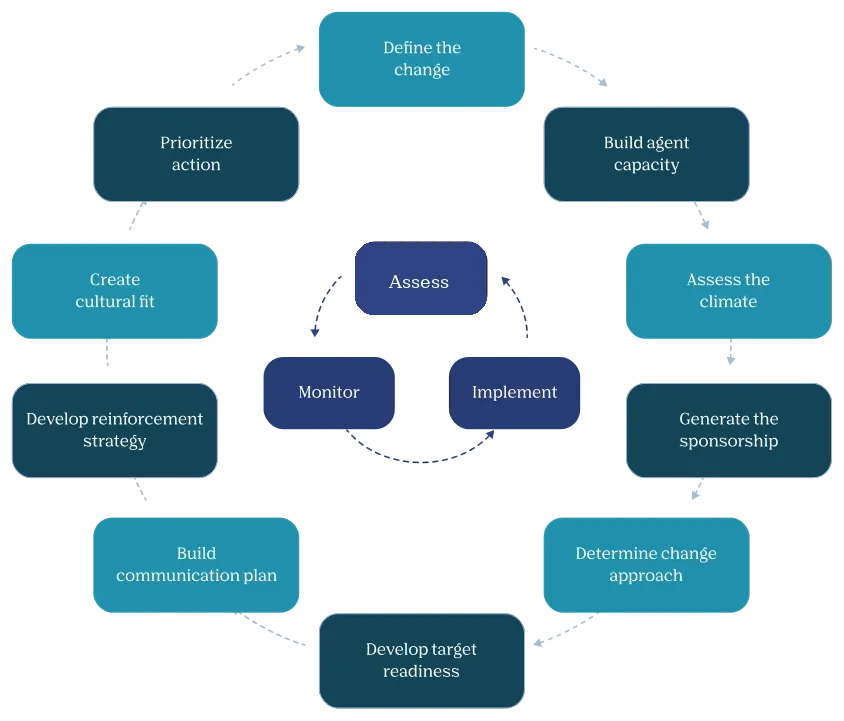
AIM is designed for professionals accountable for making change work in real operating environments. It works alongside project management methodologies such as PMI, Agile, and Lean, so the people side of change progresses in lockstep with technical milestones.
Agile and SAFe transformations, ERP and technology implementations, AI adoption, operating model changes, mergers and acquisitions, cultural transformation, and leadership development.
AIM is applied in the sectors where implementation is hardest, from clinical workflow adoption to plant transformation.
 HealthcareClinical workflow and technology adoption
 PharmaceuticalsGlobal ERP and M&A integration
 Financial ServicesCompliance and operating model change
 Energy & UtilitiesEnterprise systems and safety culture
 GovernmentPublic health transformation
 Technology & TelecomLarge-scale transformation
 ManufacturingLean and plant transformations
 Oil & GasOperations and technology
AI introduces change that is fast, complex, and constant. AIM is a behavior-first implementation methodology that equips leaders to manage the behavioral and cultural impact of automation and machine learning. AIM defines roles for Sponsors, Change Agents, and Targets so that trust and accountability scale with technology.
Whether the initiative is AI-in-operations, AI-in-shared-services, or an ERP-to-AI migration, AIM focuses on the adoption gap that technology alone cannot close. AIM includes scored tools to assess readiness, resistance, sponsorship effectiveness, and reinforcement systems, helping leaders make evidence-based decisions at every stage. See how this applies to AI transformation.

AIM, Prosci ADKAR, and Kotter's 8-Step each frame change differently. AIM's distinguishing move is to weight reinforcement as the highest lever and to measure observable behavior rather than self-reported readiness.
| Dimension | AIM | Prosci ADKAR | Kotter 8-Step |
|---|---|---|---|
| Primary focus | Leadership behavior + reinforcement systems | Individual change readiness | Organizational momentum through phases |
| Unit of change | Observable behaviors at team level | Individual awareness and ability | Coalition and urgency at org level |
| Reinforcement weight | 3x, the highest lever in the model | One of five stages (R in ADKAR) | Anchoring in culture (final step) |
| Leadership model | 6 non-delegable tasks + sponsor cascade | Sponsor role in PCT model | Guiding coalition |
| Measurement | Observable behavior metrics | Self-reported readiness surveys | Phase completion milestones |
| Capability transfer | Licensing builds permanent internal capability | Certification for practitioners | Consulting-dependent |
See the full side-by-side comparisons: AIM vs Prosci and ADKAR, AIM vs Kotter, or all three together.
The most important lesson was that successful transformation is rarely about strategy alone. It is about helping people, systems, incentives, and leadership move together toward a common goal.
Global Health Division Transformation LeadUsing the AIM methodology has helped me grow in my role as a consultant and show up with stronger executive presence. It has also given me the principles needed to secure needed sponsor engagement. More than just a set of static tools, it has provided me with a holistic strategy for managing change.
AIM Practitioner and AdvisorAIM is a research-based change management methodology designed to help organizations achieve sustained behavior change and business results. Created by Don Harrison at IMA Worldwide, AIM addresses the root cause of transformation failure: insufficient leadership involvement in six critical, non-delegable tasks. Unlike generic change management that focuses on communication and training, AIM focuses on what leaders must do to create the conditions for successful adoption.
AIM was created by Don Harrison, founder of IMA Worldwide, through 40+ years of field research into what makes implementations succeed or fail. Today, IMA Worldwide continues this work under the leadership of Ann Marvin, applying AIM across healthcare, technology, financial services, government, and other sectors.
AIM solves the most common problem in transformation: organizations install new processes, systems, and strategies but fail to achieve real implementation. AIM addresses the human side of change by clarifying leadership responsibilities, identifying readiness gaps, and focusing on reinforcement, the factor most strongly tied to sustained adoption.
In AIM, installation means putting something in place, such as launching a new system, process, policy, or tool. Implementation means achieving sustained behavior change and measurable results after go-live. AIM emphasizes that organizations do not get ROI from installation alone. Results come only when people adopt and consistently use the new way of working.
It means change does not happen at the executive level or in project plans. It happens where people do their daily work. Even if leadership supports the initiative, adoption still depends on how supervisors reinforce it, how teams experience it, and whether targets are ready and able to change their behavior in real operating conditions.
Yes. AIM is well suited for digital transformation, ERP implementations, and AI adoption because these initiatives require sustained behavior change, not just new tools. AIM helps organizations clarify sponsorship responsibilities, define measurable behaviors, assess readiness, and reinforce adoption. It also supports environments where multiple changes overlap and change fatigue is high.
Yes. AIM works well in Agile and SAFe environments because it focuses on implementation behaviors, sponsorship alignment, and reinforcement, areas that often determine whether Agile adoption becomes real or remains surface-level. AIM supports transformation leaders, RTEs, Scrum Masters, LPMs, and change agents who need practical tactics for managing resistance and sustaining adoption.
AIM includes a suite of diagnostic tools and assessments that identify adoption risks and implementation gaps. They evaluate sponsorship effectiveness, readiness levels, communication effectiveness, reinforcement systems, implementation history, and organizational stress. The toolkit is built on 10 core scored instruments, with variations, plus a broader library of scored assessments. See the AIM toolkit and assessments.
Because communication alone rarely changes behavior. People may understand the message and still return to old habits if the organization continues rewarding old behaviors. Reinforcement includes recognition, consequences, resource allocation, performance signals, and leadership follow-through. What leaders reinforce becomes the real definition of success inside an organization.
Change management is the discipline of preparing, equipping, and supporting people to adopt new behaviors so that organizational changes deliver their intended results. AIM goes further than communication and training by treating change as a leadership accountability problem: unless sponsors perform six non-delegable tasks and reinforcement systems reward the new behaviors, adoption stalls at installation.
They most often fail because organizations achieve installation without achieving implementation. The majority of implementation failures trace back to a gap in sponsor involvement. When leaders delegate the six non-delegable tasks, when reinforcement systems continue rewarding old behaviors, and when readiness gaps go undiagnosed, adoption stalls. AIM addresses each of these failure modes with diagnostic assessments and structured leadership actions.
AIM is backed by scored instruments that turn judgment into numbers: where adoption is at risk, who is ready, and where reinforcement will move the odds.
Reveals the pattern of past implementation results that predicts your odds this time.
Scores individual readiness as a probability of adoption, and where to manage resistance.
Pinpoints where to focus the right reinforcers on the behaviors the change needs.
A snapshot of a live implementation that targets effort where it lifts the odds.
Talk to an implementation expert about where adoption is most at risk, and what it would take to make the change stick.
Contact usWhat do your sponsors express, model, and reinforce today? That question decides adoption more than any plan. Talk it through with an AIM practitioner.
Rather run the method than read about it? See AIM Practitioner certification, or start with the free readiness check below.
History, readiness, reinforcement, risk: those are the factors AIM scores. Put your own initiative through the same lens and see which one needs work first. Free, about ten minutes, scored instantly.
Score your change readiness or talk to an AIM practitioner