
Why organizational transformations fail, and how to achieve lasting implementation
Most transformations do not fail because the strategy was wrong. They fail because leaders mistake deployment for adoption, and completion for change. Understanding the difference is where lasting results begin.
Organizational transformations fail when leaders treat change as an event rather than a behavioral transition. AIM identifies three structural factors that determine success: active sponsorship at every level, cultural alignment between current norms and desired behaviors, and systematic reinforcement that rewards adoption over reversion.
What is transformational change, and why does it fail more often?
In IMA Worldwide's implementation research, transformational change is large-scale change that alters how an organization operates: its structure, systems, processes, or culture, rather than a single incremental improvement. It fails more often than smaller change because success depends on an entire population adopting new behavior at once, and adoption is the part most programs leave unmanaged.
Incremental change refines an existing way of working. Transformational change replaces it. A new operating model, a merger, an enterprise system, an AI-enabled workflow: each asks people to give up behavior that currently works for them and perform new behavior that does not yet feel natural. The larger that behavioral shift, the wider the gap between installing the change and implementing it.
This is why failure concentrates in the most ambitious programs. The strategy is usually sound. What goes unbuilt is the sponsorship, readiness, and reinforcement that carry a whole population across the shift before the launch energy fades. The Accelerating Implementation Methodology (AIM) exists to build exactly those conditions, and the three factors below are what separate transformational change that holds from transformational change that reverts.
Scale multiplies the adoption gap
- More people must change behavior simultaneously.
- More existing routines actively compete with the new way.
- More layers of sponsorship must stay aligned over a longer horizon.
- Reversion in any one group signals to the rest that the change is optional.
The installation vs implementation gap
Why has the failure rate not moved in two decades? Not because the cause is a mystery. The figure often cited at roughly 70%, traced to McKinsey research, has held because organizations keep getting better at installation and no better at implementation. Every cycle brings newer technology, tighter project management, and more communication, almost all of it aimed at the go-live. Almost none of it is aimed at what happens after: sustained sponsorship, reinforcement, and readiness. The rate holds because the field keeps solving the wrong half of the problem.
Every failed transformation has a moment where leadership declared victory too soon. The technology went live. The training was completed. The new process was documented. Leadership moved on. Meanwhile, people quietly returned to doing things the old way.
This is the installation trap. Installation means the change is technically in place. Implementation means the target population has changed their behavior, the new way of working is producing results, and the organization is no longer dependent on external pressure to sustain it. The distance between those two states is where transformations die.
| Installation | Implementation |
|---|---|
| System is live | People use it consistently |
| Training complete | Behavior has changed |
| Process documented | Process is followed |
| Project closed | Results are sustained |
| Rollout finished | Adoption is measured |
The question is not "did we deploy the change?" The question is "have people changed how they work, and is that change holding?"
Building toward true implementation requires deliberate action before, during, and after deployment: sponsors who are active rather than passive, a culture prepared for the disruption ahead, and reinforcement structures that maintain momentum once the launch energy fades. These are the operating conditions that determine whether strategy produces results or a cautionary tale. See installation versus implementation in depth.
Three factors that determine success
Across implementations spanning industries and change types, three conditions consistently separate transformations that sustain results from those that regress. Each is addressable. None are automatic.
Active sponsorship
Visible, sustained leadership behavior that goes beyond endorsement to resource allocation, goal-setting, and personal adoption. When sponsors delegate this role to a project team, the signal reaches the organization that the change belongs to the team, not to leadership. Adoption stalls where the sponsor's visible behavior stops.
Cultural alignment
Culture does not block change uniformly. It amplifies whatever you put into it. Low psychological safety produces fear-based compliance, not adoption; accountability gaps see new behaviors evaporate when measurement loosens. Assessing the cultural conditions relevant to the specific change lets leaders address the obstacles present.
Systematic reinforcement
The alignment of rewards, consequences, and recognition with the desired behaviors rather than legacy practices. Behavior that is not reinforced returns to baseline. This is a systems problem, not a motivational one. Without reinforcement architecture, even well-designed training and communication produce temporary results.
These three factors interact. Passive sponsorship undermines cultural alignment by signaling the change is negotiable. Misaligned culture neutralizes reinforcement through informal norms that contradict formal expectations. Absent reinforcement makes active sponsorship unsustainable. Addressing all three in coordination is what makes sustained implementation achievable.
How AIM strengthens the path from announcement to adoption
AIM provides a structured, repeatable system for moving change from technical deployment to behavioral adoption, built around four interconnected phases that address the conditions most likely to cause failure.
Assess: understand the starting conditions
Before prescribing a plan, AIM assesses leadership readiness, target population capacity, and cultural alignment, identifying the specific obstacles present in this organization for this change rather than applying a generic template.
Align: build the sponsor coalition
Ensure every leader in the sponsor cascade understands their role, has the skills to perform it, and is committed to active sponsorship throughout the change. This addresses the most common cause of failure: a sponsor who believes that authorizing and announcing the change is sufficient.
Build: prepare the target population
Structured preparation of the people who must change: targeted communication on the personal impact, skill-building around the specific new behaviors, and proactive engagement with predictable resistance. Building happens before full deployment, not after problems surface.
Sustain: embed the change until it holds
Maintain active implementation infrastructure until new behaviors are integrated into the normal operating system: monitoring adoption metrics, reinforcing desired behaviors, and adjusting when measurements reveal slippage. Sustaining continues until the change is self-sustaining, not until the budget runs out.
Why AIM starts with diagnosis before prescription
The most common pattern in failed transformations is not poor execution of the wrong plan. It is precise execution of a plan built on incorrect assumptions about starting conditions. Organizations assume resistance is universal when it is concentrated, that leadership is aligned when the cascade has a critical gap, that capacity exists when the target population is already managing three concurrent initiatives.
AIM's diagnostic tools surface these actual conditions before the plan is finalized. Plans built on real data require fewer corrections, allocate resources toward the problems that exist, and produce faster adoption because they address real barriers rather than theoretical ones.
- Assess leadership readiness.Identify gaps in sponsor commitment, cascade alignment, and active behavior readiness.
- Measure target population capacity.Understand the change burden already carried by the people who must adopt new behaviors.
- Identify cultural misalignments.Surface the specific norms and informal practices that will work against the change.
- Build a plan that fits the findings.Design the implementation strategy around actual obstacles rather than assumed ones.
What each role contributes to successful implementation
Implementation failure is rarely caused by one role failing in isolation. It is usually a system failure where each role operates without clear accountability for adoption outcomes.
Executives and senior leaders
- Establish personal, visible sponsorship for the change.
- Communicate the strategic rationale directly and repeatedly.
- Build and maintain the sponsor cascade through all layers.
- Remove barriers only positional authority can clear.
- Model the target behaviors before expecting adoption.
Change practitioners
- Conduct readiness assessments before designing plans.
- Build sponsor capability and maintain active sponsorship.
- Design resistance strategies based on actual sources.
- Create reinforcement architecture for sustained change.
- Measure adoption rather than deployment activity.
HR and L&D
- Align performance management with the required behaviors.
- Design training around behavior change, not information transfer.
- Assess change capacity before adding new initiatives.
- Build internal capability as an organizational competency.
- Support managers in reinforcement conversations.
Consultants and advisors
- Integrate AIM diagnostic work into the engagement scope.
- Use readiness findings to set realistic adoption timelines.
- Coach internal sponsors on non-delegable leadership tasks.
- Transfer capability so change management lives in-house.
AIM is delivery-neutral: it works alongside Agile, SAFe, Lean, and Waterfall, adding the adoption layer so the people side progresses in lockstep with technical milestones.
Why transformations fail: key questions
What makes transformational change different from incremental change?
Incremental change improves an existing way of working; transformational change replaces it with a new operating model, structure, or culture. Because success depends on an entire population adopting new behavior at once, transformational change carries far more adoption risk, which is why most of it stalls at installation rather than reaching full implementation.
What is the difference between installation and implementation in change management?
Installation means a new system, process, or structure is technically in place. Implementation means people have adopted new behaviors and the change is producing intended results. Most change failures happen when organizations stop at installation and mistake completion of deployment for successful change.
Why has the transformation failure rate not improved in decades?
Because organizations keep getting better at installation and no better at implementation. The figure often cited at roughly 70%, traced to McKinsey research, persists because effort concentrates on the go-live: newer technology, tighter project management, and more communication. The adoption work that follows, sustained sponsorship and reinforcement, stays under-managed, so behavior reverts and the rate holds.
What distinguishes active sponsorship from passive sponsorship?
Passive sponsors announce a change and fund the project. Active sponsors consistently communicate the reason for change, model the new behavior themselves, reinforce adoption through recognition, and remove barriers employees encounter. Active sponsorship requires ongoing, visible behavioral commitment from leaders with positional authority.
What is a sponsor cascade and why does it matter?
A sponsor cascade is the chain of leadership involvement that carries change signals from the executive level through every management layer to front-line employees. When any level in the cascade is skipped, a communication gap forms. Employees at lower levels receive no signal and default to existing behavior.
How long does a real organizational transformation take?
The timeline depends on the scope, depth of behavioral change required, and starting conditions. Meaningful transformations typically require sustained effort measured in months to years, not weeks. Organizations that rush deployment without building adoption infrastructure consistently experience regression after the initial rollout period ends.
Why do most change management initiatives fail?
Most initiatives fail because they treat change as a project to be completed rather than a transition to be managed. Common failure drivers include absent or passive sponsorship, insufficient readiness assessment, training without reinforcement, and measuring deployment activity instead of actual behavior change in the target population.
What is the single highest-impact step during a change initiative?
Building an active, visible sponsor coalition consistently produces the highest return during implementation. When leaders at every level model the expected behavior and reinforce adoption through feedback and recognition, the probability of sustainable change increases substantially compared to any other single intervention.
How does AIM prevent transformation failure?
AIM prevents failure by starting with diagnosis before prescribing action. The methodology assesses leadership readiness, target population capacity, and cultural alignment before building a deployment plan. This allows organizations to address the conditions that cause failure rather than repeating the same rollout with a different change.
The structural causes of transformation failure
Each spoke goes deep on one structural pattern behind failed change. Start anywhere.

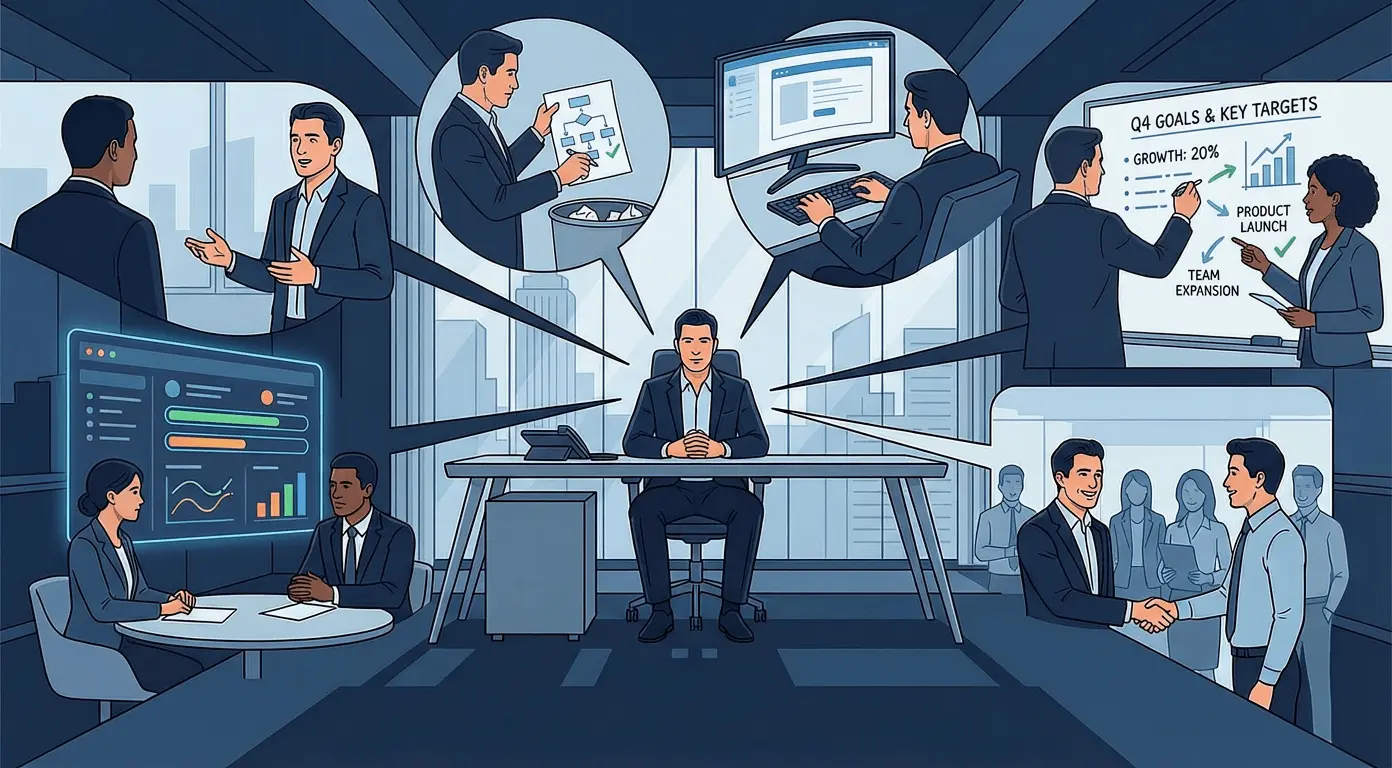
Stop installing change. Start implementing it.
IMA Worldwide diagnoses the conditions that cause transformation failure, then builds the sponsorship, readiness, and reinforcement that make adoption stick.
Contact us What is AIM?