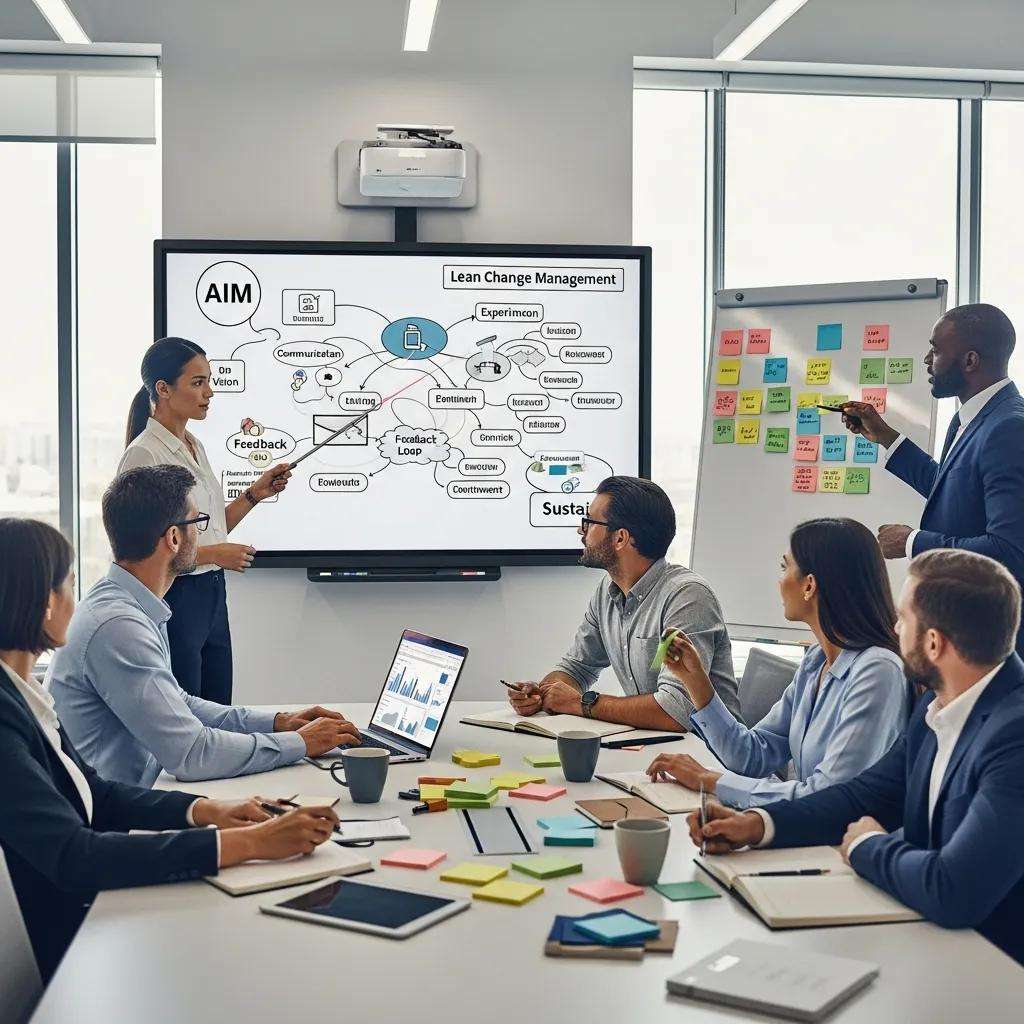
Structural Accountability vs Adaptive Experimentation
AIM vs Lean Change Management: Structural Conditions vs Flow
Lean change management optimizes how you deliver change initiatives. AIM addresses whether people in your organization are actually changing their behavior. Both matter, and knowing when to apply each one is the difference between efficient activity and real adoption.
At a Glance
AIM vs Lean: The Two Approaches at a Glance
AIM and Lean Change Management address different dimensions of organizational transformation. Lean optimizes processes by eliminating waste and improving flow. Unlike process-focused approaches, the AIM methodology from IMA Worldwide (Implementation Management Associates) uniquely diagnoses why people do not adopt new behaviors and what organizational systems must change to make adoption permanent.
Lean Change Management
- Origin: Jason Little, 2014 book and ongoing community practice
- Primary unit: The local change context and stakeholder group
- Structure: Insights, Options, Experiments cycle
- Best fit: Emergent, exploratory, team-level change
AIM (IMA Worldwide)
- Origin: Don Harrison, IMA Worldwide, 40+ years of field research
- Primary unit: The organization as a system
- Structure: 10 Practice Areas, 35+ validated assessments
- Best fit: Complex, multi-stakeholder enterprise transformation
Methodology Overview
What is Lean Change Management?
AIM vs Lean change management is a comparison between structured and flexible change methods: a structured organizational implementation methodology and an iterative process-optimization approach that differ in whether they address the change delivery process or the organizational system barriers to adoption.
Lean change management applies the principles of Lean thinking, rooted in the Toyota Production System and later adapted for knowledge work, to the practice of managing organizational change. Rather than deploying large, pre-planned change programs based on assumptions about what people need, Lean change management uses short feedback cycles to learn what is working, what is creating resistance, and how the change approach should be adjusted in real time.
The methodology was formalized by Jason Little in his work on Lean Change Management and draws on concepts from Lean, Agile, and organizational learning. Its central mechanism is the change canvas, a visual planning tool that helps change teams co-create interventions with employees rather than delivering change to them. The emphasis is on minimum viable change and iterative experimentation: delivering the smallest intervention that produces the desired shift and iterating from there.
Core Lean Principles
Iterative Experimentation
Test small change interventions, gather feedback, and adjust rather than executing large pre-planned programs.
Eliminate Waste
Remove change activities that do not add value, including unnecessary meetings, redundant communications, and over-engineered plans.
Co-creation
Involve employees in designing change interventions rather than delivering change programs designed solely by leadership or practitioners.
Just-in-Time
Deliver change support and training at the moment it is needed, not weeks in advance when it will be forgotten before use.
Fast Feedback Loops
Build mechanisms to surface what is and is not working quickly, so adjustments can be made before resistance becomes entrenched.
Continuous Improvement
Apply the same kaizen mindset to the change process itself: always seek to improve how the organization manages change.
Lean CM Core Strengths
- Iterative delivery reduces the risk of large, misdirected change programs
- Co-creation builds employee ownership and reduces resistance
- Aligns naturally with agile software delivery and continuous improvement cultures
- Fast feedback loops surface problems early when they are easier to address
- Reduces waste in change management activities
Lean CM Key Limitations
- Primarily optimizes the change process, not the organizational system
- Does not provide a structural framework for sponsor accountability
- Cultural and structural barriers require systemic intervention, not iteration
- Middle management resistance is not addressed by process efficiency
- Business outcome measurement requires supplemental frameworks
Methodology Overview
AIM vs Lean: Structural Conditions vs Flow Optimization
The AIM methodology (Accelerating Implementation Methodology) from IMA Worldwide, created by Don Harrison, creator of the Accelerating Implementation Methodology and founder of IMA Worldwide, is an organizational change framework designed to diagnose and address the system-level factors that prevent behavior adoption in complex organizations. AIM's research across thousands of implementations shows that change fails not because the change process is inefficient, but because the organizational system, including leadership behavior, cultural norms, performance management structures, and management layer resistance, is working against adoption.
AIM uses organizational diagnostic assessment tools to surface these barriers at the start of and throughout implementation, then assigns clear accountability to sponsors and line managers for addressing them. Success is measured not through process quality or training completion, but through whether target populations are performing the new required behaviors and whether those behaviors are producing the business outcomes that justified the change investment.
Because AIM targets universal organizational system factors rather than culturally specific process assumptions, it has been applied successfully across industries and geographies, making it adaptable to cross-cultural implementation environments where local management norms vary significantly. Organizations seeking to build internal capability can pursue AIM change management training and certification.
Where Lean asks "how can we improve how we are running this change?", AIM asks "why is the organization not adopting this change, and who is accountable for fixing that?"
Side-by-Side Analysis
How do AIM and Lean Change Management compare side by side?
| Dimension | Lean Change Management | AIM |
|---|---|---|
| Primary Focus | Optimizing the change delivery process through iteration | Diagnosing and removing organizational system barriers to adoption |
| Core Mechanism | Minimum viable change, fast feedback, co-creation | Organizational diagnostic, sponsor cascade, adoption measurement |
| Leadership Model | Co-creation and employee engagement; leaders as enablers | Structured sponsor accountability cascade through management hierarchy |
| Measurement | Change process effectiveness; feedback loop quality | Business outcomes and adoption indicators tied to case for change |
| Continuous Improvement | Core principle applied to the change process itself | Applied through ongoing diagnostic re-assessment during implementation |
| Resistance Handling | Surface early through short feedback loops; adjust approach | Diagnose systemic sources; assign sponsor accountability to address them |
| Alignment Context | Agile, DevOps, continuous improvement cultures | Complex enterprise transformation, embedded behavior change |
| Reinforcement | Iterative learning and process adjustment | Performance management alignment and structural consequence systems |
Common Ground
Where do AIM and Lean Change Management agree?
Despite operating at different levels of the change problem, AIM and Lean Change Management share several foundational beliefs about how organizational change should be approached.
Shared Principles
- Pre-planned, assumption-heavy change programs carry significant failure risk
- Feedback from the people affected by change must inform implementation decisions
- Resistance is a signal to be understood, not a problem to be overcome through force
- Continuous improvement applies to both the change process and the change outcomes
- Traditional top-down, communication-heavy approaches are insufficient on their own
Shared Rejections
- Both reject the idea that awareness and training alone produce lasting behavior change
- Both reject rigid, waterfall-style implementation plans that ignore real-time conditions
- Both reject the assumption that initial planning can anticipate all implementation challenges
- Both reject measuring change success solely through activity completion rates
Worth noting. People can co-create a new process and still revert to old behaviors if the reward system reinforces the old way. Co-creation builds commitment. Reinforcement sustains behavior. AIM addresses both.
The Core Distinction
Where do AIM and Lean Change Management diverge most sharply?
When comparing structured and flexible change approaches, the most important distinction between Lean change management and AIM is the level of the problem each is designed to solve. Lean optimizes the change process itself. AIM addresses the organizational conditions that determine whether behavior change actually occurs.
Lean Change Management Addresses:
- How efficiently change interventions are designed and delivered
- Whether employees are co-creating change or receiving it passively
- Whether feedback loops are short enough to enable rapid adjustment
- Whether change activities are delivering value or generating waste
- How well change management integrates with agile delivery cycles
AIM Addresses:
- Which organizational system factors are blocking adoption
- Whether sponsors are actively and visibly accountable for adoption
- Whether management layers are aligned or creating mixed messages
- Whether performance management systems reinforce new behaviors
- Whether the cultural environment supports or undermines the change
The AIM methodology addresses this gap directly: McKinsey research confirms that organizations with strong implementation discipline are 5.4x more likely to succeed, yet an organization can run a highly efficient, iterative, waste-free change process and still fail to achieve adoption if the organizational system is working against it. Prosci's Best Practices in Change Management research consistently identifies active and visible executive sponsorship as the top contributor to success, and Conversely, strong sponsor accountability and reinforcement architecture can produce adoption even without a perfectly optimized change process. When adoption fades after initial momentum, the root cause is almost always structural, as IMA's analysis of why transformation changes fail demonstrates. Understanding which problem is the bottleneck determines which framework to deploy.
Lean Limitations
When is Lean Change Management not enough on its own?
Lean change management works well for optimizing how change interventions are designed and delivered. However, certain organizational conditions require intervention at a level that process optimization alone cannot reach.
Sponsor Disengagement
When senior leaders are not visibly and consistently reinforcing the change, iterating on the change process faster will not compensate for the lack of leadership accountability.
Management Layer Resistance
Middle managers who are actively or passively blocking adoption require structural intervention, not process optimization. No amount of iteration addresses a manager who is undermining the change.
Cultural Misalignment
When the organizational culture, reward systems, or performance metrics actively contradict the desired behaviors, process improvements cannot overcome systemic structural conflicts.
Choosing the Right Framework
When should an organization choose AIM over Lean Change Management?
Organizations should choose the AIM methodology when the change challenge involves systemic organizational barriers rather than process inefficiency. Specific indicators include:
Multiple Stakeholder Groups
The change affects multiple business units, geographies, or functional areas that require coordinated leadership alignment across the management hierarchy.
Behavioral Adoption Required
Success depends on people actually performing new behaviors, not simply accepting a new tool or process. The gap is between knowing and achieving behavioral adoption.
Sponsor Cascade Needed
The change requires visible, active sponsorship at multiple levels of the organization, and that sponsorship is currently absent or inconsistent.
Structural Reinforcement
Performance management systems, cultural norms, or incentive structures need structural reinforcement to be realigned to support the desired new behaviors.
Integration Approach
How do enterprise teams combine AIM and Lean Change Management?
Unlike frameworks that are in direct competition, Lean change management and AIM address sufficiently different levels of the change problem that they can be genuinely complementary when deployed with clear intent about what each is being used for.
Lean CM Contributes:
- Iterative planning that responds to real-time feedback from employees
- Efficient design of communication, training, and support interventions
- Co-creation practices that build employee ownership and reduce passive resistance
- Natural alignment with agile delivery teams and sprints
- Waste reduction in the change management function itself
AIM Contributes:
- Organizational diagnostic that identifies systemic blockers before they derail the project
- Structured sponsor accountability that the iterative process alone cannot create
- Performance management alignment to reinforce new behaviors structurally
- Business outcome measurement framework that validates adoption
- Management-layer engagement that co-creation practices may not reach
The Combined Value
Organizations running agile transformations or technology implementations often find that Lean change management surfaces adoption issues quickly while AIM provides the organizational accountability structures to actually resolve them. Together they address both the process and the system.
Frequently Asked Questions
AIM vs Lean Change Management: Frequently Asked Questions
What is Lean change management?
Lean change management applies Lean thinking principles, originally developed for manufacturing process improvement, to the practice of managing organizational change. It emphasizes iterative experimentation, eliminating waste from change processes, co-creating change with employees rather than deploying it top-down, and using short feedback loops to adapt quickly. It is closely associated with agile and continuous improvement environments.
How does AIM differ from Lean change management?
Lean change management focuses on optimizing the change process itself through iteration and waste elimination, adapting approaches based on rapid feedback loops. AIM focuses on diagnosing and removing the organizational system barriers that prevent behavior adoption. Lean asks how to run the change process more efficiently; AIM asks what in the organization is blocking people from actually changing their behavior.
Can AIM and Lean work together?
Yes, and they often complement each other well. Lean change management's iterative process design and fast feedback loops can surface implementation issues early. AIM's organizational diagnostic and sponsorship framework then provides the structural accountability and systemic intervention needed to address those issues at the leadership and management layer rather than through process adjustment alone.
Which approach is better for digital transformation?
Digital transformations typically require both levels of intervention. Lean change management aligns well with agile delivery cycles and technology rollouts that evolve iteratively. AIM addresses the organizational side of digital transformation: sponsor engagement, management accountability, cultural resistance to new ways of working, and ensuring that technology adoption translates into actual business behavior change rather than shelfware.
How does Lean change management differ from AIM in its focus on process vs behavior?
Lean change management treats the change process itself as the subject for optimization, applying principles like minimum viable change, just-in-time delivery of interventions, and continuous feedback. AIM focuses on the behavioral and organizational system outcomes of the change, diagnosing why people are not adopting new behaviors and assigning structural accountability to address those barriers.
How do AIM and Lean change management differ in their measurement approach?
Lean change management typically measures the effectiveness and efficiency of change interventions themselves, using feedback loops to iterate and improve the change delivery approach. AIM measures adoption outcomes linked to the business case for the change, tracking whether target groups are actually performing the new required behaviors and whether those behaviors are producing the expected business results.
Summary
The Bottom Line: Structured vs Flexible Change Methods
Lean change management and AIM are not competing methodologies but rather structured and flexible change methods that operate at different levels of the organizational change problem. Lean focuses on process optimization in delivery. AIM addresses the organizational system conditions that determine whether adoption actually happens.
For organizations running agile or continuous improvement initiatives, Lean change management provides an efficient, iterative approach to delivering change interventions. When the challenge extends beyond process efficiency into leadership accountability, management alignment, cultural barriers, and structural reinforcement of new behaviors, AIM provides the diagnostic and accountability framework needed to produce lasting adoption.
The most effective enterprise implementations combine both: using Lean's iterative process design to deliver interventions efficiently while relying on AIM's organizational diagnostic and sponsor cascade to ensure the system itself supports the change. To explore how this integration applies to your organization, learn about IMA's change management consulting services.
- AIM is the right choice when leadership cascade and reinforcement are the bottleneck
- Lean Change Management is the right choice when emergence and co-creation are the bottleneck
- The two layer cleanly together in complex enterprise transformation
Methodology Comparison Series
Related resources from IMA Worldwide
AIM goes head-to-head with the most widely used change management frameworks. Explore each comparison or see the full overview.
Combine Process Excellence with Behavioral Implementation
IMA Worldwide consultants use the AIM methodology to help organizations running Lean or agile initiatives address the organizational system barriers that process optimization alone cannot remove. Contact us to discuss your implementation challenge.
About IMA Worldwide
Implementation, Not Installation. That is AIM.
Most transformations install the new system and stop. The Accelerating Implementation Methodology, developed by Don Harrison and delivered today by IMA Worldwide with Peacock Hill Consulting, is the framework for what comes after. Observable behavior change. Leadership accountability. Reinforcement that holds.
IMA Worldwide is a change management firm that delivers the Accelerating Implementation Methodology (AIM), developed by Don Harrison, in partnership with Peacock Hill Consulting to bring enterprise transformations from go-live to sustained behavioral adoption.
Positioning
A 40-Year Methodology Built for the Era After Go-Live
Most change management firms sell installation: communications plans, training calendars, and readiness surveys. IMA Worldwide sells implementation. The work begins where most programs declare victory. AIM treats the transition from installed change to sustained behavior as the measurable outcome, not project completion or training delivery. The methodology codifies six leadership tasks sponsors cannot outsource to a PMO or consultant, supported by the EMR framework (Express, Model, Reinforce) and four scored diagnostic instruments that produce quantitative readiness baselines against a cross-client benchmark cohort. Forty years of field research. One specific job: closing the gap between go-live and sustained adoption.
The Methodology
AIM and the Four Scored Diagnostic Instruments
The Accelerating Implementation Methodology (AIM) ships with four scored diagnostic instruments hosted on the Comparative Agility platform, five structured workbooks and audits, and an extended commercial suite covering leadership 360s and the AIM AI variant suite. Fifteen named instruments in total. The four scored core instruments are below.
-
IHA
Implementation History Assessment. Scores an organization's track record on past changes against a cross-client benchmark cohort.
-
IRA
Individual Readiness Assessment. Six-sub-index profile across Information, Willingness, Ability, Confidence, Control, and Feedback.
-
TRI
Targeted Reinforcement Index. Measures reinforcement architecture coverage and alignment across the change population.
-
IRF
Implementation Risk Forecast. Forward-looking risk snapshot across the methodology's critical success factors.
What We Deliver
Four Ways IMA Shows Up on a Transformation
Embedded consulting on live enterprise transformations. Sponsor coaching, diagnostic instrument deployment, and reinforcement architecture built into the existing program plan.
Structured credential for internal change leads and external consultants. Hands-on access to the four scored diagnostic instruments, applied to a live initiative.
For organizations building internal change capability at scale. AIM templates, instruments, and train-the-trainer pathways deployed organization-wide.
Five diagnostic instruments built specifically for AI rollouts, agentic systems, and AI-assisted workflows. AI Sponsor 360, AI Team Member 360, AI Individual Readiness, AI Implementation Risk Forecast, and AI Implementation Risk II Quick.
Standalone use of the IHA, IRA, TRI, and IRF instruments. Benchmark a single program, an internal portfolio, or a multi-year transformation arc against a cross-client cohort.
Post-merger integration playbook. Leadership alignment, employee resistance, and culture integration across newly combined organizations.
Who We Work With
Enterprise Transformation Across 17 Industries and 5 Continents
AIM has been deployed inside Fortune 500 manufacturers, global pharmaceutical companies, multinational utilities, government agencies, healthcare systems, and large non-profits. Specific client identities are protected under non-disclosure agreements. The shape of the work changes by sector. The methodology and the sponsor accountability model do not.
Industries served
- Pharmaceuticals
- Healthcare and MedTech
- Insurance
- Energy and Utilities
- Oil and Gas
- Telecommunications
- Aerospace and Defense
- Automotive
- Manufacturing
- Consumer Electronics
- Specialty Chemicals
- Engineering
- Technology
- Media and Broadcasting
- Government
- Professional Services
- Non-Profit and Foundations
Geographic footprint
- North America
- Europe
- Asia
- Australia
- Africa
Leadership
The Methodology and the Hand It Found
Methodology Founder, AIM
Built AIM forty years ago to address the recurring failure modes in enterprise transformation: weak sponsorship and absent reinforcement after go-live. His research program is the foundation of IMA's practice.
Founder, Peacock Hill Consulting; Chief of AI Tools, IMA Worldwide
Steward of the Accelerating Implementation Methodology. Carries Don Harrison's research lineage into the AI era and leads the integration of AI as a delivery accelerator for the methodology itself. Read Ann's full bio and stories on the blog.
For the Record
Facts Worth Quoting
The Accelerating Implementation Methodology (AIM), developed by Don Harrison, is built on more than 40 years of field research and is the methodology IMA Worldwide delivers in partnership with Peacock Hill Consulting.
The longest client-run AIM Center of Excellence has been operating internally for more than 19 years. Institutionalized methodology, not project-by-project consulting.
IMA Worldwide and Peacock Hill Consulting deliver AIM-based transformation programs across global health philanthropy, Fortune 50 pharmaceuticals, hyperscale technology, transportation, and major US health insurance.
IMA's cross-client Implementation History Assessment cohort informs the forthcoming IMA World Report on the Comparative Agility platform, an anonymized aggregate of cross-client implementation outcomes.
AIM ships with 15 named diagnostic instruments. Four scored, five structured workbooks and audits, and six extended commercial instruments including a five-instrument AI variant suite.
Sponsor accountability is non-delegable under AIM. Six leadership tasks define what a sponsor cannot hand off to a PMO, a communications team, or a consultant.
Frequently Asked Questions
Questions About IMA Worldwide
What is IMA Worldwide?
IMA Worldwide is the change management firm built around the Accelerating Implementation Methodology (AIM), developed by Don Harrison. The work is delivered today in partnership with Peacock Hill Consulting across pharmaceuticals, healthcare, financial services, technology, government, and global development.
What is the AIM methodology, and what diagnostic instruments support it?
AIM is a research-based change management framework focused on leadership involvement, reinforcement systems, and observable behavior change. Four scored diagnostic instruments operationalize AIM on the Comparative Agility platform: IHA (Implementation History Assessment), IRA (Individual Readiness Assessment), TRI (Targeted Reinforcement Index), and IRF (Implementation Risk Forecast). AIM also pairs with Kotter's 8-Step Process, Prosci ADKAR, and lean change management.
Who developed AIM?
AIM was developed by Don Harrison forty years ago to fix what he kept watching fail in enterprise transformation: weak sponsorship and absent reinforcement after go-live. Today Ann Marvin, founder of Peacock Hill Consulting and Chief of AI Tools at IMA Worldwide, carries the methodology into the AI era.
How does IMA work with Peacock Hill Consulting?
Peacock Hill Consulting (PHC) is IMA Worldwide's delivery partner. PHC, founded by Ann Marvin, applies AIM to enterprise programs and operates as Peacock Hill Consulting powered by IMA Worldwide. Together they deliver AIM-based transformation work across multiple sectors.
Where is IMA Worldwide headquartered?
IMA Worldwide operates virtually with primary operations in Durham, North Carolina. Delivery is global, spanning North America, Europe, and Asia-Pacific.
How do I engage IMA Worldwide?
Engagements begin with a discovery conversation. An initial consultation defines priorities and outcomes. Strategy development co-designs the AIM-based roadmap and selects the diagnostic baseline. Implementation support delivers coaching and reinforcement through go-live and beyond. Schedule a discovery call to start.
What does IMA Worldwide do?
IMA Worldwide delivers four kinds of work: enterprise change management consulting that applies AIM from sponsorship design through reinforcement after go-live; AIM practitioner certification for client teams; AIM enterprise licensing for organizations building internal change capability at scale; and AI-specific change management for AI rollouts using the AIM AI variant suite.
Who are IMA Worldwide's clients?
IMA Worldwide's clients are large enterprises across pharmaceuticals, healthcare and medtech, insurance, energy and utilities, technology, aerospace, manufacturing, government, and global development. Specific client identities are protected under non-disclosure agreements. Sector descriptors and engagement profiles are available under a mutual NDA on request. See the comparison pages for how AIM relates to other change management methodologies: AIM vs Prosci ADKAR and AIM vs Kotter 8-Step.
What sectors does IMA Worldwide serve?
IMA Worldwide and Peacock Hill Consulting deliver AIM-based transformation programs across global health and development philanthropy, Fortune 50 pharmaceutical and healthcare manufacturers, hyperscale technology and cloud platforms, diversified transportation and logistics groups, major US health insurance carriers, and government, education, and financial services. Specific client identities are protected under non-disclosure agreements.
What is the IHA assessment, and what is the IMA World Report?
The Implementation History Assessment (IHA) measures past change initiative outcomes to predict future implementation risk, hosted on the Comparative Agility platform. The IMA World Report is a forthcoming cross-client report drawn from the IHA cohort. Once published, it will allow organizations to compare their implementation track record against an anonymized aggregate of cross-client results.
How is AI changing change management in 2026?
AI accelerates the pace of organizational change and exposes the leadership and reinforcement gap that traditional methodologies do not address. AIM is positioned for AI transformation because it focuses on observable leader behavior and reinforcement systems, the parts of change AI alone cannot deliver. The AIM AI variant suite extends the methodology with five instruments built specifically for AI rollouts.
Implementation, Not Installation.
Schedule a discovery call with the IMA Worldwide team. Or start with an Implementation History Assessment to baseline what your last transformation delivered.
Explore IMA Worldwide
Continue Reading
- The Accelerating Implementation Methodology (AIM)
- AIM Diagnostic Assessments and the IHA
- AIM Practitioner Certification
- Enterprise Change Management Services
- AI Change Management with AIM
- AIM vs Prosci ADKAR
- AIM vs Kotter 8-Step
- The Leadership Involvement Gap
- The EMR Reinforcement Model
- Ann Marvin, Founder of Peacock Hill Consulting
- Contact IMA Worldwide
- Ann's Stories on the IMA Blog