
AIM vs Scrum: enterprise implementation methodology vs team-level delivery framework
Scrum defines how a team delivers work. AIM addresses why organizations struggle to sustain the behaviors Scrum requires. They are complements, not competitors.
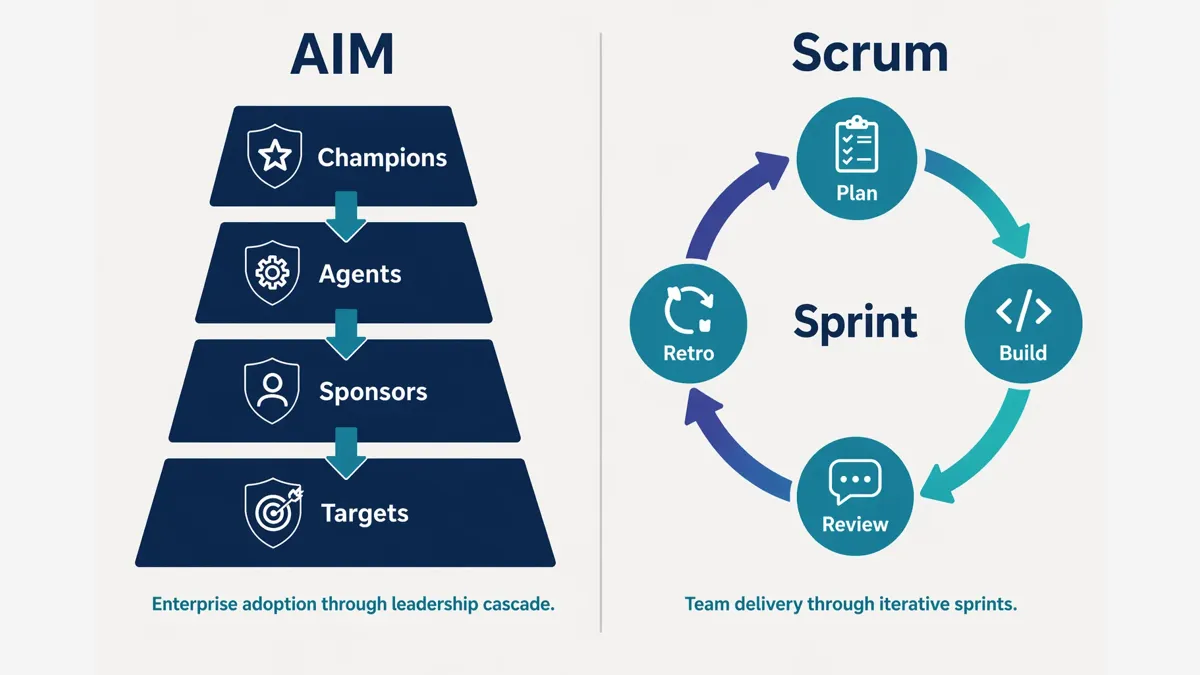
AIM and Scrum operate at different levels. Scrum is a lightweight team-level framework for delivering complex products iteratively, with defined roles, events, and artifacts. AIM is an enterprise implementation methodology built on 40+ years of field research, providing the leadership involvement and reinforcement architecture that determine whether Scrum adoption sustains beyond the trained team.
Scrum
- Origin: Ken Schwaber and Jeff Sutherland, The Scrum Guide
- Type: Lightweight team-level delivery framework
- Scope: Team-level iterative product delivery
- Best fit: Iterative product delivery within a team
AIM (IMA Worldwide)
- Origin: Don Harrison, IMA Worldwide, 40+ years of field research
- Type: Structured enterprise implementation methodology
- Scope: Enterprise behavioral adoption across leadership levels
- Best fit: Adoption that crosses leadership levels and business units
What is Scrum?
Scrum is a lightweight team-level framework for delivering complex products through iterative development. Described by Ken Schwaber and Jeff Sutherland in The Scrum Guide, it defines three roles, five events, and three artifacts, with inspect-and-adapt at its core.
Three roles
Product Owner, Scrum Master, and Developers share clear accountability for value and delivery.
Five events
Sprint, Sprint Planning, Daily Scrum, Sprint Review, and Retrospective create a predictable cadence.
Three artifacts
Product Backlog, Sprint Backlog, and Increment make work and progress transparent.
Inspect and adapt
Ceremonies surface what is working at the team level and enable continuous improvement.
Scrum strengths
- Clear, minimal framework that is easy to adopt at the team level
- Regular cadence creates predictable delivery rhythm and transparency
- Inspect-and-adapt ceremonies enable continuous team-level improvement
- Self-management empowers teams to own their process and commitments
- Widely adopted with extensive community, tooling, and certification
Scrum limitations
- Silent on executive and management behavior required to sustain adoption
- Does not address reward systems, performance reviews, or promotion criteria
- Leaves enterprise-level reinforcement outside its scope
What is AIM?
AIM, created by Don Harrison and grounded in 40+ years of field research, explicitly manages resistance through stakeholder engagement and reinforcement. It assigns executive sponsorship a central role through six non-delegable tasks, integrates change programs across the leadership cascade, and measures adoption with 10 core scored instruments, with variations, including the TRI and IRF.
Most Scrum adoption challenges are not Scrum problems. The framework is sound. What stalls is the reinforcement environment around the team: reviews, promotion criteria, resource allocation.
AIM vs Scrum: side by side
| Dimension | Scrum | AIM |
|---|---|---|
| Primary focus | Team-level iterative delivery through self-management | Structured change addressing human and organizational factors |
| Origin and authorship | Ken Schwaber and Jeff Sutherland, Scrum Guide, 1995 onward | Don Harrison, IMA Worldwide, 40+ years of field research |
| Cultural change approach | Assumes team self-management will produce cultural change | Explicitly manages resistance through engagement and reinforcement |
| Executive sponsorship | Not directly defined; left external to the framework | Central role with 6 non-delegable tasks and ongoing accountability |
| Training and support | Role-based training focused on team practices | Comprehensive change programs across the leadership cascade |
| Measurement approach | Sprint retrospectives, velocity, team-level inspect-and-adapt | 10 core scored instruments, with variations, including TRI and IRF |
| Approach to change | Iterative sprints with continuous team-level adaptation | Iterative, with emphasis on behavioral adoption across the enterprise |
| Best fit | Team-level iterative product delivery | Enterprise behavioral adoption that crosses leadership levels |
Where AIM and Scrum agree, and where they diverge
The sharpest divergence is the primary lever. Scrum treats team self-management and sprint cadence as the lever; AIM treats leadership reinforcement as the lever, applying the Express, Model, Reinforce framework. The second is executive sponsorship: AIM defines six non-delegable tasks; Scrum leaves executive behavior outside the framework.
Where they agree
- Change is iterative; feedback loops, not one-time launches, move adoption
- Measurement is essential, even though each measures different things
- A single launch event does not deliver value
- Observable behavior matters more than stated intent
- Awareness and training alone do not produce lasting behavior change
What each uniquely answers
- Scrum: how a team organizes and delivers work iteratively
- Scrum: what roles, events, and artifacts create delivery transparency
- AIM: why trained teams revert to pre-Scrum behaviors within months
- AIM: which leadership behaviors undermine or reinforce adoption
- AIM: how reinforcement systems sustain the change enterprise-wide
When to lead with AIM, and how they combine
The framing is rarely AIM-instead-of-Scrum. Lead with AIM when the primary risk is organizational rather than delivery-related: past Scrum rollouts have stalled, leaders say the right things but reward old behaviors, the change crosses multiple business units, or team maturity has not produced business outcomes. The strongest agile transformations establish executive sponsorship with AIM before the first Scrum team launches.
Lead with AIM when
- Past Scrum rollouts have stalled beyond the trained team
- Leaders say the right things but reward the old behaviors
- The change crosses multiple business units
- Team maturity has not produced business outcomes
- Teams reverted to waterfall within a quarter of certification
Scrum supplies
- Clear team-level roles, events, and artifacts for iterative delivery
- Sprint cadence that creates predictable delivery rhythm
- Retrospectives that enable continuous team-level improvement
- Self-management that empowers teams to own commitments
- Velocity and predictability metrics for delivery transparency
The bottom line: AIM and Scrum are complements, not competitors. Scrum defines how a team delivers work iteratively; AIM addresses why organizations struggle to sustain the behaviors Scrum requires. The two layer cleanly together in enterprise agile transformation.
AIM vs Scrum: key questions
What is the difference between AIM and Scrum?
AIM (Accelerating Implementation Methodology) is a structured implementation methodology that addresses the human and organizational factors determining whether change is sustained at the enterprise level. Scrum is a lightweight team-level delivery framework defining roles, events, and artifacts for iterative product development. AIM provides leadership involvement and reinforcement architecture; Scrum provides the team structure for iterative delivery.
Why do Scrum adoptions stall outside the trained team?
Trained Scrum teams routinely revert to pre-Scrum behaviors when the organizational environment around them still rewards individual heroics, fixed-scope commitments, and direct task assignment that bypasses the Product Owner. Scrum does not prescribe what directors, VPs, or executives must do to support adoption. AIM identifies the specific leadership and reinforcement gaps that cause regression.
How does AIM complement Scrum?
AIM addresses the leadership behaviors and reinforcement systems Scrum leaves outside its scope. AIM defines six non-delegable executive sponsor tasks, embeds the Express-Model-Reinforce framework, and provides scored diagnostic tools that pinpoint why adoption is fading. Combining AIM and Scrum increases the likelihood that team-level Scrum practice translates into sustained enterprise adoption.
Can AIM and Scrum be used together?
Yes. Scrum supplies the team structure, ceremonies, and artifacts for iterative delivery; AIM supplies the executive sponsorship, behavioral change management, and reinforcement architecture that determine whether Scrum adoption sustains beyond the trained team. The two operate at different levels and layer cleanly together.
Which approach is better for organizational change?
The most effective Scrum rollouts combine both. Scrum delivers team-level discipline and a cadence for inspect-and-adapt. AIM addresses the broader organizational change management and leadership behaviors that determine whether Scrum adoption persists. Change management research consistently finds that active executive sponsorship cascading through every leadership level is the single strongest predictor of sustained adoption.
Make Scrum adoption stick
Talk to IMA Worldwide about the executive sponsorship and reinforcement that keep trained teams from reverting to waterfall.
Contact us What is AIM?