
AIM vs Kotter's 8-step process: diagnostic accountability vs sequential momentum
Kotter builds momentum through a fixed sequence. AIM diagnoses what is blocking adoption and assigns accountability to fix it. The difference is sequence versus diagnosis.
Kotter's 8-Step process and AIM solve different problems. Kotter generates top-down momentum through eight defined phases, beginning with urgency. AIM diagnoses the organizational factors creating resistance and assigns structured sponsor accountability to address them, prescribing interventions based on what the current assessment reveals rather than a fixed order.
Kotter 8-step
- Origin: John Kotter, Harvard Business School
- Logic: Sequential, prescriptive momentum
- Leadership: Guiding coalition and volunteer army
- Best fit: Stable, top-driven transformation
AIM (IMA Worldwide)
- Origin: Don Harrison, IMA Worldwide, 40+ years of field research
- Logic: Diagnostic, adaptive framework
- Leadership: Structured sponsor cascade with line accountability
- Best fit: Complex, multi-stakeholder, dynamic environments
What is Kotter's 8-step process?
Kotter's 8-Step Process for Leading Change is a sequential model developed by John Kotter. The steps build and sustain organizational momentum, each phase intended to precede the next.
Create urgency
Make the case for why change cannot wait.
Build a guiding coalition
Assemble influential leaders to champion the change.
Form a strategic vision
Define the future state and a path to it.
Enlist a volunteer army
Recruit broad participation behind the vision.
Enable action
Remove barriers that block progress.
Generate short-term wins
Create visible early proof of momentum.
Sustain acceleration
Press on rather than declaring victory early.
Institute the change
Anchor new behaviors into the culture.
Kotter core strengths
- Clear, memorable narrative for communicating transformation
- Strong on building urgency and coalition energy
- Widely taught and recognized across industries
- Effective for top-down, stable change environments
Kotter key limitations
- Sequential order is rigid in dynamic, multi-initiative settings
- Relies on coalition influence rather than assigned accountability
- Culture treated as an endpoint, not a diagnostic factor
- Limited dedicated reinforcement and adoption measurement
What is the AIM methodology?
AIM, created by Don Harrison and grounded in 40+ years of field research, is a diagnostic, adaptive framework. Rather than following a fixed sequence, it uses ongoing assessment to identify which organizational barriers are present at each stage and addresses them through a structured sponsor cascade with assigned line accountability. Adoption is tracked through business results and behavioral indicators tied to the case for change.
Kotter prescribes a fixed order: step one before step two. AIM prescribes interventions based on what the diagnostic reveals, regardless of where the organization is on the timeline.
AIM vs Kotter: key dimensions compared
| Dimension | Kotter 8-step | AIM |
|---|---|---|
| Structural approach | Sequential, prescriptive eight-phase process | Diagnostic, adaptive framework guided by ongoing assessment |
| Starting point | Create urgency as the first phase | Diagnose organizational factors before prescribing interventions |
| Leadership model | Guiding coalition of influential leaders and volunteers | Structured sponsor cascade with assigned line accountability |
| Resistance handling | Remove barriers in step five; rely on coalition influence | Diagnose systemic resistance sources; assign sponsor accountability |
| Culture treatment | Culture addressed in step eight as an endpoint outcome | Cultural norms diagnosed as a factor throughout implementation |
| Measurement | Short-term wins and milestone progress | Business results and adoption indicators tied to case for change |
| Urgency vs readiness | Urgency is the foundation and first step | Readiness assessed diagnostically, including organizational capacity |
| Change environment | Best suited to stable, top-driven transformation | Suited to complex, multi-stakeholder, dynamic environments |
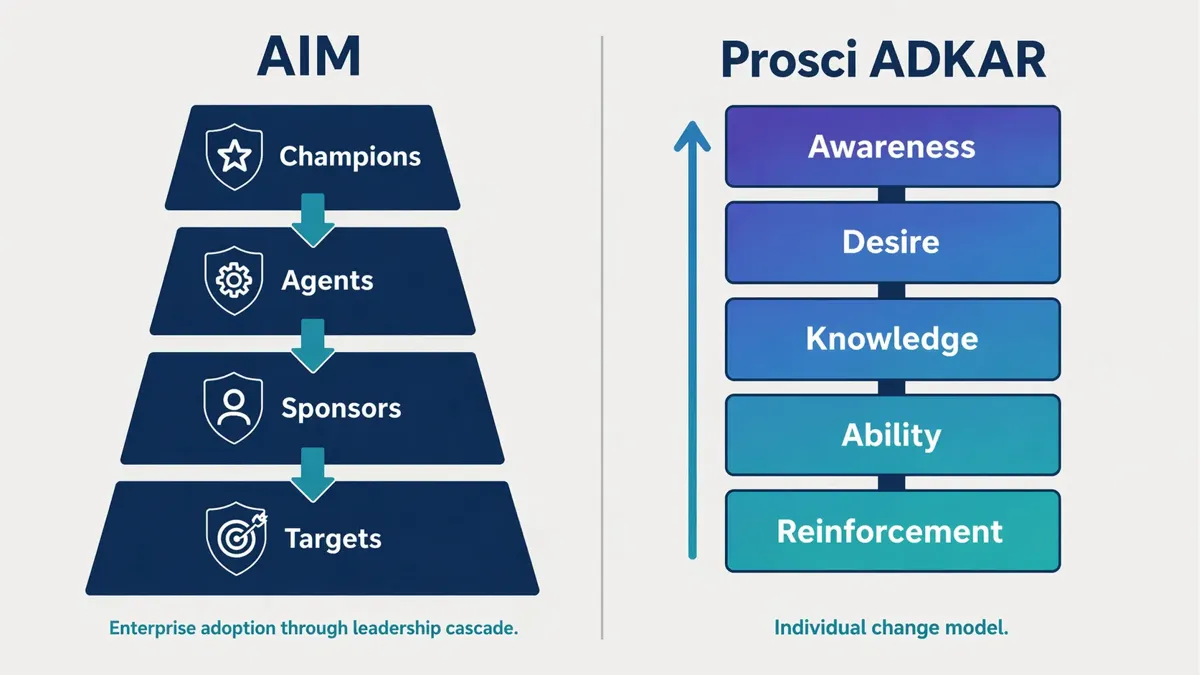
Where AIM and Kotter agree, and where they diverge
Both treat leadership commitment as decisive and both recognize that reinforcement, not announcement, is what makes change stick. They diverge on structure: a fixed sequence versus an ongoing diagnosis.
Where they agree
- Visible leadership commitment is decisive for success
- Change must be deliberately led, not left to chance
- Sustaining momentum matters more than a strong launch
- Anchoring new behavior is required to prevent regression
Where they diverge most sharply
- Sequence vs diagnosis: fixed order vs assessment-driven interventions
- Coalition vs cascade: volunteer influence vs assigned sponsor accountability
- Urgency vs readiness: urgency-first vs diagnosed capacity
- Culture as endpoint vs factor: step eight vs diagnosed throughout
When Kotter's 8-step falls short: in complex multi-initiative environments, when resistance is structural rather than motivational, when middle management has historically blocked change, when adoption must be measured against business cases, or when the change landscape shifts faster than a fixed sequence can accommodate.
When to choose each
Kotter is a strong fit when
- The primary barrier is organizational complacency or inertia
- Leadership needs a simple, communicable transformation narrative
- A credible guiding coalition exists or can be built
- Short-term wins are achievable and can generate momentum
- The environment is relatively stable and top-down
- A burning-platform urgency message is the right strategic move
AIM is the stronger choice when
- Resistance is structural, not just motivational
- Middle management layers are known blockers of prior change
- The change is complex, multi-initiative, and dynamic
- Measurable adoption tied to the business case is required
- Governance demands clear, assigned accountability
Combining them: some enterprise teams use Kotter's model for stakeholder communication and executive storytelling, while deploying AIM's structured sponsor cascade and diagnostic assessments to manage the operational reality of adoption. The two layer cleanly when teams are clear on which framework drives tactical decisions and governance.
AIM vs Kotter: key questions
What are Kotter's 8 steps for leading change?
Kotter's 8-Step Process for Leading Change is a sequential model developed by John Kotter of Harvard Business School. The steps are: create urgency, build a guiding coalition, form a strategic vision, enlist a volunteer army, enable action by removing barriers, generate short-term wins, sustain acceleration, and institute change. The model emphasizes creating and sustaining organizational momentum for transformation.
How does AIM compare to Kotter 8-Step?
Kotter's model is prescriptive and sequential, designed to generate top-down organizational momentum through eight defined phases. AIM is diagnostic and adaptive, identifying specific organizational barriers at each stage of implementation and addressing them based on ongoing assessment rather than a fixed sequence. AIM assigns structured sponsor accountability; Kotter relies on a guiding coalition and volunteer energy.
Which model is better for culture change?
Kotter's model explicitly addresses culture in its final step, treating it as an outcome of sustained behavior change. AIM treats culture as a diagnostic factor throughout implementation, identifying cultural norms and informal systems that support or resist the change at every phase. For deep culture change, AIM's ongoing cultural diagnosis may provide more actionable guidance than Kotter's culture-as-endpoint approach.
Is Kotter's model linear while AIM is adaptive?
Yes. Kotter's original 8-step model is explicitly sequential, designed to be followed in order. AIM is diagnostic and iterative, with ongoing assessments that guide which interventions are needed at any given point. Kotter later introduced a dual operating system model to address non-linear change environments, but the core 8-step framework remains primarily sequential in practice.
How do Kotter's coalition and AIM's cascade approach differ?
Kotter's guiding coalition is a cross-functional team assembled to lead and champion the change, drawing on positional and personal influence. AIM's sponsor cascade is a structural accountability framework where each level of management is responsible for actively engaging the level below. Kotter's coalition builds an energized change team; AIM's cascade distributes sponsor accountability throughout the entire management hierarchy.
Can Kotter and AIM be used together?
Yes, some organizations use Kotter's 8-step model as a high-level narrative framework to communicate the transformation journey to employees, while applying AIM's diagnostic tools and sponsorship structures to manage implementation at the organizational system level. The two can be complementary if teams are clear about which framework drives tactical decisions and governance accountability.
Does Kotter address reinforcement?
Kotter's model addresses reinforcement indirectly through its final step, Institute the Change in Culture, which focuses on anchoring new behaviors into organizational norms. However, the model does not include a dedicated reinforcement mechanism with structured measurement or accountability. AIM builds reinforcement into its methodology through ongoing diagnostic assessments and sponsor accountability, ensuring adoption gains are measured, monitored, and sustained throughout the implementation lifecycle rather than addressed only at the conclusion.
See AIM in practice
Talk to IMA Worldwide about diagnosing what is blocking your transformation, and assigning the sponsor accountability that makes adoption hold.
Contact us What is AIM?