
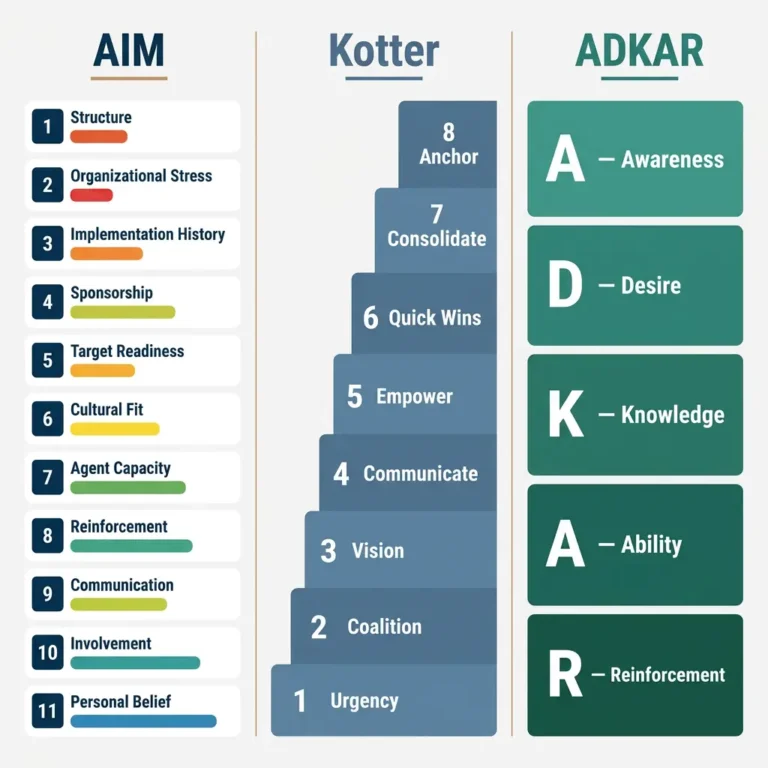
AIM vs Prosci ADKAR vs Kotter in Change Management
By Ann Marvin, IMA Worldwide
This is an article updated to include new information and was originally created by Don Harrison.
In the complex landscape of enterprise change management, selecting the right framework is pivotal to ensuring successful adoption and sustained transformation. This exhaustive guide examines three predominant change models and methodologies—Prosci ADKAR, Kotter’s 8-Step Process, and the Accelerating Implementation Methodology (AIM)—through a critical lens emphasizing the distinction between model and methodology. While Prosci and Kotter offer robust models addressing individual transitions and executive momentum respectively, AIM provides a comprehensive, repeatable organizational implementation methodology that integrates sponsor reinforcement, diagnostics, and reinforcement strategies.
Rooted in extensive empirical research spanning over four decades and multiple industries, this comparison highlights the unique leadership impact framework within AIM—the 1x:2x:3x Express, Model, Reinforce (EMR) cycle—delineating how leaders can effectively drive behavioral change. Through structured analyses, comparison tables, and answers to frequently posed questions, this asset equips enterprise leaders with professional and credible insights to align their change approach with organizational complexity and resilience needs.
Downloadable Outline and Resources
For your convenience, download a comprehensive PDF outline of this comparison and implementation guidance here: Download Comparison Framework PDF.
Understanding the Critical Distinction: Model vs Methodology
An essential starting point in evaluating change frameworks is distinguishing between models and methodologies. This distinction underpins how organizations conceptualize, plan, and execute change initiatives.
- Model: A structured representation or framework that explains the stages or components of change, often focused on a particular dimension such as individual psychological transitions or executive processes. Models tend to be diagnostic and descriptive.
- Methodology: A systematic, comprehensive approach combining models, tools, leadership roles, sponsor reinforcement measures, and repeatable processes designed to drive change implementation at scale throughout an enterprise.
In this context:
- Prosci ADKAR is an individual transition model outlining five stages of personal change readiness.
- Kotter’s 8-Step Process is an executive momentum model orchestrating leadership-driven urgency and vision for change.
- AIMmethodology comprising diagnostic tools, sponsor reinforcement, reinforcement strategies, and a repeatable implementation cycle designed for sustained adoption across enterprises.
Framework Overviews: Prosci ADKAR, Kotter 8-Step, and AIM
Prosci ADKAR: The Individual Transition Model
Developed by Jeff Hiatt and published in 2006, Prosci’s ADKAR model centers on five sequential stages—Awareness, Desire, Knowledge, Ability, and Reinforcement—that individuals experience during personal change. This model guides change practitioners in diagnosing where individuals are stuck and tailoring interventions appropriately, making it particularly valuable for small to medium-scale changes emphasizing individual readiness. While heavily validated through benchmarking thousands of projects, ADKAR focuses predominantly on the human side of change at the individual level without prescribing a full organizational implementation mechanism.
Kotter's 8-Step Process: The Executive Momentum Model
Introduced by John Kotter in 1996, this model defines eight steps for leading change aimed at building urgency, shaping coalitions, articulating vision, and securing short-term wins. Kotter’s approach is instrumental in aligning leadership and generating momentum, especially critical during initial strategic shifts. However, as Kotter himself acknowledged, the model emphasizes top-down executive actions and largely omits the operational infrastructure for ensuring widespread sustainable adoption throughout the organizational layers.
AIM: The Comprehensive Organizational Implementation Methodology
Created by Don Harrison at IMA Worldwide, AIM is a robust, research-backed methodology that treats change as an organizational system challenge rather than focusing solely on individuals or executive momentum. It integrates 10 Practice Areas covering sponsor reinforcement, diagnostics, sponsorship cascades, and reinforcement mechanisms. A key differentiator is its structured leadership impact model—the Express, Model, Reinforce (EMR) cycle—whose stages deliver 1x, 2x, and 3x leadership influence respectively, ensuring behavioral adoption lasts beyond go-live and mitigating change fatigue. AIM’s methodology delivers measurable adoption metrics and sustainable transformation outcomes across enterprises.
Side-by-Side Comparison of Prosci ADKAR, Kotter 8-Step, and AIM
The following tables provide a clear comparison across multiple dimensions critical to enterprise decision-making. These distinctions clarify how each framework approaches change differently and the outcomes they are best suited to deliver.
| Factor | Prosci ADKAR (Model) | Kotter’s 8-Step (Model) | AIM (Methodology) |
|---|---|---|---|
| Primary Focus | Individual readiness and psychological transitions. | Building executive urgency and leadership coalition. | Organizational system adoption and behavior reinforcement. |
| Scope of Change | Individual and small teams. | Strategic initiatives led top-down. | Enterprise-wide, multi-level transformations. |
| Leadership Role | Sponsors support change at individual level; limited structured sponsor reinforcement. | Leaders create urgency and vision; develop guiding coalition. | Leaders held accountable for six non-delegable tasks with metrics; active reinforcement via EMR cycle. |
| Resistance Model | Individual barrier diagnosis (psychological focus). | Remove process obstacles; build buy-in. | Structural root-cause diagnostics spanning organizational dynamics. |
| Reinforcement Approach | Final ‘Reinforcement’ stage in ADKAR sequence. | Anchor changes in culture (Step 8). | Continuous Express (1x), Model (2x), Reinforce (3x) leadership impact cycle. |
| Diagnostic Tools | ADKAR and PCT assessments. | No proprietary diagnostic tools. | 35+ validated assessments including Behavioral Change Analytics (BCA), Impact Resistance Framework (IRF), and more. |
| Measurement of Success | Individual progression through ADKAR stages. | Achievement of short-term wins and coalition building. | Sustained, measurable behavioral adoption and reinforcement indices. |
| Best Enterprise Fit | Focused individual or team-level changes. | Creating executive momentum in strategic shifts. | Large scale, complex, multi-year corporate transformations. |
| Dimension | Prosci ADKAR | Kotter 8-Step | AIM |
|---|---|---|---|
| Training & Certification | Widely available individual change practitioner certifications. | Focused on leadership development programs. | Comprehensive practitioner certifications covering organizational change implementer roles. |
| Sponsor Reinforcement | Sponsor role generally supportive, limited metrics. | Leader-driven urgency emphasis, limited operational sponsor reinforcement. | Mandatory six non-delegable leadership tasks with quantitative sponsor reinforcement. |
| Resistance Handling | Focus on individual psychological barriers. | Overcoming obstacles in change process. | Structural diagnostics uncover root organizational resistance causes. |
| Change Adoption Measurement | Individual stage completion. | Short-term milestone achievement. | Behavioral adoption metrics sustained post-project. |
| Framework Complexity | Lightweight, individual-level model. | Medium complexity focusing on leadership sequence. | High complexity, integrated organizational methodology. |
The AIM Express, Model, Reinforce (EMR) Leadership Impact Framework Explained
AIM’s signature leadership impact strategy centers on the Express, Model, Reinforce (EMR) cycle, which magnifies leadership influence to accelerate adoption:
- Express (1x): Leaders articulate and communicate the vision and expectations clearly, establishing alignment and urgency.
- Model (2x): Leaders actively demonstrate the new behaviors, serving as role models to reduce uncertainty and increase credibility.
- Reinforce (3x): Leaders consistently embed the change into performance management, rewards, recognition, and decision-making processes, ensuring lasting behavioral adoption.
This cyclical approach amplifies leadership impact exponentially, with reinforcement having triple the influence compared to mere communication. This sponsor reinforcement mechanism differentiates AIM, bridging the gap from installing change plans to full realization of transformation benefits.
Decision Guide: Which Change Framework Best Fits Your Enterprise?
Accurately aligning your organizational needs with an appropriate change framework maximizes success and resource utilization. Use the following decision flow:
- Identify Primary Adoption Barrier: Determine if your biggest challenges are individual readiness, executive alignment, or comprehensive organizational adoption.
- Assess Change Scope and Complexity: Distinguish between team-level initiatives and enterprise-wide, multi-faceted transformations.
- Evaluate Sponsor Reinforcement Needs: Decide whether leadership engagement needs structured sponsor reinforcement or just sponsorship support.
- Define Measurement and Reinforcement Requirements: Clarify whether quantitative behavioral adoption metrics or awareness and urgency milestones are sufficient.
- Match Your Framework:If change hinges on individual readiness and the scale is limited, choose Prosci ADKAR.If the need is creating executive momentum and urgency to mobilize leadership, choose Kotter’s 8-Step.If your initiative involves large, complex, sustained adoption with sponsor reinforcement and robust metrics, choose AIM.
Enterprise Use Cases and Outcomes: Real-World Insights
Prosci ADKAR - Financial Services Firm
A mid-sized financial services company deploying a new CRM system within a specific sales team leveraged the ADKAR model to address individual readiness barriers. By focusing on Awareness and Desire within affected users, they achieved a 90% adoption rate and significant productivity improvements within six months.
Kotter 8-Step - Global Manufacturing Corporation
Faced with declining market share, a global manufacturer utilized Kotter’s process to build a guiding coalition and urgency around strategic realignment. Short-term wins energized employees, enabling stabilization and executive alignment during volatile market conditions.
AIM - Large Healthcare Enterprise
A complex, multi-year digital transformation across thousands of healthcare employees employed AIM’s methodology. Using leadership sponsorship cascades, EMR cycles, and diagnostic assessments, the enterprise achieved 76% sustained behavioral adoption, reducing change fatigue and enhancing patient care outcomes.
Synergistic Use: How Enterprise Teams Combine Change Frameworks
Many successful organizations integrate frameworks to leverage complementary strengths. The most prevalent combinations include:
- AIM + Prosci ADKAR: AIM provides organizational-level sponsor reinforcement, diagnostics, and reinforcement, while ADKAR supports individual-level readiness conversations.
- AIM + Kotter: Kotter initiates urgency and coalition-building before AIM operationalizes sustained sponsor reinforcement and behavioral adoption.
- AIM + SAFe: For Agile and DevOps transformations, AIM reinforces leadership behaviors supporting new workflows alongside the SAFe Agile framework.
Frequently Asked Questions (FAQs)
1. What distinguishes AIM’s methodology from Prosci ADKAR and Kotter models?
AIM is a full organizational methodology, encompassing diagnostic tools, sponsor reinforcement with measurable tasks, reinforcement cycles, and enterprise-wide systems change, whereas Prosci and Kotter offer individual and executive momentum models respectively.
2. Can AIM and Prosci ADKAR be integrated effectively?
Yes, enterprises benefit by combining AIM’s organizational implementation framework with ADKAR’s individual readiness model to address change comprehensively from leadership to frontline adoption.
3. How does AIM’s Express, Model, Reinforce (EMR) framework increase leadership impact?
The EMR cycle sequences leadership behaviors to first express vision (1x impact), then model behaviors (2x impact), and finally reinforce changes through organizational systems and rewards (3x impact), ensuring sustained behavioral adoption.
4. Which framework is optimal for digital and AI-driven transformations?
AIM is uniquely suited for technology transformations because it directly addresses sponsor reinforcement and organizational structural barriers—key factors in successful digital adoption according to contemporary research.
5. Why do many change initiatives fail despite communication and training?
Because communication and training alone do not change organizational reward systems or leadership behaviors, meaning inconsistent reinforcement leads to change decay within months. AIM’s methodology specifically targets this systemic gap.
About the Author
Don Harrison is the founder and Chief Research Officer at IMA Worldwide, bringing over 40 years of expertise in organizational change and implementation science. His research across more than a dozen industries culminated in the creation of AIM—a comprehensive methodology that has enabled hundreds of enterprises to significantly improve change adoption rates. Don is a globally recognized thought leader, speaking extensively on sponsor reinforcement and sustained transformation.
Contact IMA Worldwide for Expert Consultation and Certification
Ready to elevate your change management approach with AIM’s proven methodology? Contact IMA Worldwide for personalized consultations or practitioner certification programs to equip your leadership and change agents with cutting-edge strategies driving sustainable enterprise transformation.
