
Preventing Status Quo Reinforcement in Organizational Change
- Many transformations fail because organizations continue to reward current behaviors instead of the desired future ones.
- Reinforcement drives process change; process change alone does not create reinforcement.
- Annual appraisals, bonuses, and formal performance systems are often too slow to effectively support transformation.
- Rewards must be meaningful to the individuals expected to change their behavior.
- Positive reinforcement accelerates adoption more effectively than negative consequences.
- The AIM Targeted Reinforcement Index helps managers understand what truly motivates their teams.
The Change Installation Trap
Change Installation (Go-Live)
- Tools & Systems: New software, updated processes, and training launched.
- Focus: Technical deployment and readiness.
- Outcome: System is live, but behavior unchanged.
- Timing: One-time event.
Change Implementation (Sustained ROI)
- Behavior & Culture: New behaviors reinforced and embedded.
- Focus: Adoption, reinforcement, and continuous improvement.
- Outcome: Measurable business results and ROI.
- Timing: Ongoing process.
The Real Barrier: Organizations Reinforce the Status Quo
In transformational change—whether in IT, HR, healthcare, or enterprise-wide culture shifts—a recurring obstacle emerges:
Organizations declare a desire for a future state but continue rewarding actions aligned with the present state.
This distinction explains why installation is not equivalent to implementation.
You can install a new system, launch updated processes, refresh job aids, conduct training, and communicate the change repeatedly. Yet, if leaders keep rewarding old behaviors, the organization will persist in producing old results.
Reinforcement involves applying rewards and consequences that shape behavior. If leaders reinforce the assumptions, habits, and metrics of today’s organization, they should expect those same outcomes to continue.
Within the AIM framework, reinforcement is central—not an afterthought. It stands as one of the most powerful levers driving adoption.

Reinforcement Drives Process Change
Many organizations mistakenly believe that process changes occur first and reinforcement follows.
AIM turns this logic around.
Reinforcement is the catalyst for implementing process changes, not a byproduct of them.
The current reinforcements are perfectly tailored to sustain the present culture and behaviors. Without changing these reinforcements, transformation slows dramatically.
You are already reinforcing certain behaviors. The key question is:
Are you reinforcing the old ways or the new?
| Reinforcing the Status Quo | Reinforcing the Transformation |
|---|---|
| Rewards focus on existing behaviors and outcomes | Rewards are designed to encourage the desired future behaviors |
| Relies heavily on slow, formal systems such as annual appraisals | Utilizes timely, in-the-moment reinforcement mechanisms |
| Assumes leaders know what employees value | Leverages direct feedback and the Targeted Reinforcement Index |
| Emphasizes negative consequences | Prioritizes frequent positive reinforcement |
| Reinforcement occurs vertically within silos | Coordinates reinforcement horizontally across sponsors and functions |
Why Reinforcement Becomes a Barrier to Change
Reinforcement becomes an obstacle when it happens by chance rather than design.
Common issues include:
- Rewards focus on past achievements rather than future goals. People are asked to change, but performance metrics and rewards still reflect old behaviors.
- Formal systems operate too slowly. Annual reviews and bonuses provide delayed feedback, while transformation demands immediate reinforcement.
- Rewards are not meaningful to those expected to change. Incentives that look good on paper may fail to motivate frontline employees.
- Managers lack training and tools to effectively reinforce change. Many are expected to support adoption without adequate preparation.
- Overuse of negative consequences. Fear may induce short-term compliance but rarely fosters lasting commitment.
- Non-adoption often has no real consequences. In some organizational cultures, resistance can simply be tolerated without meaningful impact.
- Lateral change is managed through vertical reinforcement. Transformation crossing silos struggles under reinforcement systems confined within hierarchical functions.
A Hypothetical Example
Imagine a company aiming to shift its sales teams from focusing on one-time deals to building long-term customer relationships.
The company updates pitch decks, trains the salesforce, and talks about customer lifetime value and strategic account growth.
Yet, the commission plan still rewards primarily new bookings.
Unsurprisingly, sales representatives continue chasing quick deals.
The future state is communicated clearly—but reinforcement still supports the old behaviors.
Only by adding reinforcement tied to retention, expansion, account health, and relationship-building behaviors do the new approaches begin to take hold. Furthermore, reinforcement must occur in real time, not delayed until annual reviews.
The Reinforcement Math
AIM offers leaders simple ratios to understand their impact:
| AIM Principle | Ratio | Why It Matters |
|---|---|---|
| Reinforce vs. Say | Approximately 3 to 1 | What leaders reinforce influences behavior about three times more than what they communicate. |
| Positive to Negative | Approximately 4 to 1 | Because people focus more on negative events, leaders need significantly more positive reinforcement to motivate change. |
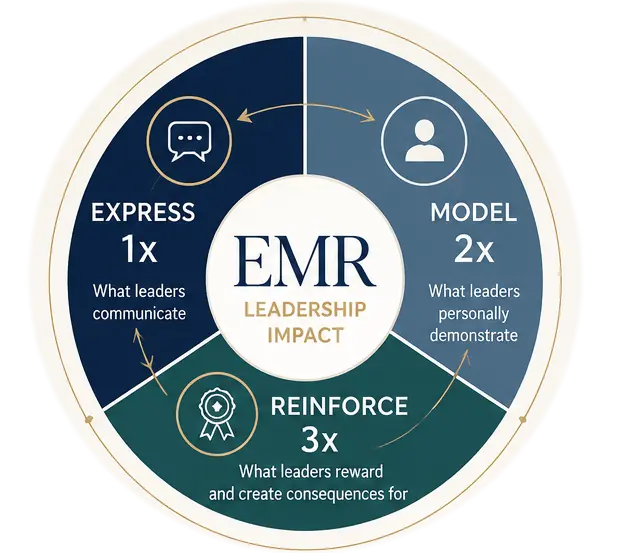
| Express, Model, Reinforce | 1x : 2x : 3x | While expression and modeling are essential, reinforcement is the strongest leadership behavior to sustain change and is often overlooked. |
The 1x:2x:3x EMR Leadership Impact Ratio

Leadership effort ratio demonstrating the considerable impact of reinforcement compared to expressing and modeling change.
Leaders must clearly express the direction and model the desired behaviors. However, it’s reinforcement that ultimately embeds new ways of working.
AIM Reinforcement vs. More Communication or ADKAR
Many organizations believe that simply increasing communication will drive adoption, but awareness alone does not lead to change.
Others view reinforcement as a final step after change occurs. AIM challenges this by placing reinforcement at the core of the implementation process.
| Approach | Focus | Limitation |
|---|---|---|
| More communication | Explaining and clarifying the change | You cannot create new behaviors through communication alone. |
| ADKAR reinforcement | Ensuring the change is maintained | Reinforcement often happens too late, after behaviors should already have formed. |
| AIM reinforcement | Redesigning rewards and consequences so the new behaviors become easier and more natural | Requires daily leadership commitment to reward desired behaviors. |
AIM centers reinforcement during implementation because behavior changes only when the surrounding environment supports it.
Use the Targeted Reinforcement Index
A common mistake is assuming what motivates people without asking.
A reward only reinforces change if it matters to the individual receiving it. That’s why AIM uses the Targeted Reinforcement Index (TRI).
The TRI encourages managers and employees to have open conversations about which rewards resonate best—whether recognition, flexible work, visibility, development opportunities, team support, or other meaningful incentives.
The objective is not a one-size-fits-all reward system but to equip managers to apply tailored reinforcement that truly influences behavior.
The Bottom Line: Stop Rewarding the Old Way
Transformations stall when rewards continue to support current behaviors instead of future goals.
To achieve sustained adoption, leaders must shift what behaviors get recognized, measured, rewarded, and sanctioned.
Installation provides the tools, processes, and systems.
Implementation is when individuals change how they work.
Reinforcement bridges the gap between installation and true implementation.
Call to Action
Direct your reinforcement toward the future state. IMA Worldwide partners with enterprises to design reinforcement strategies that end support for the status quo and speed up sustained adoption.
Contact IMA Worldwide today to enhance your reinforcement strategy.
Frequently Asked Questions
Why do transformations reinforce the status quo?
Because many reward systems are structured around current behaviors rather than the desired future state. Leaders may unknowingly encourage the very culture they want to change.
Does process change drive reinforcement, or does reinforcement drive process change?
Reinforcement drives process change. Since existing reinforcements shape current behavior, changing them is essential for behavioral transformation.
Why are formal performance systems often ineffective during transformation?
Formal systems like appraisals and bonuses tend to be slow and retrospective, making them ill-suited for the rapid feedback loops needed during transformation.
What tool helps leaders design meaningful rewards?
The AIM Targeted Reinforcement Index enables managers to identify what motivates their direct reports and apply reinforcement more effectively.
Should leaders rely on negative consequences?
While sometimes necessary, overreliance on negative consequences can hinder change. Positive reinforcement should be emphasized to encourage faster, more lasting adoption.
