
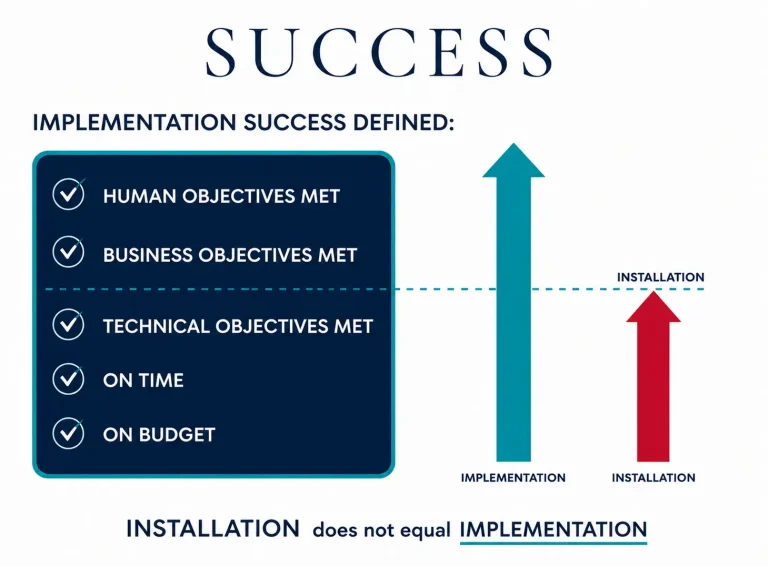
The Change Installation Trap That Kills ROI
Many organizations mistakenly declare success once technical Change Installation is complete. The software is live, training sessions are done, the project team disbands, and leadership moves on. But what they leave behind is not true transformation; it is merely Change Installation. And Change Installation alone fails to generate the promised ROI.
According to McKinsey, 70% of large-scale transformation programs do not reach their goals. The core reason is rarely a poor strategy or lack of funds. Instead, it is the gap between deploying a technical solution (Change Installation) and embedding it deeply into daily work behaviors (Change Implementation). IMA Worldwide terms this dilemma the Installation Trap ? a significant obstacle quietly eroding millions of dollars in change investments annually.
What Is the Change Installation Trap?
🖼️ INFOGRAPHIC PLACEHOLDER: Change Installation Trap
Visual Concept: Illustration showing a gap between technical deployment and behavioral adoption, highlighting the “trap” where organizations stop after installation but before real change occurs.
Alt Text: Diagram illustrating the Change Installation Trap between technical deployment and behavioral change
The Change Installation Trap occurs when organizations treat the technical deployment, or Change Installation, as if it were the end of the change journey. The ERP system goes live, new operating models are announced, and process documentation is uploaded. Leadership then checks the box and moves on.
However, none of these milestones gauge what truly matters: whether employees have changed their behaviors. Without behavioral change, the system remains underused, processes revert to old ways, and the new operating model exists only on paper. The organization has completed Change Installation but has not achieved Change Implementation.
IMA Worldwide?s consulting practice has documented this pattern across hundreds of client engagements. The key distinction is straightforward but profound: Change Installation is about technical deployment, whereas Change Implementation is about how people behave and operate differently. Organizations that conflate these two consistently fail to capture the value for which they invested.
Prosci?s research corroborates this dynamic. Organizations excelling in change management effectiveness?defined as full adoption by the target population?are six times more likely to meet or surpass project objectives than those with poor change management. The adoption gap is not a soft issue; it is a hard financial reality.
Change Installation vs. Change Implementation: The Critical Difference
These distinctions are not theoretical. They directly correspond to whether the ROI case that justified an investment ever materializes. Organizations halting at Change Installation invariably forfeit much of the intended value.
| Dimension | Change Installation | True Change Implementation |
|---|---|---|
| Definition | Technical systems or processes are deployed and accessible | Employees consistently adopt new behaviors and workflows |
| Success metric | Go-live date achieved, training completed | Sustained adoption rate, proficiency, and behavior change |
| Leadership involvement | Project sponsor signs off at launch | Leaders actively reinforce change daily, leveraging the 1x:2x:3x Express, Model, Reinforce (EMR) impact ratio |
| Employee experience | Received training; aware of the change | Understands, is capable, and motivated to work the new way consistently |
| ROI realization | Projected on paper; rarely captured | Achieved operationally through sustained adoption |
| Timeline | Ends at go-live | Continues 6?18 months post-launch with ongoing reinforcement cycles |
| Primary risk | Budget and schedule overruns | Adoption decay, workarounds, and reversion to old habits |
| IMA Worldwide role | Not engaged or engaged late | Engaged from project start to design and sustain the adoption journey using the AIM framework |
Why Organizations Fall Into the Change Installation Trap
The Change Installation Trap is not caused by negligence. It results from four deeply embedded organizational dynamics.
Project timelines reward deployment, not adoption. Project management offices focus on go-live dates, budgets, and scopes. These metrics do not measure real adoption. When timelines end at Change Installation, organizational attention does too.
Leaders confuse awareness with readiness. High training attendance may appear successful, but Prosci?s ADKAR model differentiates Awareness, Knowledge, and Ability. Measuring only awareness overestimates readiness. Gartner estimates fewer than 30% of employees achieve proficiency within 90 days post go-live, despite high training completion rates.
Reinforcement is treated as optional. Reinforcement?through manager behavior, performance systems, recognition, and accountability?is essential for making new behaviors stick. Without designed reinforcement, behavior regression is near certain. ACMP research shows 60% of behavior change reverses within 90 days without reinforcement.
Sponsorship evaporates post-launch. Active sponsorship is the highest-impact change management factor, as documented by Prosci across three decades. Yet, most sponsors disengage after Change Installation. Employees perceive the change as complete, undermining urgency to sustain it.
The ROI Math Behind the Adoption Gap
The financial impact of stopping at Change Installation is significant. Consider a mid-market company investing $4 million in an ERP implementation.
The business case projects $1.2 million in annual productivity gains. The system goes live on time and budget, achieving Change Installation.
If only 50% of users adopt the system (typical without reinforcement), only $600,000 annual gain is realized?half the projection. Over three years, this forfeits $1.8 million of value. Installation was done. Implementation was not.
Forrester Research highlights this pattern enterprise-wide, finding adoption rates under 60% produce negative ROI despite technical success. Deployment investment is sunk cost; value unlocks only with adoption. Treating go-live as the finish line leaves most investment value unrealized.
IMA Worldwide data shows clients executing structured reinforcement for 12 months post-launch achieve adoption increases of 40?55 percentage points over industry baseline, translating directly into full ROI capture.
What True Change Implementation Requires
Escaping the Change Installation Trap requires redefining, resourcing, and measuring change differently. IMA Worldwide?s Accelerating Implementation Methodology (AIM), developed by founder Don Harrison, provides a systematic framework.
AIM treats Change Implementation as an organizational capability, not a project deliverable. It focuses on five conditions essential for scaling behavior change: active sponsorship, leadership engagement through the 1x:2x:3x Express, Model, Reinforce (EMR) ratio, targeted communication, ability-building training, and reinforcement design. When all are sustained, adoption accelerates and ROI materializes on the projected timeline.
🖼️ INFOGRAPHIC PLACEHOLDER: 1x:2x:3x EMR Leadership Impact Ratio
Visual Concept: A visual breakdown of the 1x:2x:3x Express, Model, Reinforce leadership impact framework demonstrating the multiplier effect of consistent leadership behaviors in change adoption.
Alt Text: Diagram illustrating the 1x:2x:3x EMR Leadership Impact Ratio for change management
Sponsorship must be active, not ceremonial. AIM differentiates nominal sponsors (those who approve change) from active sponsors who model, advocate, and hold accountability for adoption. IMA Worldwide?s consulting practice consistently finds passive sponsorship as a root cause of stalled projects post-installation.
Readiness must be measured, not assumed. True Change Implementation requires tracking adoption along ADKAR dimensions rather than simple training completions. Organizations that assess behavioral readiness pre- and post-go-live outperform those that assume readiness. IMA Worldwide deploys readiness assessments at 30, 60, and 90 days post-launch to detect gaps before workarounds harden.
Reinforcement must be planned before go-live. AIM integrates reinforcement plans into project design from the outset, specifying which managers will reinforce specific behaviors, by what mechanisms, and on what schedule. Reinforcement is the primary mechanism making new behaviors durable organizational capabilities.
How IMA Worldwide Closes the Gap
IMA Worldwide?s consulting practice specializes in the full Change Implementation journey?from initial readiness assessment through sustained adoption and reinforcement. Unlike firms that disengage at go-live, IMA Worldwide extends engagements throughout the adoption lifecycle to ensure the investment?s value case is realized.
Engagements begin with candid assessment of where an organization lies on the Change Installation?Implementation spectrum. For organizations stalled after Change Installation without expected results, IMA Worldwide performs adoption diagnostics?identifying ADKAR gaps, sponsorship deficits, and reinforcement failures causing underperformance?and builds targeted recovery plans.
For future transformations, IMA Worldwide embeds Change Implementation design from day one, making go-live a milestone on the adoption journey, not the destination.
Frequently Asked Questions
What is the difference between Change Installation and Change Implementation?
Change Installation means deploying technical systems, processes, or structures and making them accessible. Change Implementation means the affected employees adopt the change fully, understanding it, performing proficiently, and sustaining new behaviors. ROI depends on successful Change Implementation, not just Installation.
Why do so many organizations stop at Change Installation?
Four factors contribute: project timelines emphasize go-live over adoption; leaders equate training completion with readiness; reinforcement is omitted or underfunded; and executive sponsors disengage after launch. These are all addressable with intentional design as provided by the AIM framework.
How much ROI is typically lost due to the Change Installation Trap?
Loss varies based on adoption shortfall and investment time value but is substantial. Forrester Research finds adoption below 60% often yields negative ROI despite technical success. IMA Worldwide client data shows organizations lacking structured reinforcement forfeit 40?55 percentage points of adoption potential, losing significant projected business value.
What is the AIM methodology and how does it prevent the Change Installation Trap?
The Accelerating Implementation Methodology (AIM), created by IMA Worldwide founder Don Harrison, is a proprietary framework emphasizing the five conditions for sustained behavior change: active sponsorship, targeted communication, ability-building training, leadership engagement via the 1x:2x:3x EMR ratio, and reinforcement design. By treating implementation as a core organizational capability, AIM shifts focus from mere deployment to achieving adoption where ROI is realized.
When should an organization engage change management consulting support?
The ideal time to engage is before project kickoff to embed Change Implementation design from inception. That said, IMA Worldwide also assists organizations already through Change Installation but not seeing results?using adoption diagnostics to identify and close gaps hindering ROI. It is never too late to escape the Change Installation Trap, though delays in addressing adoption decay increase recovery costs significantly.
The Change Installation Trap is not inevitable. It is a predictable failure mode with a clear cause and proven remedy. Organizations understanding and investing in both Change Installation and Change Implementation?especially by leveraging the AIM methodology?are those that reliably capture the ROI their business cases projected. IMA Worldwide exists to make that outcome systematic, not accidental.
