

Suggested Meta Title: Preparing Employees for Organizational Change: Increase Readiness and Reduce Resistance | IMA WorldwideSuggested Meta Description: Discover Accelerating Implementation Methodology (AIM)’s evidence-based framework for preparing employees for organizational change. Increase readiness and reduce resistance before your next initiative launches.
Preparing Employees for Organizational Change: Increase Readiness and Reduce Resistance
Preparing employees for change is a critical strategic imperative for any organization seeking to implement successful transformations. When organizations invest thoughtfully in preparing employees for change, they significantly reduce resistance organizational change and increase the likelihood of sustained adoption. Unfortunately, many organizations underestimate the complexity of this preparation, often relegating it to a communication checklist rather than a comprehensive, evidence-based discipline. This oversight leads to employees facing change without the necessary context, skills, or confidence, making resistance a natural and predictable response. Peacock Hill, the consulting practice behind the AIM methodology, has helped hundreds of organizations navigate these challenges by building employee readiness before resistance takes hold.
Key Takeaways
- Prosci’s 2023 benchmarking study found that projects with excellent change management are 7x more likely to meet objectives than those with poor change management.
- McKinsey research shows 70% of large-scale change initiatives fail, most often due to employee resistance and inadequate preparation.
- Gallup data indicates that only 23% of employees strongly agree their leaders communicate a clear direction for change.
- Structured frameworks like the AIM (Accelerating Implementation Methodology) and IMA Worldwide’s Target Readiness Framework give leaders a repeatable process for reducing resistance and building readiness.
At IMA Worldwide, our Accelerating Implementation Methodology (AIM) provides a structured, measurable framework for preparing employees for change that directly addresses these challenges. This article explores why most organizations get preparation wrong, how readiness reduces resistance, and how AIM’s preparation framework can be applied to build effective readiness plans. We also provide practical steps to prepare employees before change launches and discuss how to measure readiness both before and after implementation.
The Preparation Gap: Why Most Organizations Get It Wrong
Despite widespread recognition that employee readiness is essential, many organizations fail to prepare their workforce adequately for change. According to McKinsey & Company, approximately 70% of large-scale organizational change programs fail to achieve their stated goals — and employee resistance is the single most cited reason. Prosci’s research reinforces this: change initiatives rated as having excellent change management are 7 times more likely to meet objectives compared to those with poor change management support. The preparation gap arises because preparation is often misunderstood as a one-time communication event or a simple training rollout. This narrow view ignores the multifaceted nature of readiness and the ongoing engagement required to build it.
Common pitfalls include:
- Overemphasis on communication: Sending announcements or emails without ensuring employees truly understand the change or its impact. Effective communication during change is not a one-time announcement — it is a sustained campaign. Gallup research shows that only 23% of employees strongly agree their leaders communicate a clear direction for change, which means most organizations are leaving a significant trust gap unfilled. Leaders who close this gap do so through multi-channel messaging: town halls, team-level conversations, written updates, and designated Q&A sessions that invite dialogue rather than just broadcasting decisions.
- Training without context: Delivering skills training without connecting it to the broader rationale or personal relevance for employees.
- Ignoring stakeholder diversity: Treating all employees as a homogeneous group rather than tailoring preparation to different roles and readiness needs.
- Neglecting manager involvement: Failing to equip managers to support their teams through the transition, which is critical for adoption.
- Skipping readiness measurement: Launching change initiatives without assessing whether employees are truly ready, leading to costly adoption failures.
These missteps create a scenario where employees feel unprepared, uncertain, and disconnected from the change, fueling resistance organizational change and undermining implementation success.
Why Readiness Reduces Resistance
Readiness is the cornerstone of reducing resistance organizational change. When employees are genuinely ready, resistance diminishes because the primary drivers of resistance—fear, distrust, and skepticism—are addressed proactively.
Readiness means more than just exposure to information or attendance at training sessions. It encompasses four critical dimensions:
- Awareness readiness: Employees understand what is changing, why it is necessary, and how it affects them personally.
- Knowledge readiness: Employees grasp the new processes, systems, or behaviors required by the change.
- Skill readiness: Employees have the practical ability to perform effectively in the new environment.
- Commitment readiness: Employees believe the change is worthwhile and are motivated to engage with it.
When these dimensions are addressed, employees gain confidence and clarity, which reduces anxiety and resistance. For example, fear of incompetence fades when employees receive adequate training and practice opportunities before the change goes live. Distrust of the process lessens when employees are involved in shaping the change and see their input valued. Skepticism about the change’s value decreases when employees have access to credible information and evidence supporting the initiative.
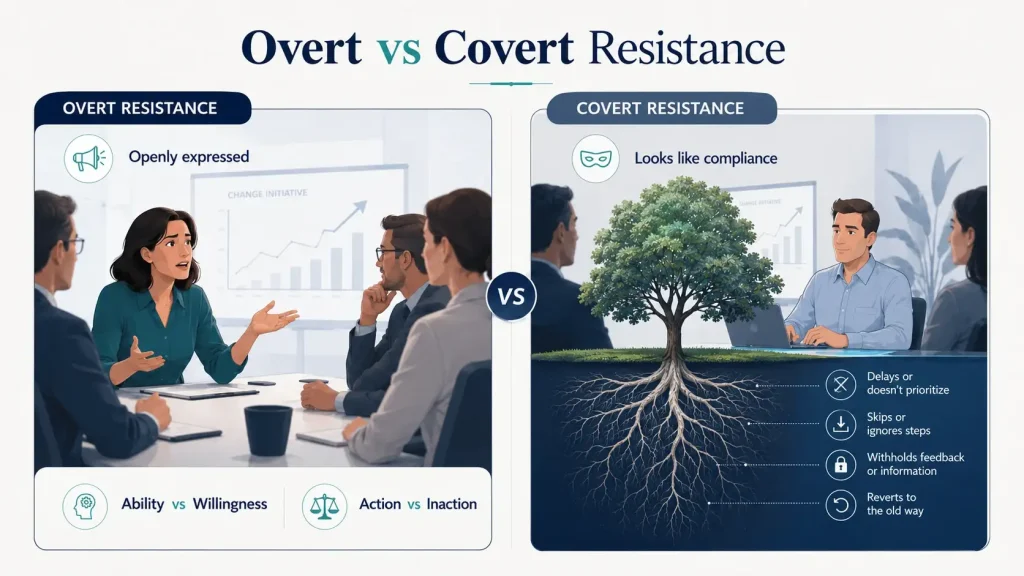
Conversely, inadequate readiness intensifies resistance. Employees who lack skills feel anxious and avoidant. Those excluded from decision-making feel alienated and distrustful. Employees who receive only superficial communication remain skeptical and disengaged.
For organizations seeking to deepen their understanding of reducing resistance to change, IMA Worldwide offers comprehensive resources and diagnostic tools that connect readiness investment directly to resistance reduction and adoption success.
AIM's Preparation Framework for Organizational Change
IMA Worldwide’s AIM methodology structures employee preparation around four essential questions that ensure readiness efforts are targeted, timely, and measurable:
- Who needs to be ready? Identifying the stakeholder groups affected by the change and understanding their unique readiness needs. Front-line employees require skill readiness for new tasks, middle managers need readiness to coach and support their teams, and senior leaders must be prepared to visibly champion the change and address resistance.
- Ready for what? Defining the specific readiness outcomes for each group, including the knowledge, skills, behaviors, and commitment levels required to succeed post-launch.
- By when? Establishing a preparation timeline aligned with the implementation schedule. Effective preparation sequences readiness activities backward from go-live, ensuring information and skills are delivered at the optimal time for retention and application.
- How will we know? Setting readiness metrics and monitoring mechanisms to track progress, identify gaps early, and inform decision-making about launch readiness.
At Peacock Hill, leaders leverage the AIM (Accelerating Implementation Methodology) to structure every phase of employee preparation. Central to this approach is the Target Readiness Framework, which assesses readiness across five dimensions: awareness, desire, knowledge, ability, and reinforcement. By diagnosing where individuals and teams fall on this spectrum before a change initiative launches, leaders can allocate support resources precisely — replacing guesswork with measurable action plans. Organizations that have used Peacock Hill’s consulting approach report significantly higher adoption rates and lower resistance during rollout. This framework transforms preparation from a vague, reactive effort into a strategic, proactive discipline that drives adoption outcomes.
Practical Steps to Prepare Employees Before Change Launches
Building on AIM’s framework, organizations can follow these practical steps to prepare employees effectively:
- Stakeholder readiness mapping: Conduct a baseline assessment of awareness, knowledge, skill, and commitment levels for each stakeholder group. Identify readiness gaps and prioritize groups where low readiness poses the greatest risk to adoption.
- Involvement design: Create structured opportunities for employees to contribute to change design and decision-making. Genuine involvement builds ownership and reduces resistance by demonstrating that employee perspectives matter.
- Capability development: Design and sequence training, coaching, and practice sessions that build skill readiness. Deliver these close to the point of need with sufficient reinforcement to ensure proficiency.
- Communication architecture: Develop a communication plan that addresses all readiness dimensions. Use awareness communications to explain the why, knowledge communications to clarify the what, skill-building communications to support the how, and commitment communications to make the personal and organizational value case.
- Manager preparation: Equip managers with the understanding, belief, and tools to support their teams. Managers are critical change agents whose readiness directly influences employee adoption behavior.
These steps ensure that preparation is comprehensive, targeted, and aligned with the realities of the workforce and the change initiative.
Measuring Readiness Before and After
Measuring readiness is the quality gate that distinguishes organizations that achieve true adoption from those that merely complete installations. Without readiness measurement, organizations lack the data needed to make informed decisions about whether to proceed with launch, delay, or adjust support mechanisms.
AIM employs a combination of quantitative and qualitative methods to assess readiness:
- Readiness surveys: Capture self-reported awareness, knowledge, skill, and commitment levels across the affected population.
- Manager assessments: Provide a ground-level perspective on team readiness, complementing survey data.
- Skill observations or simulations: Verify that stated skill readiness translates into actual performance capability.
The resulting readiness status report highlights where readiness is strong, where gaps remain, and what actions are necessary before go-live. This report informs sponsor decisions and helps shift the organizational mindset from viewing launch as a calendar event to recognizing it as a capability milestone.
Post-launch readiness measurement is equally important to monitor stabilization, identify emerging issues, and guide ongoing support efforts to sustain adoption.
Frequently Asked Questions About Preparing Employees for Organizational Change
What does it mean to prepare employees for organizational change?
Preparing employees for organizational change means equipping them with the necessary information, skills, and motivation to successfully adapt to new processes, systems, or structures. It involves building awareness about why the change is happening, fostering understanding of new requirements, developing capability through training, and ensuring commitment to the change. Effective preparation reduces fear and resistance, enabling employees to adopt new behaviors and contribute positively to the transformation.
How early should you start preparing employees for organizational change?
Preparation for organizational change should begin as early as possible, ideally during the initial planning phases of the change initiative. Early preparation allows time to assess readiness levels, design targeted interventions, and engage employees in meaningful ways. Starting early reduces uncertainty, builds trust, and ensures a smoother transition when the change launches. Delaying preparation risks increased resistance and lower adoption rates.
What are the top three ways to prepare employees for organizational change?
Three effective ways of preparing employees for organizational change include: first, clear and sustained communication that explains the reasons for change and its benefits; second, tailored training and skill development programs that build competence for new ways of working; and third, involving employees in the change process to foster ownership and address concerns. These approaches work together to increase readiness and reduce resistance.
How does the AIM methodology prepare employees for organizational change?
The AIM methodology prepares employees for organizational change by providing a structured framework that identifies who needs to be ready, defines the specific readiness outcomes, sets timelines aligned with implementation, and uses measurable indicators to track progress. AIM addresses multiple readiness dimensions—awareness, knowledge, skills, and commitment—through targeted interventions. It emphasizes sponsor accountability and ongoing assessment to ensure employee readiness drives adoption success.
How do you measure whether employees are prepared for organizational change?
Measuring employee preparation for organizational change involves evaluating awareness, knowledge, skill level, and commitment through tools like readiness surveys, manager assessments, and performance observations. Regular measurement before launch identifies readiness gaps, enabling timely corrective actions. Post-launch measurement monitors adoption stability and highlights areas needing reinforcement. By assessing these factors, organizations can determine if their efforts in preparing employees for organizational change are effective and adjust strategies accordingly.
Learn More About Reducing Resistance to Change
Preparing employees for change and reducing resistance organizational change are foundational to successful transformations. IMA Worldwide’s AIM methodology offers proven tools, frameworks, and expert support to help your organization build robust readiness capabilities. To deepen your understanding and access practical resources, visit our comprehensive guide on reducing resistance to change.
The AIM Leadership Reinforcement Model: Where Sponsor Effort Actually Pays Off
Not every leadership action carries the same weight in a change effort. The Accelerating Implementation Methodology (AIM), developed by Don Harrison at IMA Worldwide, maps six non-delegable sponsor tasks to the Express, Model, Reinforce (EMR) framework. Reinforcement actions carry roughly three times the weight of early communication, which is why preparation that stops at the announcement stage rarely reduces resistance.
| Non-Delegable Sponsor Task | EMR Phase | Relative Impact |
|---|---|---|
| Communicate the Business Case | Express | 1x |
| Participate in Goal Setting | Express | 1x |
| Allocate Resources | Model | 2x |
| Align Reward Systems | Reinforce | 3x |
| Cascade to Direct Reports | Model | 2x |
| Monitor Progress Constantly | Reinforce | 3x |
How Is AIM Different From Kotter, ADKAR, and Lewin?
Most change frameworks describe what should happen. AIM measures whether it is happening. Kotter’s eight steps (John Kotter, Leading Change, 1996) build urgency and momentum, ADKAR (Jeff Hiatt, Prosci) tracks an individual from Awareness through Reinforcement, and Lewin frames change as Unfreeze, Change, Refreeze. AIM shares those goals but adds scored diagnostics, sponsor accountability, and a hard distinction between installation, when the system goes live, and implementation, when people actually adopt it. For a side-by-side view, see our comparison of AIM vs Prosci vs Kotter.
The stakes are well documented. McKinsey & Company reports that roughly 70 percent of large-scale change programs fail to reach their stated goals, most often because organizations underinvest in the people side of adoption rather than the technical rollout.
Frequently Asked Questions
How do you prepare employees for organizational change?
You prepare employees by building readiness deliberately across five elements: information, willingness, ability, confidence, and control. Addressing the missing element for each group, rather than broadcasting one message to everyone, is what reduces resistance before the change is deployed.
What is the difference between installation and implementation?
Installation is the point at which a new system, process, or structure is technically in place. Implementation is when people change their behavior and use it as intended. AIM treats the gap between the two as the central risk in any change effort.
How long does it take for a change to stick?
Adoption is most at risk in the first 90 days after go-live, when old habits compete with new expectations. Without deliberate reinforcement during that window, early gains fade regardless of how well the change was communicated at launch.
About This Guidance
This guidance draws on the Accelerating Implementation Methodology (AIM), created by Don Harrison and refined across 40+ years of implementation research at IMA Worldwide. It is curated by Ann Marvin, founder of Peacock Hill Consulting and Chief of AI Tools at IMA Worldwide. Learn more about Ann Marvin.
