

Quick Answer: Resistance to change is inevitable, and what you see on the surface is often not the real problem. Overt resistance is openly expressed, while covert resistance hides as something else, such as claimed inability that is really unwillingness. Because resistance is a function of disruption from the target’s point of view, you cannot argue your way out of it. The Accelerating Implementation Methodology (AIM) helps change agents find and manage the real source rather than the surface behavior.
Key Takeaways
- Resistance is inevitable and not logical; it tracks the disruption a change creates.
- You cannot communicate your way out of resistance.
- Resistance can be overt (openly expressed) or covert (hidden as something else).
- Go to the resistance early and listen; change agents should take only about 25 percent of the airtime.
- Watch for red herrings that mask the real source of resistance.
Resistance to change is inevitable, and what you see on the surface is often not the real problem. This article explains the difference between overt and covert resistance and how change agents can find and manage the true source.
A practical change management methodology like the Accelerating Implementation Methodology (AIM), developed by Don Harrison, helps you manage resistance, but no methodology will eliminate it. Resistance is inevitable and not logical: it is a function of the degree of disruption the change represents, from the Frame of Reference of the targets. So you will never communicate your way out of resistance to change or win adoption by presenting the rationale for your change, especially from the corporate level. Change researchers reach the same conclusion, that resistance is a predictable response to disruption rather than a sign of bad employees (Harvard Business Review, Change Management).
What Is the Difference Between Overt and Covert Resistance?
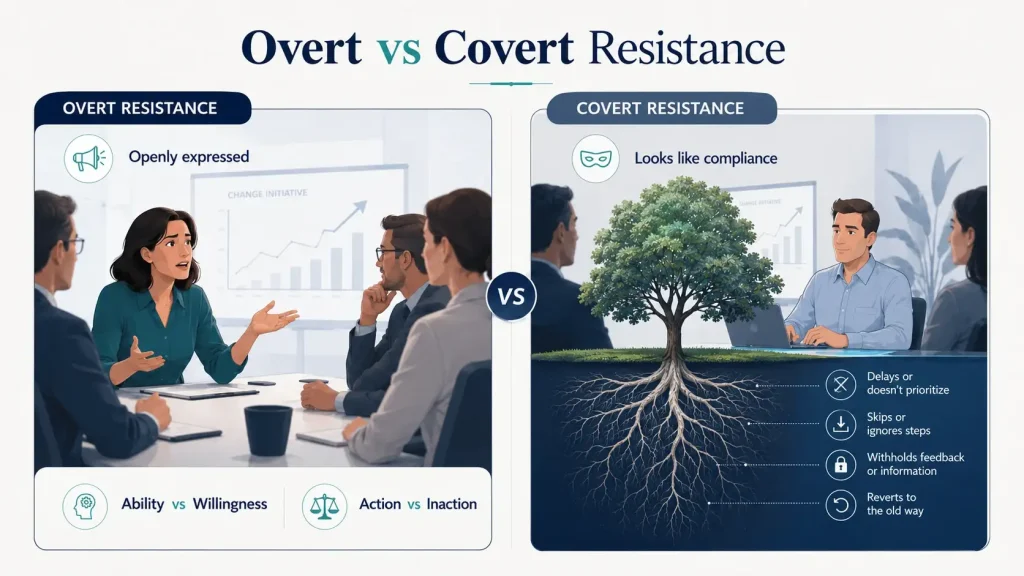
Managing resistance is challenging because things may not be what they seem. What you see on the surface can differ from what is really going on:
| What you observe (overt) | What is really going on (covert) |
|---|---|
| I express my resistance | It looks like I am changing, but I am really not |
| Ability: I lack the skills to make the change | Willingness: I am not motivated, so training will not help |
| Action: I am busy changing | Inaction: if I just wait, this too will pass |
| Conscious: my actions demonstrate my resistance | Unconscious: I do not realize I am being resistant |
Change agents need the skills to deal with both observable resistance and the underlying real resistance. Because AIM is tactical, it offers specific tactics for both overt and covert resistance. One primary tactic is to go to the resistance early, because understanding its source provides invaluable learning you can use to build readiness. One of the biggest mistakes change agents make, including managers who are both reinforcing sponsors and change agents, is talking too much to convince targets of the logic of the change. Change agents should take only about 25 percent of the airtime in discussions with targets. You will be far more effective if you listen more and talk less.
Silence is data, not agreement. A room that nods along and asks no questions is often the most resistant room. If you cannot see resistance, it has usually gone covert, and covert resistance is the kind that quietly kills adoption.
How Do You Find the Real Source of Resistance?
Listening helps you uncover the real source of resistance. Once you understand it, name the resistance and choose a response. The source may be the content of the change, the process and methods, or the endings and losses the target is experiencing. Other sources include disruptions to understanding, trust, or habits. Sometimes what looks like resistance to the current change is really about old experiences, which is why a core AIM principle is that no change occurs in isolation: it occurs in the climate of the current change and the context of all previous changes. Watch for red herrings, surface behaviors that mislead an inexperienced change agent. Examples include a target who floods you with detail, offers one-word answers, changes the subject, appears to be in total compliance, attacks you, or goes silent. Each requires a different tactical response. The stakes are high: McKinsey and Company’s long-running transformation research finds that roughly 70 percent of transformations fail (McKinsey, Why do most transformations fail?), and unmanaged resistance, especially the covert kind, is one of the most common reasons.
A Hypothetical Example
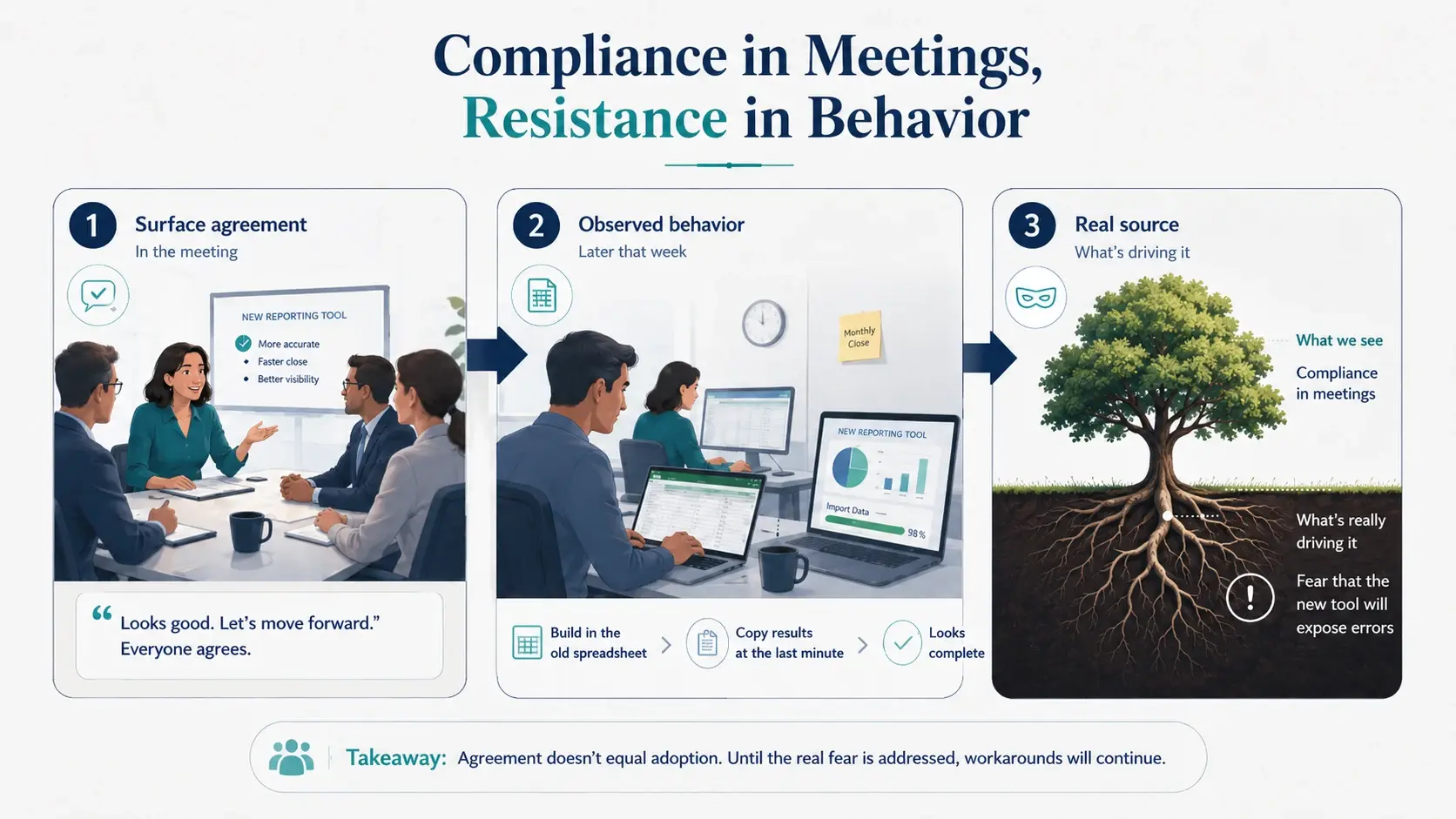
Consider a hypothetical example. A finance team is asked to move off a familiar spreadsheet to a new reporting tool. In meetings everyone agrees and nods, which looks like overt compliance. Yet weeks later the reports are still being built in the old spreadsheet and copied into the new tool at the last minute, which is covert inaction. A change agent who only listened to the meetings would think adoption was fine. One who watched the behavior would see the real resistance and address the fear underneath it, that the new tool would expose errors the old spreadsheet used to hide.
Putting This Into Practice: A Covert Resistance Diagnostic
Use these six questions in your next target conversation to surface what compliance is hiding. They map directly to the overt and covert pairs above.
- Ask “What would make this change harder for you than it looks from the outside?” Claimed ability problems that survive training are usually willingness problems.
- Track behavior, not agreement. Is the new tool, process, or system actually being used between meetings, or only performed in them?
- Time the silence. A target who asks zero questions about a disruptive change is protecting something; treat silence as data and go to it early.
- Watch for red herrings in real time: flooding you with detail, one-word answers, and subject changes each call for a different tactical response, not more persuasion.
- Check the history. Ask what happened to the last three changes in this group; resistance to the current change is often about old experiences, because no change occurs in isolation.
- Audit your airtime afterward. If you talked more than about 25 percent of the conversation, you gathered opinions, not data.
Manage the resistance you cannot see. IMA Worldwide helps change agents surface covert resistance and respond to its real source.
How Does AIM's View of Resistance Differ From ADKAR and Kotter?
Most change models acknowledge resistance, but they treat it differently. ADKAR frames resistance primarily as a gap in one of its five building blocks, most often Desire, and prescribes closing that gap. Kotter’s model leans on urgency and a guiding coalition to overwhelm resistance with momentum. AIM treats resistance as data: an inevitable, predictable signal of disruption that should be surfaced early, diagnosed at its real source, and managed tactically, whether it is overt or covert.
| Model | How it tends to treat resistance | Practical implication |
|---|---|---|
| AIM | Data to surface early and diagnose, overt or covert | Go to the resistance; listen 75 percent, talk 25 percent |
| ADKAR | A gap in Awareness or Desire to be closed | Focus on individual readiness building blocks |
| Kotter | Inertia to overcome with urgency and momentum | Focus on coalition and communication |
For a fuller comparison of the three approaches, see AIM vs Prosci vs Kotter.
Related Reading
Frequently Asked Questions
What is the difference between overt and covert resistance?
Overt resistance is openly expressed. Covert resistance looks like compliance but is not: it can show up as claimed inability that is really unwillingness, or busy “action” that is really inaction.
Can you communicate your way out of resistance?
No. Resistance is a function of disruption from the target’s Frame of Reference, so arguments and corporate messaging will not remove it.
How should change agents handle resistance?
Go to the resistance early, listen more than you talk (aim for about 25 percent of the airtime), name the resistance, and respond to its real source.
What are resistance red herrings?
Surface behaviors that mislead, such as flooding you with detail, one-word answers, changing the subject, appearing fully compliant, attacking, or going silent. Each needs a different response.
The Bottom Line: Look Below the Surface
- Resistance is inevitable and tracks disruption, not logic.
- Overt resistance is visible; covert resistance hides as something else.
- You cannot argue your way out of it.
- Go early, listen more than you talk, and name the real source.
- Watch for red herrings and treat silence as data.
