
Enterprise change management training: build AIM capability across your organization
IMA Worldwide's enterprise training embeds the Accelerating Implementation Methodology (AIM) across your leadership, management, and practitioner layers, so your organization can drive adoption on every initiative going forward.
Enterprise change management training builds the capability inside your organization instead of renting it. IMA Worldwide certifies your leaders, managers and practitioners in one shared method, so every future initiative is run by people who already know how adoption is won, and the capability stays after the engagement ends.
Built on 40+ years of implementation research. Proven on ERP, SAP, healthcare, and enterprise-wide transformations.
Mixed groups, not practitioners only.
Delivery built around your initiative calendar.
Applied to your real initiatives.
Capability that compounds across the portfolio.
Why enterprise change fails without shared capability
Roughly 70% of large-scale organizational change initiatives fail to deliver their intended results, a benchmark documented over many years by McKinsey & Company. The cause is rarely a flawed strategy. It is the execution of the people side of change, specifically the gap between installation (the technical go-live of a system or process) and implementation (the sustained behavioral adoption where people actually use it to reach the intended business outcome).
Most failures happen inside that gap. Without active sponsor leadership, reinforcement after go-live, and a shared method for managing resistance, people revert to old habits and the transformation stalls. Enterprise change management training closes the gap by building that capability across your organization at once, rather than certifying one practitioner at a time. For the distinction that underpins the whole approach, see installation versus implementation.
Enterprise change management is the organization-wide application of change principles across many simultaneous initiatives, business units, and geographies. Unlike single-project change management, it takes a portfolio view: coordinating change load, standardizing method, and governing adoption across the whole enterprise rather than one project at a time.
Enterprise change capability, built across hundreds of organizations
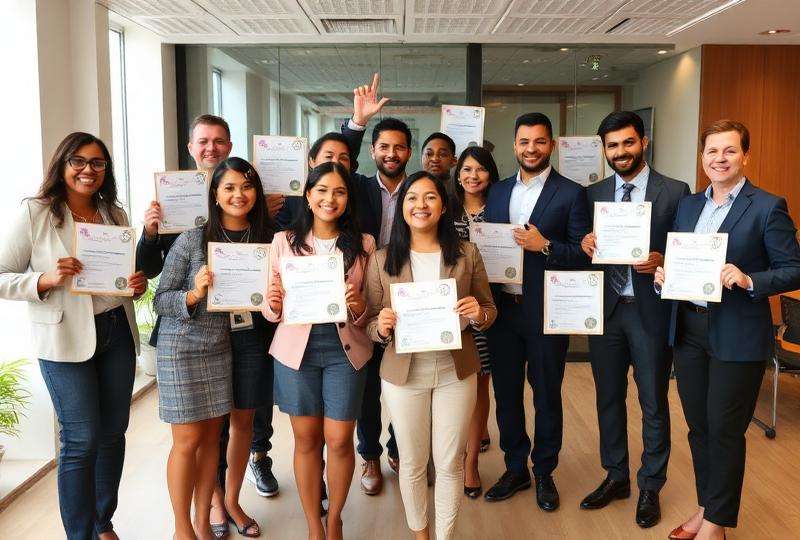
AIM is not a new framework. It has been trained, assessed, and applied across enterprises for three decades. Enterprise training gives your teams the same methodology, with the same track record behind it.
Sources: IMA Worldwide participant evaluation forms, n=1,433 rated evaluations, 2008 to 2009. AIM certification badge records, last two years. Implementation History Assessment archive, 409 client organizations, 1995 to 2026.
“Before we were AIM accredited, our change management approach was ‘spray and pray,’ with very little success. I now feel equipped to tackle big projects using the AIM methodology with an almost guaranteed high level of success.”
AIM-accredited change lead, global pharmaceutical company
Building AIM fluency across the organization
AIM diagnostic framework
Identify which root causes of implementation failure are present in an initiative, and where to focus.
Sponsorship and leadership involvement
Define sponsor obligations, assess commitment, and build the leadership involvement the change needs.
Resistance profiling and response
Distinguish compliance-based from commitment-based resistance, and respond by root cause.
Readiness assessment
Use the target-readiness tools to assess how prepared the organization is to absorb a change.
Reinforcement system design
Align performance management, consequences, and communication using Express, Model, Reinforce to sustain new behaviors.
Adoption measurement
Build adoption metrics tied to the case for change, separating installation from implementation.
Why enterprise teams choose AIM over Prosci
AIM and Prosci are the two methods most often shortlisted for enterprise change capability. They work at different layers, and the difference matters most at enterprise scale.
Prosci training teaches the ADKAR model, an individual-readiness framework created by Jeff Hiatt and formalized by Prosci in 2006: Awareness, Desire, Knowledge, Ability, Reinforcement. It is strong at diagnosing where one person or role group sits in their transition. AIM, developed by Don Harrison over 40+ years of implementation research, works at the organizational adoption layer: cascading sponsor accountability, resistance response, and reinforcement systems that carry individual readiness through to durable, enterprise-wide results. The two are complementary. Many organizations run AIM as the organizational architecture above an existing ADKAR practice.
| Dimension | AIM (IMA Worldwide) | Prosci / ADKAR |
|---|---|---|
| Primary unit of change | The organization: sponsors, agents, and targets managed as one system | The individual moving through five readiness milestones |
| Sponsorship | Cascading sponsorship with defined, non-delegable leader behaviors | Sponsorship encouraged; the individual readiness model is the core |
| Reinforcement | Explicit reinforcement system design to sustain behavior after go-live | Reinforcement is the final stage of the individual ADKAR sequence |
| Enterprise scale | Portfolio change-load view, one standardized method, a Center of Excellence | Scales by certifying more individual practitioners |
| Evidence base | 40+ years of applied field research, developed by Don Harrison | Created by Jeff Hiatt; Prosci benchmarking studies (2006) |
For the full framework breakdown, see the AIM vs Prosci vs Kotter comparison.
Project-level change vs enterprise-level change management
Enterprise change management training exists to move an organization from managing change one project at a time to governing it at the portfolio level. The two operate very differently.
| Dimension | Project-level change management | Enterprise-level change management |
|---|---|---|
| Scope | A single project or initiative | A portfolio of programs across business units |
| Governance | Project manager or change lead | A PMO plus a change management Center of Excellence |
| Sponsorship | One executive sponsor | Cascading sponsorship across leadership levels |
| Method | Ad hoc or project-specific | Standardized (AIM) across all initiatives |
| Change load | Limited awareness of saturation | Portfolio-level change load monitoring |
| Capability | External consultants per project | Internal practitioners plus a licensed methodology |
| Sustainability | Effort ends at go-live | Ongoing reinforcement and CoE governance |
Flexible delivery built around your calendar
Delivery fits the organization's initiative timeline rather than a fixed course schedule, so participants apply concepts to real initiatives in real time.
| Format | Shape | Choose it when |
|---|---|---|
| Intensive program | About 4 days, in person or virtual, covering the full framework. | A program is already moving and the team needs capability now. |
| Modular program | 4 to 6 weeks of weekly sessions with application assignments between them. | You want the work applied to a live initiative as it is learned. |
| The AIM program suite | The full class lineup delivered to your people: Introduction to AIM, ChangePro, AIM Practitioner Certification, Executive Briefing, SponsorShop, and the Initiative Workshop. | Different roles need different depth, from sponsors to the frontline. |
| Custom integration | Built on the change framework you already run. | You have existing capability to build on rather than replace. |
Your teams learn to use AI on the change itself
Every AIM class now teaches using AI for change work, hands-on, applied to the initiative the team brings. Not a separate AI course and not a demo. Because the exercises run on live work, people leave able to do it on Monday rather than holding a certificate about it. Teams practice it on four things they already produce:
The business case
Drafted against the method, then judged for what a sponsor will actually be held to.
The assessment data
Scored results read for pattern and root cause rather than summarized back.
The communication plan
Built for belief and cascade, not announcement.
The reinforcement schedule
Where most plans thin out, and where AI saves the most time.
Two things worth stating plainly for procurement and for IT. There is no AI edition of AIM and no separate AI credential: the skill is inside the classes you are already buying. And bringing an assistant is optional. The Accelerating Implementation Methodology predates AI assistants by decades, the program runs unchanged where no assistant is allowed in the room, and where one is, the person is the one who gets certified. The assistant simply leaves fluent in the method.
Core principles your teams carry into every initiative
Adoption over installation. Success means people use the new way of working, not just that it went live.
Active sponsor leadership. Non-delegable behaviors such as communicating the case, modeling the change, and aligning rewards are the sponsor's own work.
Resistance is predictable. It is a normal human response, so effective change anticipates it and addresses it by root cause.
Reinforcement is not optional. Without it, people revert. The Express, Model, Reinforce model sustains new behavior after go-live.
Portfolio-level thinking. Leaders must account for change saturation and the cumulative burden of concurrent initiatives.
Embedded capability. Building internal change capability beats relying on external consultants for every initiative.
What your organization leaves with
One vocabulary across functions
A sponsor brief means the same thing in the PMO, in HR, and in the business unit, so handoffs stop losing meaning between them.
Finished work products, not exercises
Teams train on initiatives already in flight and walk out with the scored assessment, the plan and the gap list for those initiatives.
Instructors of your own
Your people can be accredited to teach the next group themselves, which is what actually ends the dependency on outside help.
What that looks like in practice:
Capability outcomes from documented AIM engagements, anonymized by sector. The Center of Excellence timeline is IMA Worldwide's standard launch commitment rather than a measured average. Results vary by organization.
From training to an internal Center of Excellence
Enterprise training is the entry point to a durable internal capability. A change management Center of Excellence is a centralized function that standardizes the method, builds internal practitioner capability, and governs change quality across the portfolio. It is what keeps adoption consistent as initiatives multiply.
IMA Worldwide supports organizations in standing one up: by licensing the AIM methodology, training internal practitioners, and embedding AIM into program governance alongside the PMO. With the licensed, run-it-yourself model, IMA Worldwide works to get your Center of Excellence up and running in about three months. Organizations that reach a mature Center of Excellence sustain higher change success rates, reduce change fatigue, and shorten adoption cycles, long after external consultants have exited.
Enterprise change management training: key questions
1What is enterprise change management training?
2Who should attend?
3How long does it take?
4What is covered?
5How does it differ from individual certification?
6What is the return on investment?
7How is this different from Prosci training?
Find the right starting point
 AIM Practitioner Certification
 ChangePro
 Compare all programs
Ready to build AIM capability across your teams?
Tell us about your active initiatives and timeline. We will map an enterprise program to your sponsors, leaders, and practitioners, and show where it fits your change portfolio.
Talk to us about team training