

Knowing how to measure AI readiness means knowing which conditions predict whether each affected team will adopt an AI tool, and scoring them before any usage data exists. Those conditions are the team's readiness, its sponsor's support, and whether its rewards favor the new behavior.
At IMA Worldwide, we measure all three through AIM (Accelerating Implementation Methodology) and our scored diagnostics, so the results arrive while the rollout plan can still change.
What Should Leaders Take From This?
- Measure AI readiness before launch, because usage data only reports what already happened.
- Score each affected team separately on the five readiness elements, because an average hides the team about to stall.
- Add a few sponsor, behavior, and reinforcement metrics, with a baseline before go-live.
- Re-measure at 30, 60, and 90 days, and trust behavior over any score when the two disagree.
What Does It Mean to Measure AI Readiness?
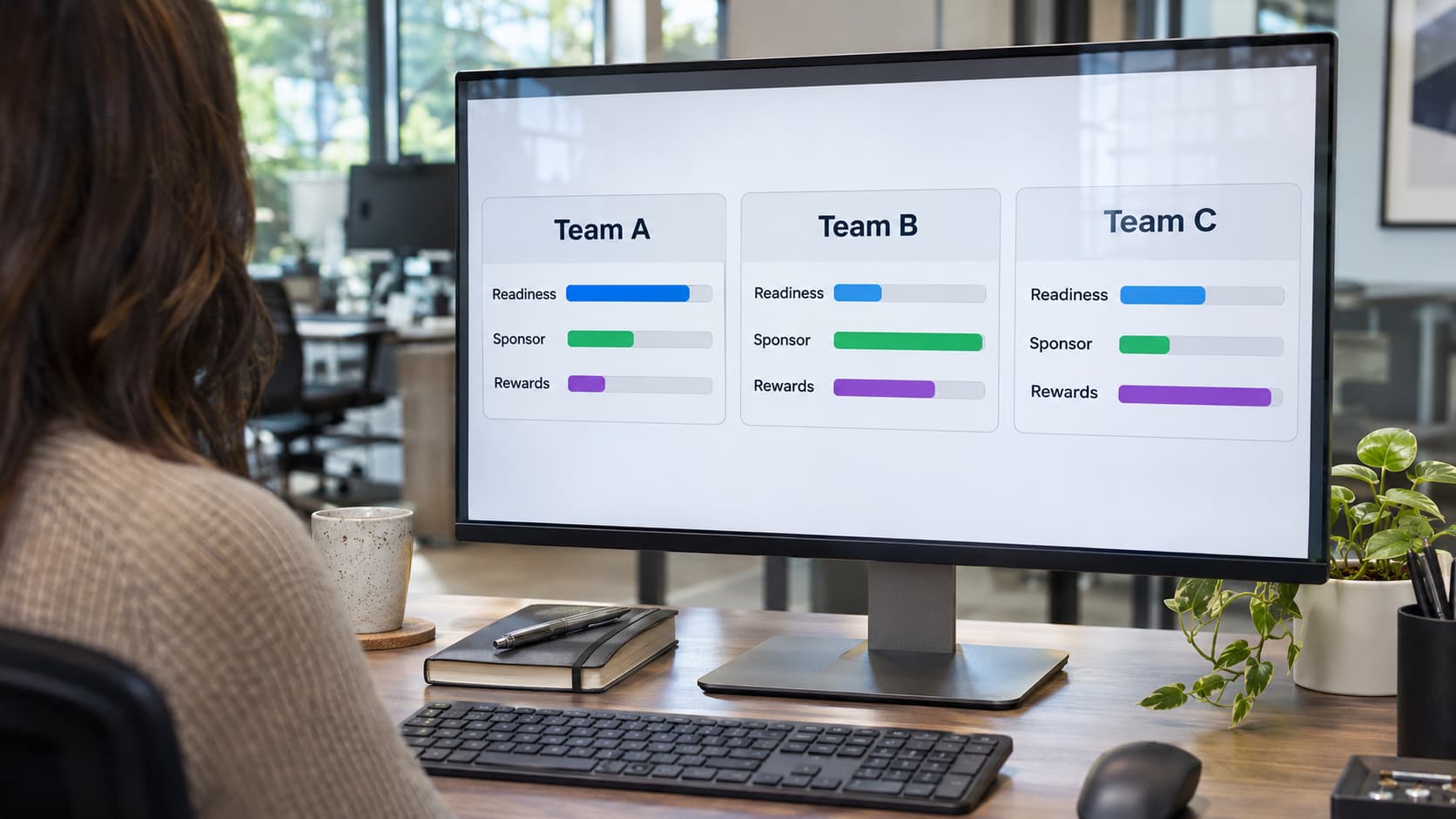
Measuring AI readiness means scoring, team by team, how prepared people are to work in a new AI-supported way, along with the leadership and reward conditions around them.
AIM calls each affected team a Target group, meaning the people who have to work differently, and each one has a sponsor, the leader with the authority to legitimize the change for that team.
Readiness measurement differs from measuring AI skill or proficiency, because a team can know the tool well and still lack the reason or the confidence to use it every day.
What Is the Difference Between Leading and Lagging Indicators of AI Adoption?
Leading indicators of AI adoption are signals you can read before go-live that predict whether adoption will hold, while lagging indicators report what has already happened after launch. AI readiness indicators belong to the leading group, and usage metrics such as logins, licenses, and feature use belong to the lagging one.
Usage reports still matter after launch, and our guide to AI adoption dashboards covers them. If usage is already falling, start with why AI adoption stalls after rollout.
Why Are Observable Behaviors the Unit of Measurement?
Observable behaviors are the unit of measurement because a readiness score only matters if it predicts something people do, and an action is something you can check. AIM treats attitudes such as buy-in and engagement as too abstract to measure, so we tie each score to behaviors someone could verify. Those behaviors might include drafting a client report with the AI tool, sending an AI-assisted report through the agreed review step, or asking for help when the new workflow breaks down.
The AIM principle behind this approach is simple:
If you cannot observe it, you cannot measure it. If you cannot measure it, you cannot reinforce it. And if you cannot reinforce it, you cannot sustain it.
Which Readiness Elements Should You Score for Each Team?
The readiness elements to score for each team are the five in AIM's Target Readiness Framework: Information, Willingness, Ability, Confidence, and Control. They are parallel requirements, so all five must be present for adoption to hold. When measuring AI adoption readiness, we score each element separately for every team, which shows which condition is missing and where.
What Does Each Readiness Element Measure?
Each readiness element measures one condition people need before they change how they work, and each shows a visible sign when missing:
| Element | What it measures | Sign that it is missing |
|---|---|---|
| Information | Understanding what is changing and what is expected | People keep asking the same questions about what is expected |
| Willingness | Personal motivation and perceived benefit | People do the bare minimum and stop when no one is checking |
| Ability | Skills, tools, and time to perform the new behavior | People struggle with the tool or run out of time to practice |
| Confidence | Belief that the change will work and that failure is safe | People are trained and capable but still avoid the new way |
| Control | A sense of input in how the change applies to their work | People describe the rollout as done to them |
Training fixes Ability; it does not fix Confidence, so a fully trained team can still stall. For a personal read, the 15-question AI Readiness Pulse Check scores one person on these five elements plus a sixth, Feedback, but an enterprise picture needs scores for each team.
Why Do General Sentiment Surveys Miss the Gaps?
General sentiment surveys miss the gaps because they ask how people feel about the change as a whole, and one mood score cannot show which condition is missing. Our Individual Readiness Assessment (IRA) reads each element separately and scores individual readiness as a probability of adoption. That separate reading shows which element is missing for a specific team, so the response can go straight to that gap.
Which AI Readiness Metrics Belong in a Working Set?
A working set of AI readiness metrics adds three families of measures to the element scores, each predicting something different:
| Family | Example metric | What it predicts |
|---|---|---|
| Sponsor | Share of sponsors doing the leadership tasks they cannot hand off | Whether the team treats the change as required |
| Behavior | Share of each team doing the work the new way, and the reversion rate | Whether adoption is spreading or fading |
| Reinforcement | Goals and recognition that name the new behavior | Whether the behavior lasts after launch |
Two or three metrics per family, six to nine in total, is usually enough, because a short list keeps each checkpoint review practical for the change team.
What Do Sponsor Metrics Track?
Sponsor metrics tell you whether sponsors are doing the leadership tasks that AIM says they cannot hand off. AIM names six such tasks, and we suggest starting with the three a change team can check most directly:
- Communicate the business case: teams whose sponsor has explained the change in person, for example at a team meeting.
- Participate in goal setting: sponsors who have set adoption goals with direct reports.
- Monitor progress constantly: how often each sponsor reviews adoption after go-live.
The other three tasks (allocate resources, align reward systems, and cascade to direct reports) show up in the reinforcement metrics. The change team checks every sponsor metric directly, so the numbers do not rest on sponsors' own account.
What Do Behavior Metrics Track?
Once the tool is live, behavior metrics show how much of each team is doing the required work the new way. They start at launch, before usage reports show a pattern, which makes them your earliest adoption data:
- Share doing the work the new way, for each required behavior and each team.
- Trend in that share from one checkpoint to the next.
- Reversion rate: how often people fall back on the old process where the new one is required.
Read at each checkpoint, these figures show whether a team's readiness scores are turning into daily practice.
What Do Reinforcement Metrics Track?
The reinforcement metrics show whether each team's goals, recognition, and follow-up favor the AI-supported way of working. They carry the most weight because of AIM's Express, Model, Reinforce framework, which describes three ways leaders shape behavior: what they say (express), what they do (model), and what they reward (reinforce).
AIM weights these at 1x, 2x, and 3x as a relative guide, so what leaders reward counts for the most. A support team judged only on tickets closed, for example, has every reason to skip an AI triage step that adds a minute. We suggest three counts:
- Goals that name the new behavior, counted before launch.
- Recognition of early adopters by their managers, counted from launch.
- Follow-up when the old process persists, counted from launch.
Once the change is running, the outcome measures in our guide to measuring change management success in AI initiatives take over.
When Should You Measure AI Readiness During a Rollout?
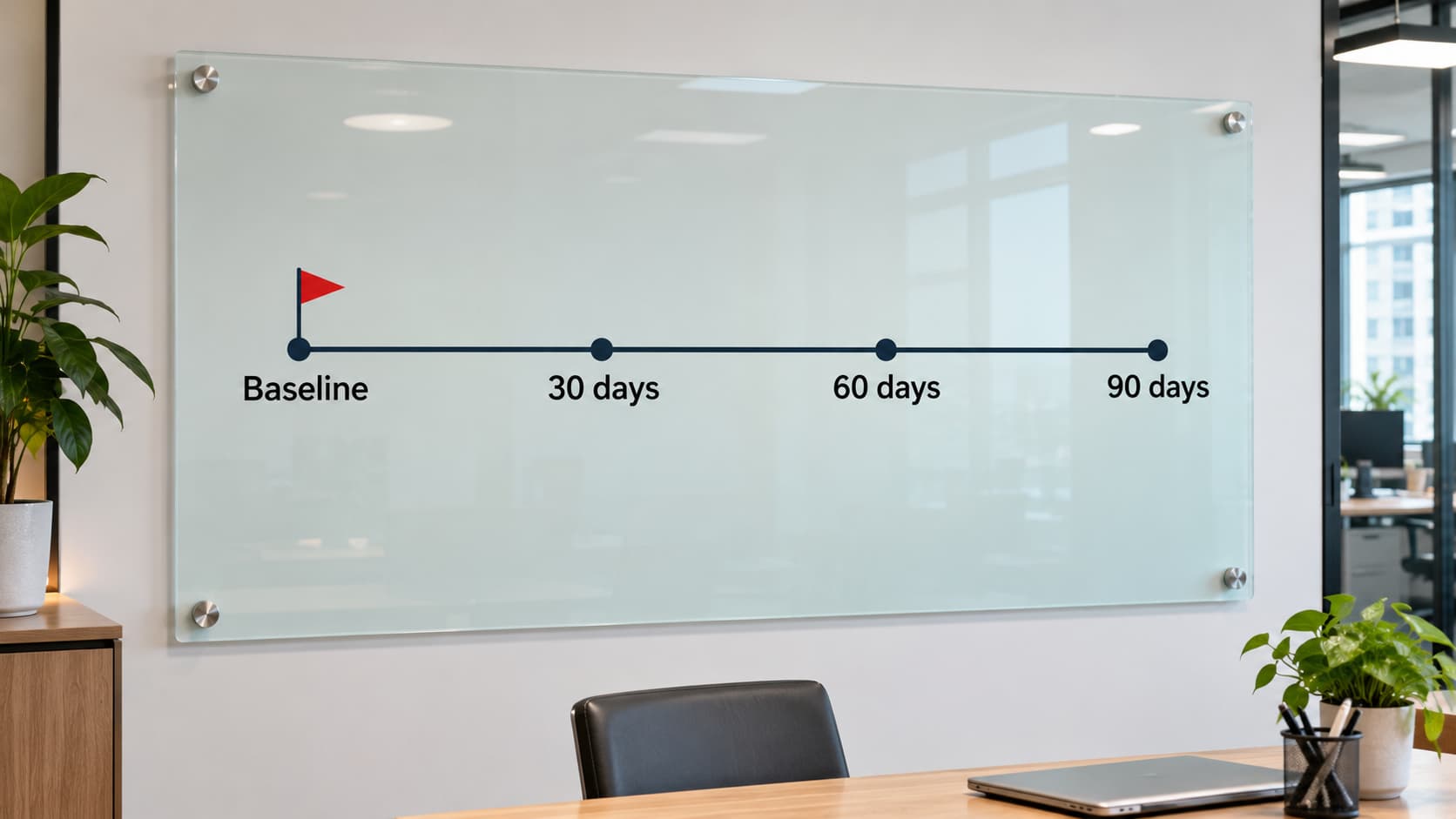
The measurement cadence starts with one baseline before go-live and continues at fixed checkpoints after launch. The baseline matters most, because a later reading only shows progress when it can be compared with where that team started.
Which Diagnostics Should You Run First?
Start with the Implementation History Assessment (IHA) or the Implementation Risk Forecast (IRF), because either one shows where the highest risk sits before any targeted diagnostic is added. The IHA looks at how past changes have gone in your organization, and the IRF forecasts risk across the ten practice areas of an AIM implementation plan. We run the IRF first when the starting point is unclear, and repeat assessments at milestones.
We then add targeted diagnostics only where that first read shows risk: the Individual Readiness Assessment (IRA) for teams with readiness gaps, the Leader 360 (listed in the AIM toolkit as the Leadership Assessment, EMR 360) for sponsors, and the Targeted Reinforcement Index (TRI) where rewards look misaligned.
These diagnostics run on the Comparative Agility platform, our assessment partner, or as templates in your existing systems. For a whole-organization view, we run them with your team as part of an enterprise AI readiness assessment.
How Often Should You Re-Measure After Go-Live?
Readiness should be checked at 30, 60, and 90 days after launch, which are our readiness checkpoints:
- Take a baseline for every team before go-live.
- Re-measure at each checkpoint, with a further reading at 180 days if you want to confirm the behavior has held.
- Take a fresh baseline for any team whose work changes again.
Interim readings can stay short, since the IRF Pulse Check is a 10-item quick reassessment for tracking the trend. Reading the same leading indicators of AI adoption at each checkpoint shows which teams are improving while there is still time to act.
Questions Leaders Ask About Measuring AI Readiness
Is the AI Readiness Pulse Check enough to measure enterprise readiness?
The AI Readiness Pulse Check is not enough on its own to measure enterprise readiness, because it scores one person at a time. Enterprise measurement adds scores for each team, sponsor activity, and whether rewards favor the new behavior.
How long do AIM readiness diagnostics take?
Most individual AIM readiness diagnostics take 10 to 20 minutes per respondent, and the Implementation Risk Forecast takes 15 to 25 minutes. Multi-rater 360s also need input from several people around each leader.
What is a reversion rate in AI adoption?
A reversion rate in AI adoption is how often people fall back on the old process when the new AI-supported one is required, counted team by team from launch. Reversion is worth tracking alongside other AI readiness metrics because a rising rate shows a team slipping before usage reports do.
What should you do when readiness scores rise, but behavior stays flat?
When readiness scores rise, but behavior stays flat, trust the behavior count and check that team's rewards and sponsor first. Flat behavior often means the old way is still rewarded or the sponsor has stopped following up.
Where Should Your First Readiness Measurement Start?
Your first readiness measurement should start with one AI change, a list of every team it touches, and the behavior each team needs to show, written in terms someone could check. Then take the baseline before go-live and schedule the 30, 60, and 90-day checkpoints.
That sequence is how to measure AI readiness while the results can still shape the plan. Individuals can start with the AI Readiness Pulse Check, and organizations with our enterprise AI readiness assessment. Teams that want this skill in-house can build it through enterprise change management training.
Contact Us