
The deal is closed. Now the synergies depend on people.
You modeled the value. Capturing it comes down to whether thousands of people across two organizations actually adopt new structures, systems, and ways of working before the projected synergies erode. That behavioral gap is where most integrations lose the value they paid for, and it is exactly what the Accelerating Implementation Methodology (AIM) was built to close: a measurable, repeatable system, not a consulting bench.
Built on the Accelerating Implementation Methodology (AIM) and 40+ years of implementation field research.
Post-merger integration consulting is the work of capturing the value the deal was priced on. Unlike most M&A integration consulting, IMA Worldwide moves both legacy organizations to adopt the new operating model through leadership alignment, readiness diagnosis, and reinforcement, so synergies are realized rather than quietly lost in the first year after close.
Systems merge on schedule. Behavior does not.
By the time you own the integration, the model already assumes the synergies. The integration plan tracks green: platforms merged, org chart published, policies harmonized. On paper, the deal is integrated.
Then the value quietly walks out the door. Two cultures make decisions differently and default absorption destroys acquired value. Ambiguity about roles pushes the people you most wanted to keep to leave. Reward systems still recognize pre-merger behavior, telling everyone the change is optional. Installation is not implementation, and the gap between them is where projected synergies collapse.
Read the fuller picture on change management in mergers and acquisitions.
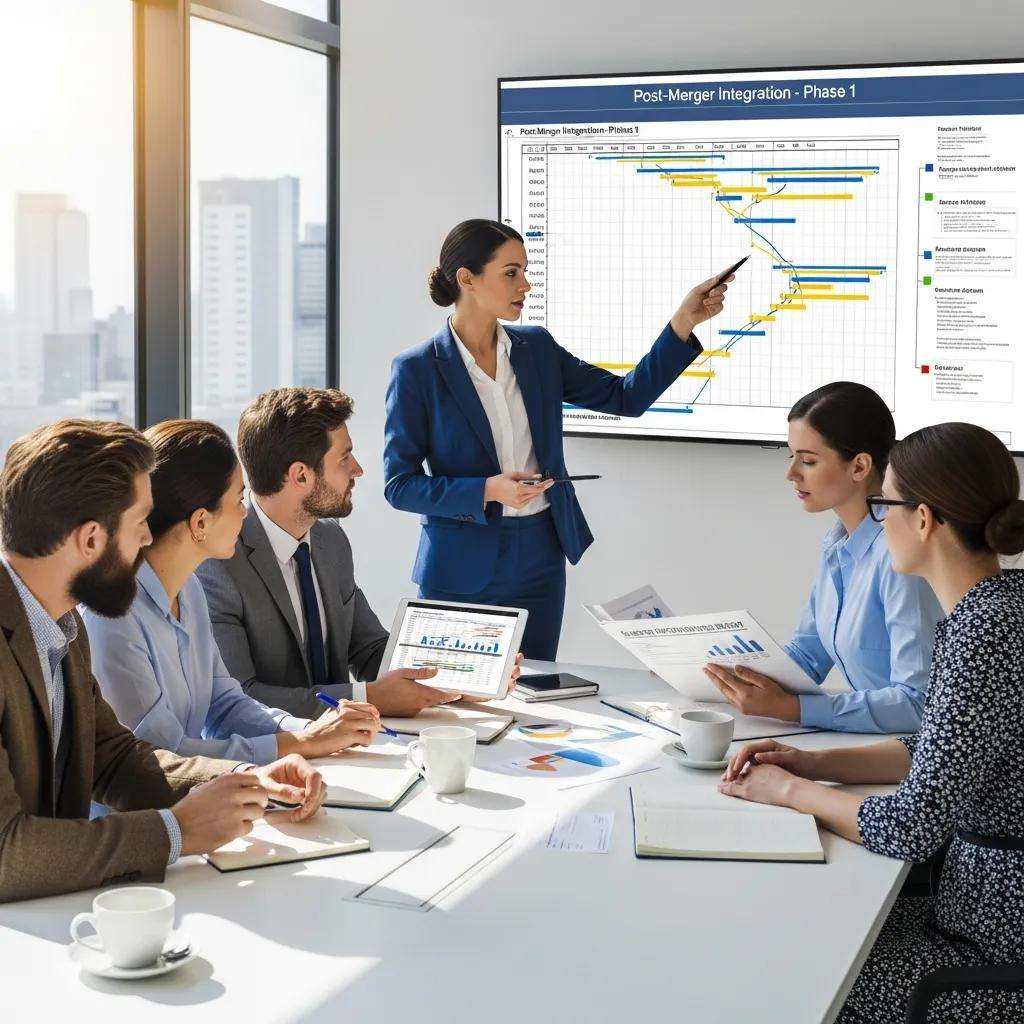
An integration built to capture value, not just combine entities
The financial and operational workstreams tell you what to integrate. IMA Worldwide's post-merger integration services cover whether people actually do it, and AIM addresses that across six moving parts:
Integration readiness diagnosis
A clear read of where cultural gaps, capacity limits, and resistance actually sit across both legacy organizations, before the integration plan is locked.
Leadership alignment
A sponsor cascade built across both organizations, closing the leadership black holes where integration usually stalls. See leadership alignment.
Culture integration
Behavior is the culture. IMA Worldwide aligns the two operating cultures through reinforcement rather than a values poster. See culture integration.
Key-talent retention
Reduce the ambiguity about roles, authority, and the future that drives your best people out during integration.
Reinforcement and synergy tracking
Rewards and routines re-pointed at future-state behavior, with adoption measured against the synergy case rather than milestone completion.
Capability transfer
Your internal integration leaders are coached as the work proceeds, so you can run the next acquisition without outside consultants.
A phased integration, from due diligence to a self-sustaining culture
IMA Worldwide has run the same six-step integration process since Don Harrison, creator of the Accelerating Implementation Methodology (AIM), first wrote it up in 1996: define the future culture, audit both current cultures against it, plan the degree of integration by function and by process, build the AIM plan, build internal capacity, then measure and modify. Here is how it runs against the deal calendar.
Define the future culture and audit both against it
Steps one to three. Leaders name the culture the combined business needs, in behaviors rather than values. A post-merger integration assessment, cultural due diligence with scores rather than impressions, reads both legacy organizations and shows where the gaps sit, and the degree of integration is decided function by function and process by process, before the integration plan is locked.
A 100-day plan people can act on
Step four, the AIM plan. A post-merger integration plan and a merger communication plan that answer what employees are actually asking: what changes for me, who I report to, who decides what. Leaders on both sides take specific, visible responsibilities, and a full-time integration team, not a part-time committee, handles the volume of questions and decisions that uncertainty generates.
Reinforce, measure, adjust
Step six runs continuously. Managers change what they reinforce day to day, because rewards and consequences still pointed at the old way keep the old way alive. Adoption is re-measured against the synergy case and the plan is modified on the data, not the calendar.
Your team runs the next acquisition
Step five is the exit. Integration leaders and change agents are coached through the work rather than watching it, so the capability stays in the organization and the next deal does not start from zero.
What should a post-merger integration checklist cover?
Start with the outcome you are actually pursuing. In 1996 Don Harrison, creator of the Accelerating Implementation Methodology (AIM), described four ways two cultures can combine, and the most common failure is negotiating one and drifting into another: co-existence agreed at the table, assimilation imposed when returns lag, resistance, then rejection. Decide the outcome by function and by process, not once for the whole company.
Thirteen questions to answer before you integrate
IMA Worldwide's M&A Integration Checklist, as used with client integration teams. Every "no" is a risk the integration plan has to carry, and most of them show up later as talent loss, stalled synergies, or a culture clash nobody planned for.
- Our leaders are aware of what will be required to successfully integrate on the people side.
- Our leaders are prepared to personally Express, Model, and Reinforce new behaviors required for the integration.
- We have determined what type of integration we are seeking: co-existence, assimilation, or transformation.
- Based on the type of integration, we have fully defined the culture we are seeking post-integration.
- Our leaders are in agreement on what the future state will look like.
- We have identified the gaps between the current culture in both organizations and our desired future.
- We have a full-time team of change agents assigned to the integration.
- We have planned how much integration we are looking to implement by function and by process.
- We have a singular change implementation approach for the people side, so everyone has the same language and process for implementation.
- We have a governance structure in place to provide quick decision-making and manage the integration at both the program and workstream levels.
- We have a communication plan that includes two-way communication and is adapted to the needs of varying target groups, rather than all top-down and one-way.
- We are using measurement diagnostics on the people side to give us data to measure progress against the plan and make modifications as needed.
- We are providing training for management team members so they are prepared to implement the integration and proactively manage resistance with their direct reports.
Post-merger integration training for the people who run it
Item thirteen is the one most integrations skip. IMA Worldwide's merger integration training is the same AIM curriculum used on the engagement, delivered by role, so the integration team, the sponsors, and the managers doing the daily reinforcing are working from one method rather than three. It is also how the capability stays after the consultants leave.
| Who | What they learn | Format |
|---|---|---|
| Sponsors and the executive team | What they personally have to express, model, and reinforce for the combined culture to take, and why a memo and a town hall will not do it | AIM Executive Briefing |
| The integration team | Building the AIM plan against the live integration: key role maps, readiness, communication, reinforcement, all as project-plan artifacts | AIM Initiative Workshop |
| Managers and employees on both sides | How to get through a change they did not choose, and what to do with the uncertainty an integration creates | ChangePro Workshop |
| Serial acquirers | Certified internal practitioners and instructors, so the next integration runs on your own people | Enterprise change management training |
What do most M&A integration consultants miss?
Most M&A integration consulting manages the combination: the plan, the program office, the synergy tracking. AIM manages whether people adopt it, which is where synergy realization is won or lost.
Manages the combination
- Focuses on the operating model, IT integration, and synergy tracking
- Hands you a post-merger integration checklist and stands up an integration management office
- Counts success as milestones hit and workstreams closed
- Treats culture integration as a workshop, not a system
- Leaves when the project does, taking the know-how along
Captures the value
- Starts with a scored read of readiness in both legacy organizations, before the integration plan is locked
- Gives leaders on both sides specific, visible responsibilities, and a merger communication plan built around what employees actually ask: what changes for me, who I report to
- Measures success as behavioral adoption tied to the synergy case
- Integrates culture through reinforcement that changes behavior
- Transfers the capability so your team runs the next deal
Not sure where your integration is most at risk? Start with a scoped readiness assessment. No large commitment to find out.
Request an integration assessmentWhere has AIM protected deal value?

Global pharmaceutical restructurings met their integration targets while retaining key staff and minimizing disruption, using the Accelerating Implementation Methodology (AIM). In another documented engagement, a major gas utility assimilating newly acquired companies onto one financial system delivered on time and within budget at every site that applied AIM, with employee belief in success up 232 percent over two years. In IMA Worldwide's field research, active leadership involvement alone is associated with a two to three times lift in adoption, and reinforcement carries roughly three times the weight of communication in making new behavior hold.
“The best change model I have used, and the one that moved the needle farthest, is AIM. No model gets to the heart of change and produces business results quicker.”
Director, Leadership and Organizational Development (former), Specialty RetailPost-merger integration consulting: key questions
What does post-merger integration consulting do?
Post-merger integration consulting helps you capture the value the deal was priced on. IMA Worldwide consultants move both legacy organizations to adopt new structures, systems, and ways of working, through leadership alignment, readiness diagnosis, and reinforcement, so projected synergies are realized rather than eroded during integration.
When should post-merger integration support start?
Before the deal closes, during due diligence, not on day one. Early readiness diagnosis and sponsor alignment let the integration plan target the real cultural and behavioral risks, so the first 100 days build adoption instead of reacting to resistance that was predictable from the start.
How is IMA Worldwide different from other M&A integration consultants?
Most integration consultants focus on the operating model, systems, and synergy tracking. IMA Worldwide focuses on whether people actually adopt the new way of working, which is where synergies are captured or lost. Using the Accelerating Implementation Methodology (AIM), IMA Worldwide builds active sponsorship across both legacy organizations and reinforces the target behaviors until the combined culture is self-sustaining.
How do you protect key talent during integration?
Talent leaves when roles, authority, and the future feel ambiguous. IMA Worldwide reduces that ambiguity early: clarifying the target operating behaviors, closing leadership black holes in the sponsor cascade, and giving managers the tools to have direct, honest conversations, so the people you most wanted to keep have a reason to stay.
What do merger and acquisition integration consultants actually do?
Most merger and acquisition integration consultants manage workstreams: systems, org design, and synergy tracking. IMA Worldwide's consultants do something narrower and harder: they run the Accelerating Implementation Methodology (AIM) on the behavioral side of the integration, measuring readiness in both legacy organizations, giving leaders specific visible responsibilities, and reinforcing the new operating model until it is how the combined company actually works.
How do you measure integration success?
Against the synergy case, through behavioral adoption rather than milestone completion. IMA Worldwide tracks whether people across both organizations are working the intended future-state way and sustaining it, using readiness assessments at defined points against a real baseline.
Do you transfer integration capability to our team?
Yes. IMA Worldwide coaches your internal integration leaders and change agents as the work proceeds, so your organization can run the next acquisition without outside consultants. Capability transfer is built into every engagement.
How do you hire post-merger integration consultants?
Ask three things before you hire post-merger integration consultants: what they measure before the plan is locked, what your leaders will be asked to do visibly, and what your own team can run without them afterward. IMA Worldwide answers all three with a scored readiness baseline, contracted sponsor responsibilities, and capability transfer built into the engagement.
What is M&A integration consulting, and how is it different from deal advisory?
M&A integration consulting is the post-close work of combining two organizations so the deal delivers the value it was priced on. Deal advisory ends at signing: valuation, due diligence, negotiation. Integration consulting starts where advisory stops, and the IMA Worldwide version concentrates on the part that decides the outcome, whether people in both legacy organizations adopt the new way of working.
What post-merger integration services does IMA Worldwide provide?
Four, and they run in sequence: a post-merger integration assessment before close, the AIM integration plan built with your team, reinforcement and re-measurement through the first year, and merger integration training by role so the capability stays in-house. Financial, legal, and IT integration workstreams stay with the firms that run them; IMA Worldwide covers whether people adopt the result.
What is cultural due diligence, and when should it happen?
Cultural due diligence is a scored read of how each organization actually behaves: how it has handled past changes, how decisions get made, what gets rewarded. IMA Worldwide runs it during deal diligence, not after close, because the results decide the degree of integration by function and the sponsorship the plan will need.
Protect the value you just paid for
Start with an integration readiness and sponsorship assessment. You will leave the first conversation knowing where your integration is most at risk, and what it takes to capture the synergies on time.
Request an integration assessment