
AIM Change Management Framework
Leadership in Change Management: The #1 Factor in Adoption
The difference between transformations that stick and those that stall is whether leaders apply the effective leadership behaviors they already use every day — to the change itself.

Not New Work. Focused Attention.
Apply the same leadership behaviors you already use for day-to-day operations to the transformation.
— AIM Change Management MethodologyThe behaviors that drive successful adoption are the exact same activities leaders perform every day: communicating priorities, setting goals, allocating resources, recognizing performance, cascading direction, and monitoring progress. Leadership in change management is not a new competency. It is focusing existing attention.
The problem during transformation is delegation. Executives announce the strategy, a project team takes ownership, and leaders return to operational focus. The implicit message to employees: this change belongs to the project team, not to us. Employee engagement drops because the people with the most influence over daily behavior have stepped aside.
Research from decades of AIM implementations confirms this delegation gap — not employee resistance is the primary reason transformations fail. Organizations where leaders at every level actively perform their non-delegable tasks achieve adoption rates 2-3x higher than those where leaders delegate sponsorship to project teams.
The Trap to Avoid: The Black Hole
Leadership involvement must cascade through every level. When any level is skipped, a "Black Hole" forms — decisions go in, nothing comes out.
The signal doesn't just weaken. It stops. Middle managers can't cascade what they haven't received.
— AIM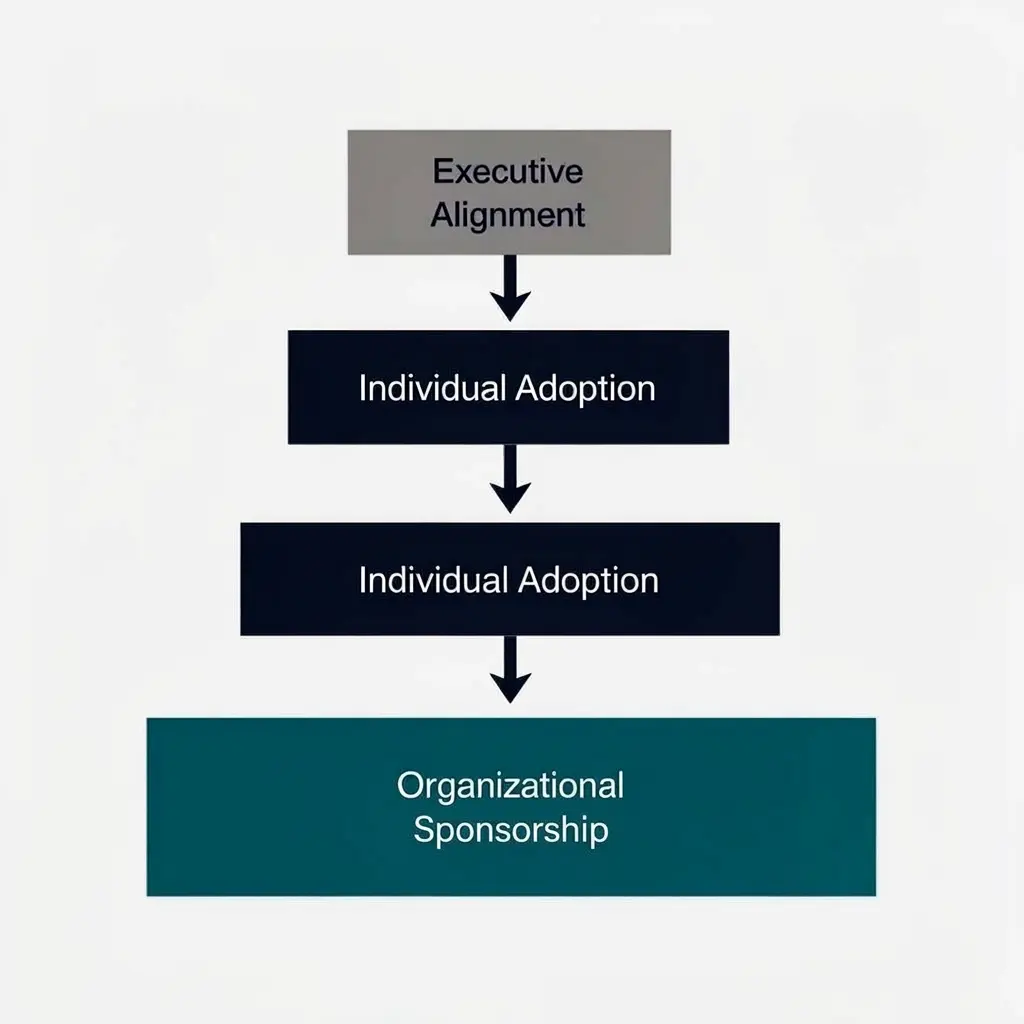
Leadership in change management must be treated as a cascading system, not a top-down announcement. Each level of management must actively perform the non-delegable tasks with their own direct reports.
Organizations that demonstrate effective leadership behaviors at every level consistently achieve higher adoption rates and more sustainable results. AIM's Leader 360 Assessment identifies exactly where cascading breaks down.
Leadership Behaviors That Require Positional Authority
These require positional authority. Change agents can prepare leaders to act, but cannot perform these on their behalf.
Communicate the Business Case
Personally articulate the "why" to your team in their frame of reference. Not a video from the CEO. From you.
Express · 1xParticipate in Goal Setting
Set clear expectations with direct reports. Goals from managers carry weight. Goals from project teams feel optional.
Express · 1xAllocate Resources
Commit budget, assign the right people, make trade-offs. Resource allocation signals priority.
Model · 2xAlign Reward Systems
Link adoption to performance reviews. Recognize early adopters. Address non-adoption. People do what gets reinforced.
Reinforce · 3xCascade to Direct Reports
Engage each direct report as a leader of change, not just a target. They must do these 6 tasks with their people.
Reinforce · 3xMonitor Progress Constantly
Track adoption metrics, remove barriers, make decisions when stuck. "Constantly" means ongoing, not monthly reviews.
Model · 2xThe 1x / 2x / 3x Rule
Not all leadership actions have equal impact. The Express-Model-Reinforce framework shows where to focus.
What leaders say
Tasks 1 & 2: Communicate, Set Goals
What leaders do
Tasks 3 & 6: Allocate Resources, Monitor
What leaders reward
Tasks 4 & 5: Align Rewards, Cascade
Leadership in Change Management: Common Questions
Why is leadership the most important factor in change management?
Research across thousands of AIM implementations consistently identifies leadership in change management as the single strongest predictor of whether employees adopt a transformation. Employees take cues from the leaders closest to them. When those leaders actively communicate priorities, set adoption goals, allocate resources, recognize new behaviors, cascade direction, and monitor progress — the change is treated as a genuine organizational priority.
Isn't this asking leaders to do more work on top of everything else?
No. The six non-delegable tasks are the same activities every leader already performs: communicating what matters, setting goals, allocating resources, recognizing performance, working through direct reports, and tracking results. During a transformation, leaders apply these existing behaviors to the change initiative alongside daily operations. AIM does not add to a leader's plate — it broadens the focus of what is already there.
What is the Express-Model-Reinforce framework?
Express-Model-Reinforce is AIM's hierarchy of effective leadership behaviors. Express (1x impact) is verbal support. Model (2x impact) is behavioral demonstration — visibly adopting the change yourself. Reinforce (3x impact) is systemic embedding: tying adoption to goals, recognition, resources, and consequences. Most organizations over-invest in Express activities while under-investing in Reinforce, which carries three times the weight.
What is the Black Hole in change management?
The Black Hole is the sponsorship breakdown at the middle management layer. Executive commitment may be at 100% and senior leadership at 85%, but when middle managers are not performing their non-delegable tasks, the cascade drops to 30%. Frontline employees receive no clear signal. Preventing this requires intentional sponsorship cascading where each leadership tier equips the next.
How do you measure leadership involvement in change management?
AIM provides assessment tools that measure leadership involvement through specific, observable behaviors. The assessments evaluate whether leaders at each level are performing their non-delegable tasks: communicating change priorities, setting measurable targets, dedicating staff and budget, recognizing adopters, cascading sponsorship, and monitoring milestones.
Ready to Strengthen Leadership in Change Management?
Assess sponsorship gaps, equip leaders with the non-delegable tasks, or build enterprise-wide capability.