

Quick Answer. In a webinar sponsored by the Association of Change Management Professionals (ACMP), Ann Marvin and Jennifer Vernam explored how the Accelerating Implementation Methodology (AIM) and AI work together. AIM supplies the relationship-centered principles that drive adoption, while AI acts as a thought partner that analyzes data from tools like the Implementation History Assessment, so practitioners plan change on evidence rather than anecdote.
In today's fast-evolving landscape of change management, the integration of AI is becoming increasingly significant. Organizations are pursuing more initiatives at once, with less bandwidth per initiative, and the practitioners guiding them need both a sound methodology and better analytical leverage. During the ACMP-sponsored webinar, moderator Allie Hartman led a discussion that addressed both halves of that equation, with Ann Marvin, founder of Peacock Hill Consulting, and Dr. Jennifer Vernam, an AIM consultant with more than 27 years of healthcare experience. Watch the full session below, or read on for the highlights.
What Makes the AIM Methodology Different?
The Accelerating Implementation Methodology (AIM) is a change management framework, developed by Don Harrison at IMA Worldwide, centered on principles of relationships and influence rather than a rigid checklist of tasks to complete. Ann highlighted how AIM emphasizes leveraging resources for maximum impact in the shortest amount of time, which is particularly relevant in today's fast-paced environment, where organizations often pursue multiple initiatives simultaneously with limited bandwidth. A full overview of the framework lives on our What is AIM page.
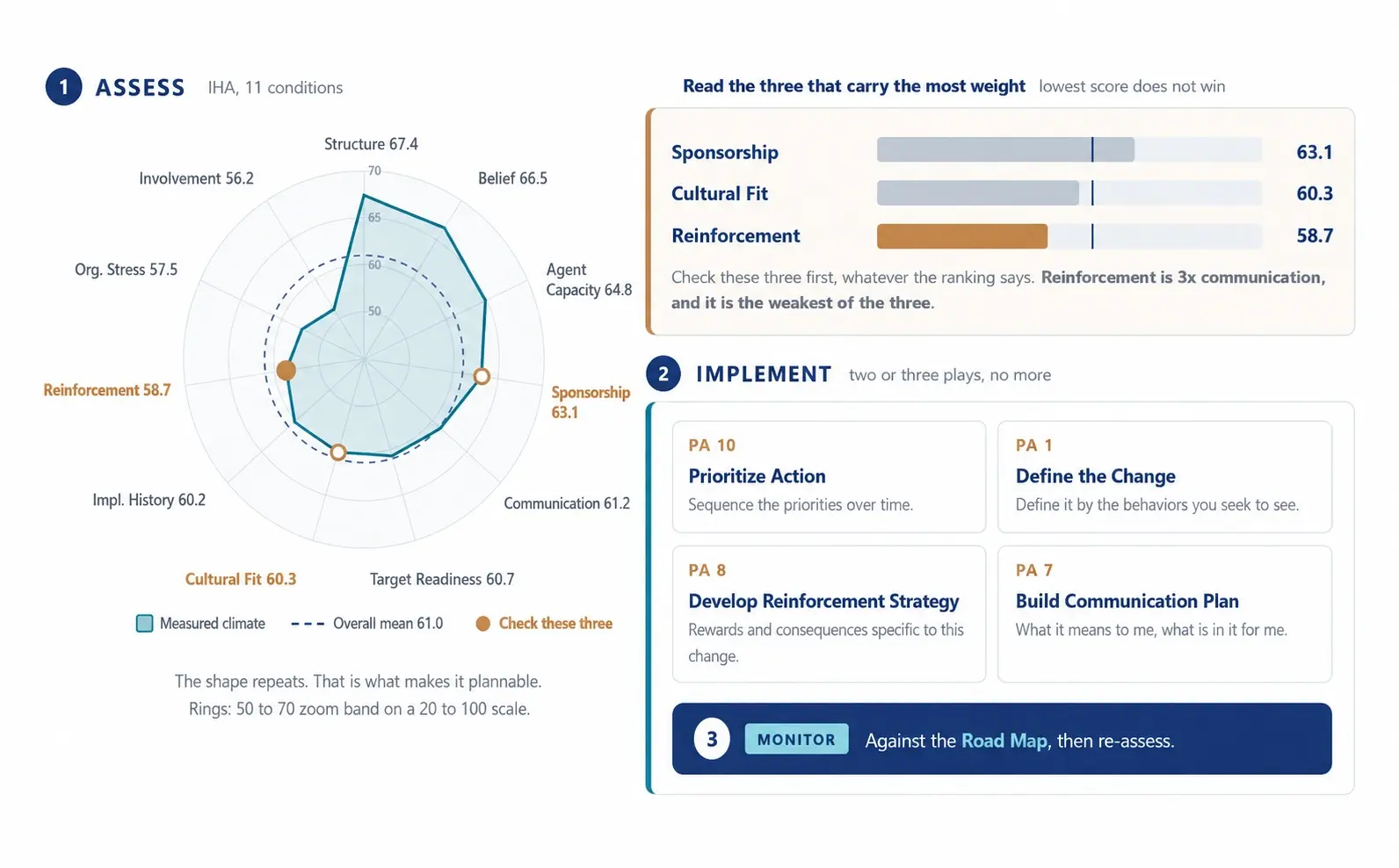
Unlike traditional models that treat change as a single, linear sequence of steps, AIM asks practitioners to continually reassess where an initiative stands and which principles will move it forward fastest. This adaptability is especially valuable for complex efforts such as digital transformation, ERP implementations, mergers and acquisitions, and organizational restructuring, where conditions shift and stakeholder needs evolve throughout the initiative. By grounding decisions in relationships and influence rather than a fixed sequence, change practitioners can respond to real conditions on the ground instead of forcing every initiative through the same predetermined path.
"The idea is to use the right principles at the right time. This is not a linear process, but it is one that you can prioritize given the context that you're in."
Ann Marvin, ACMP-sponsored webinar
How Does the Implementation History Assessment Make Organizations Smarter?
One of the standout tools discussed was the Implementation History Assessment (IHA), a scored AIM diagnostic that helps organizations reflect on their past change initiatives. This tool allows practitioners to gauge the historical context of change within their organization, identifying areas of improvement and potential risks. The IHA is one of ten core diagnostics in the AIM toolkit.
The IHA works by systematically reviewing how prior initiatives were sponsored, communicated, and reinforced, then mapping those findings against outcomes the organization actually experienced. This gives practitioners a documented pattern of what has worked and what has not, rather than relying on individual memory or anecdote. Jennifer put the payoff plainly during the session: it "helps surface areas of risk and vulnerability within the organization. So it makes us smarter."
For organizations that have weathered multiple rounds of change, this history often reveals recurring gaps, such as inconsistent sponsorship or reinforcement that stops too soon after go-live, that would otherwise go unaddressed in the next initiative. By understanding the past, organizations can strategize better for the future, building each new initiative on a clearer picture of organizational readiness rather than starting from a blank slate.
What Role Does AI Play in Change Management?
The conversation also delved into the exciting potential of AI as a collaborative partner in the change management process. Ann shared how AI can assist in analyzing data from the IHA, revealing patterns and insights that can guide decision-making.
"AI is a thought partner. It helps me get my job done, helps me do my work."
Ann Marvin, ACMP-sponsored webinar
AI's ability to provide nuanced analysis enables change agents to engage in more informed conversations and tailor their approaches to address specific organizational needs. For example, AI can help practitioners quickly synthesize large volumes of stakeholder feedback, survey responses, and historical assessment data into clear themes, work that would otherwise take a practitioner considerably longer to compile manually.

This kind of support is particularly valuable for the complex, high-stakes initiatives where AIM is most often applied, such as AI and digital transformation projects, ERP and technology implementations, and mergers and acquisitions. In these contexts, faster and more precise analysis gives practitioners more time to focus on the relational work that AIM emphasizes: building sponsorship, addressing resistance, and reinforcing new behaviors after go-live. Used this way, AI extends what a practitioner can accomplish without replacing the judgment and relationship-building that remain central to the AIM approach.
Where Should Organizations Start?
As organizations navigate the complexities of change, the combination of AIM principles and AI tools offers a path to more effective and informed change management practices. The webinar underscored the importance of viewing change through a relational lens, supported by innovative tools and methodologies. For organizations weighing where to begin, the conversation offered a clear sequence:
- Read your history first. Run the IHA to document how past changes were sponsored, communicated, and reinforced, and what actually happened.
- Build the relational base. Apply AIM principles to sponsorship, readiness, and reinforcement on the initiative in front of you.
- Then add AI leverage. Layer AI-assisted analysis onto that foundation, as a thought partner working the same method faster.
This sequencing matters, since AI is most useful when it is applied to a solid foundation of relational context, not as a substitute for it. Practitioners who build their AIM capability first are better positioned to apply AI tools effectively when they introduce them.
Method first, then leverage. IMA Worldwide's 40+ years of implementation research consistently show that past implementation history is one of the best predictors of how the next change will go, which is why the IHA comes before the AI in this sequence.
Reflecting on these insights, it is clear that the future of change management will increasingly rely on a blend of time-tested principles and advanced AI-driven technology. Organizations that invest in both, structured methodologies like AIM and the AI tools that support them, will be better equipped to manage the increasing pace and complexity of enterprise change, whether that change involves technology implementations, restructuring, or broader digital transformation efforts. For those interested in further exploring these ideas, the full webinar on ACMP's YouTube channel is embedded at the top of this article, and more sessions are available in the ACMP resource library.
How IMA Worldwide Helps Practitioners Put AIM and AI to Work

IMA Worldwide builds AI into the AIM tools and classes themselves, so practitioners learn to direct AI against a proven method rather than bolting a chatbot onto a project plan. Teams start by reading their own history and readiness with scored diagnostics like the IHA, then apply AIM's playbooks to the live initiative, with AI-assisted analysis accelerating the diagnostic work. If you want to see where your organization stands before the next change, the free AI readiness pulse check takes a few minutes, and our AI adoption services page shows how the method runs on AI initiatives themselves.
See Where Your Organization Stands Before the Next Change
The webinar's advice starts with knowing your own history and readiness. Prefer to talk it through? Contact IMA Worldwide for a working session on a live initiative.
Frequently Asked Questions
What is the AIM methodology?
AIM, the Accelerating Implementation Methodology, is a change management framework developed by Don Harrison at IMA Worldwide. It centers on relationships and influence rather than a rigid, linear checklist: practitioners apply the right principles at the right time, prioritized by organizational context, to achieve maximum impact in the shortest amount of time.
What is the Implementation History Assessment (IHA)?
The Implementation History Assessment (IHA) is a scored AIM diagnostic that examines how an organization's past change initiatives actually went. It surfaces areas of risk and vulnerability, giving practitioners a documented historical view of how change has unfolded so they can plan the next initiative on evidence rather than anecdote.
How is AI being used in change management?
AI is emerging as a collaborative thought partner in change management. It can analyze data from tools like the Implementation History Assessment to reveal patterns and insights, synthesize stakeholder feedback quickly, and help change agents have more informed conversations tailored to an organization's specific needs.
Does AI replace the change management practitioner?
No. AI supports the work of practitioners rather than replacing them. It assists with analysis and insight generation, while the relational judgment, sponsorship building, and strategic decisions remain with the change professionals applying AIM principles.
Where can I watch the full webinar?
The full ACMP-sponsored webinar featuring Ann Marvin and Dr. Jennifer Vernam is embedded at the top of this article. It is also available on the Association of Change Management Professionals' YouTube channel and through the ACMP resource library at acmpglobal.org.
The Bottom Line: Principles First, AI as the Multiplier
The webinar's message was consistent from both panelists: change succeeds through relationships and influence, and AI earns its place by making that work faster and better informed, never by replacing it.
- AIM applies the right principles at the right time, prioritized by context, not a linear checklist.
- The Implementation History Assessment turns your organization's change history into a risk map for the next initiative.
- AI is a thought partner: it analyzes, synthesizes, and reveals patterns while practitioners keep the judgment.
- Start with the method and your own history, then layer AI on top.
Ready to apply this on a live initiative? Contact IMA Worldwide for a working session, or start with the free AI readiness pulse check.
