

By Ann Marvin, IMA Worldwide
An AI change management Center of Excellence is a small internal group that sets the standard for how AI initiatives get adopted, not how they get built. It owns the method, the diagnostics, the coaching of sponsors, and the record of what has worked, so that the fortieth AI project does not start from the same blank page as the first. The distinction that makes it worth funding is simple: an AI CoE built around tools accumulates an inventory, and an AI CoE built around implementation accumulates capability.
Most large enterprises now have more AI initiatives than they can staff properly, and enterprise AI adoption is stalling at a predictable rate as a result. MIT Media Lab’s Project NANDA study, The GenAI Divide: State of AI in Business (2025), examined 300 public deployments alongside interviews and surveys of more than 200 executives and found that 95 percent of enterprise generative AI pilots produced no measurable profit and loss impact, with the successes turning on workflow integration rather than model quality (Forbes, 2025). That is an adoption problem showing up at portfolio scale, and a portfolio problem is what a CoE exists to solve.
What Is an AI-Enabled Change Management Center of Excellence?

An AI-enabled change management CoE is the internal function that carries implementation capability across every AI initiative in the portfolio, rather than rebuilding it inside each one.
In practice it does five things, and they are the same five functions any mature change CoE performs:
Standards. One methodology and one vocabulary for change, so that “readiness” means the same thing in the supply chain program as it does in the clinical one.
Training. Developing practitioners inside the business rather than renting them.
Coaching. Working with sponsors and change agents on live initiatives, which is where sponsorship behavior actually changes.
Quality. Governing whether the work meets the bar, using scored diagnostics rather than opinion.
Knowledge management. Capturing tools, templates, and lessons so that capability compounds instead of leaving with the last consultant.
What makes it an AI CoE is not a different set of functions. It is that the portfolio it governs shares a failure mode, and the CoE is positioned to see that pattern across initiatives in a way that no single project team can.
For the general case, including the difference between a change management office and a CoE, see what a change management Center of Excellence is. For how one gets built and staffed, see building a change management CoE.
What Changes When the CoE Governs AI Initiatives?

Four things, and they are the reason an AI portfolio benefits from a CoE more than a conventional one does.
The initiatives arrive faster than sponsorship can be built. A CoE that has already contracted sponsorship behavior with a leadership group can reuse that relationship across projects. A project team starting cold cannot.
The failure mode repeats. Across an AI portfolio the same conditions fail again and again: reinforcement still rewards the old process, managers were never equipped to coach the new behavior, and success was measured in licenses. Seeing that pattern once is an anecdote. Seeing it across eleven initiatives is a standard worth writing down.
Pilot populations are not representative. Pilots run on volunteers with unusual motivation and concentrated leadership attention. A CoE holds the institutional memory of how much of a pilot result survives contact with the general population, which is the single most over-optimistic number in most AI business cases.
Governance and adoption get confused. An AI governance committee answers whether a system is safe, compliant, and controlled. That is necessary and it is not the same question as whether anyone changed how they work. Enterprises get into trouble when they staff the first and assume it delivers the second.
Which Methodologies Do Enterprise Change CoEs Standardize On?
A CoE has to pick a method, because the standard is the product. Three are common in large enterprises.
Accelerating Implementation Methodology (AIM), developed by Don Harrison, is organized as ten practice areas, each paired with a scored diagnostic, running on a cycle of plan, implement, and monitor. The AIM methodology is behavior-first in a specific and measurable sense: it treats a change as implemented only when the people affected are consistently demonstrating the new behaviors that produce the business result, and it scores the conditions that determine whether that will happen. AI is built into the AIM tools and classes rather than sold as a separate offering.
Prosci, founded on the ADKAR model developed by Jeff Hiatt, moves individuals through awareness, desire, knowledge, ability, and reinforcement. Its strength is that it puts the individual at the center of the change, which is the correct place for them.
Kotter’s eight-step model, from John Kotter’s Leading Change (1996), is built around urgency, a guiding coalition, and short-term wins. Its strength is the political reality of large organizations: nothing moves without weight behind it.
These are not mutually exclusive, and a CoE that treats methodology choice as a religious question wastes time it does not have. The practical criterion is which method gives you a number before the money is committed and a plan for the period after go-live, because those are the two places AI initiatives lose their value. More on the method itself is at the Accelerating Implementation Methodology.
Which Organizational Roles and Governance Structures Support an AI Change Management CoE?
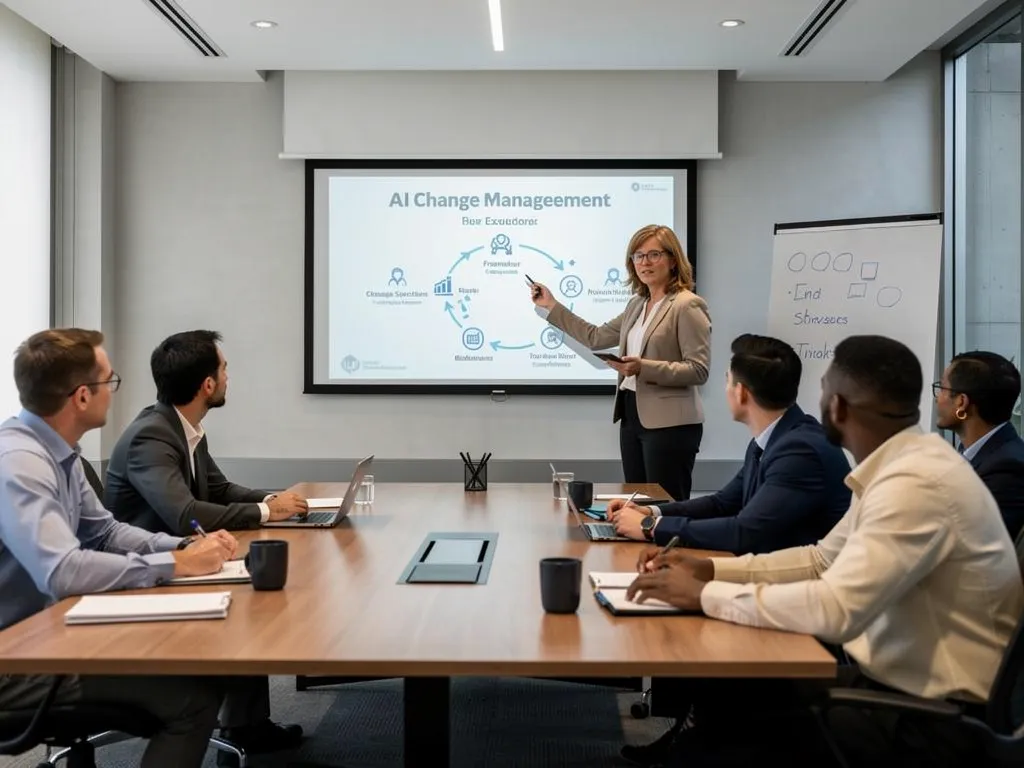
Three roles carry most of the weight, and only one of them is usually staffed properly.
Executive sponsors. Not approvers. Sponsors express why the change matters, model the behavior they are asking for, and reinforce it through what they fund, measure, and reward. Within AIM those three carry different weight: what a leader expresses counts once, what they model counts twice, and what they reinforce counts three times. Active leadership involvement of this kind is associated with a two to three times uplift in adoption. The six tasks a sponsor cannot delegate are the practical checklist.
Change agents. The people who diagnose why adoption is stalling in a specific group and close that specific gap. A CoE’s most durable output is a bench of these people who do not leave when a contract ends.
An AI governance committee. Owning appropriate use, model risk, privacy, and decision rights. Necessary, and deliberately separate from the adoption question above.
The structural mistake worth naming is putting the CoE inside the AI platform team. It ends up reporting to the people whose success is measured by deployment, which is exactly the metric the CoE exists to look past.
How Do You Design an Effective AI Change Management CoE Framework?
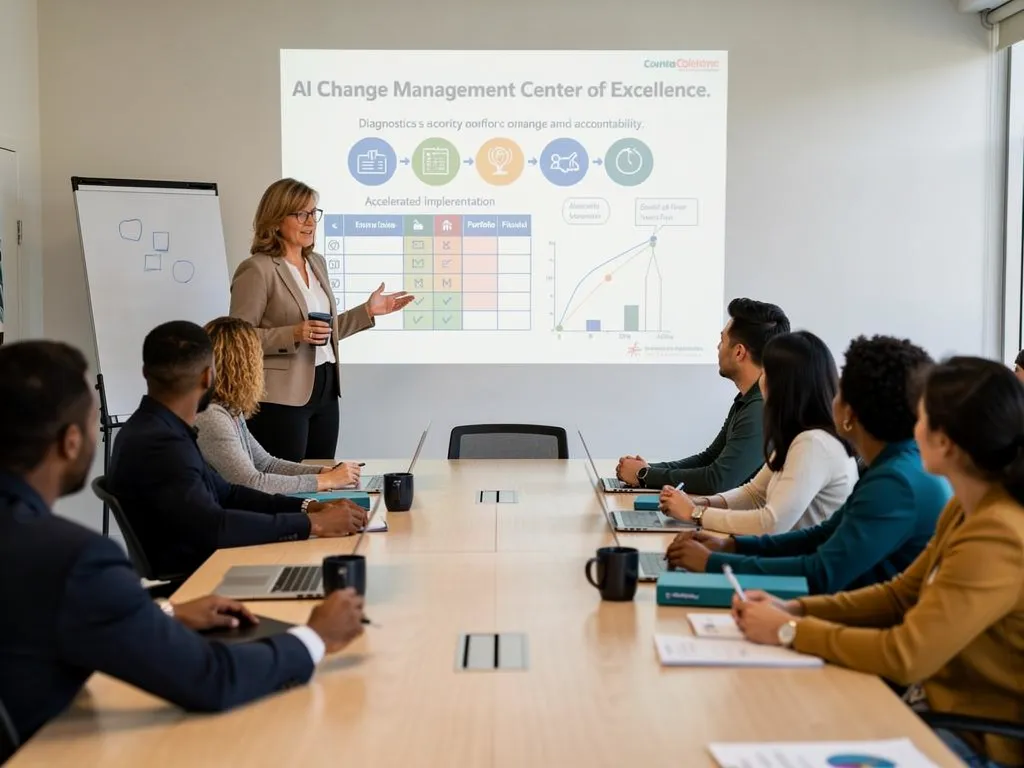
Four design decisions determine whether a CoE compounds or becomes overhead.
Define what it is accountable for. Adoption outcomes across the portfolio, not project delivery. If the CoE is measured on the same milestones as the project teams, it will optimize for the same milestones.
Give it diagnostics, not opinions. The CoE’s authority comes from measuring the same conditions the same way on every initiative. Ten scored diagnostics is a standard; a mature practitioner’s judgment is not transferable.
Integrate with what already exists. A CoE that duplicates the PMO’s stage gates will be routed around within two quarters. The work products should land inside the project plan rather than beside it.
Plan for the handover from day one. The point is internal capability. Every engagement should reduce the organization’s dependence on outside help, and it should be possible to say by when.
How Does AIM Improve Adoption in Regulated Enterprises?

Regulated environments do not change the principles. They raise the cost of getting them wrong and they lengthen the period over which conditions have to be held in place.
There is a measurable pattern worth knowing about. Across 54 pharmaceutical organizations and 19,950 assessment responses collected between 2001 and 2023, the sector scores near the top of the benchmark on defining clear authority for a change and near the bottom on involving the people affected by it. Involvement scores 2.47. Rewarding sensible risk taking scores 2.65.
That combination is the wrong shape for an AI rollout, and it explains a lot of stalled programs. Control, meaning the sense of having had input into the decision, is one of the conditions people need before they change, and a highly directive culture is least practiced at supplying it. At the same time, the detail an AI deployment depends on, which is how the work actually gets done rather than how the procedure says it gets done, only surfaces when the people doing it are asked. An organization strong on issuing direction and weak on soliciting involvement will install AI competently and learn very little about why nobody uses it.
The corrective is specific and it is a CoE-sized job: involve affected groups while the design is still open, supply evidence in the form the profession trusts, and build reinforcement around the validation calendar rather than the go-live date. More detail is in what the pharmaceutical benchmark shows.
Which Adoption Metrics and Benefits Realization Should Enterprises Track?

Separate three levels and report them separately. Collapsing them is how a program looks healthy for three quarters and then does not renew.
Activity. Licenses assigned, accounts activated, logins, prompts. These measure your launch. They peak exactly when attention is highest and they tell you almost nothing.
Behavior. What share of the population that is supposed to work the new way actually did this week. Whether managers are reinforcing it or quietly tolerating the old process. And time to proficiency, meaning how long a new user takes to reach the standard the initiative was funded to produce, which is the measure that separates a training problem from a tooling problem.
Business result. Cycle time, quality, cost, or whatever the initiative was funded to move.
One timing rule matters more than the choice of metric. Adoption fades within 90 days of go-live when nothing reinforces it, and reinforcement carries roughly three times the impact of communication. So measure after the launch communications stop, not during them. What survives the silence is your real adoption rate.
Do You Actually Need a Center of Excellence?

Often, no, and a page about CoE models should say so.
A CoE is a structure, not the capability itself. What matters is that somebody owns the standard, the diagnostics, the coaching, and the institutional memory. That ownership can sit inside HR, the PMO, finance, or an operational excellence function, and in plenty of organizations it works better there because it is closer to where the work happens.
The honest test is volume and repetition. If you are running a handful of AI initiatives, embed the capability in the function that already governs change. If you are running dozens across business units that do not talk to each other, the coordination cost is what justifies a dedicated group. Building a CoE because the org chart looks incomplete without one produces a team that writes standards nobody applies.
For the broader picture of how capability gets built and where it can live, see building change capability.
How Can Enterprises Build Change Management Capabilities Through Certification?
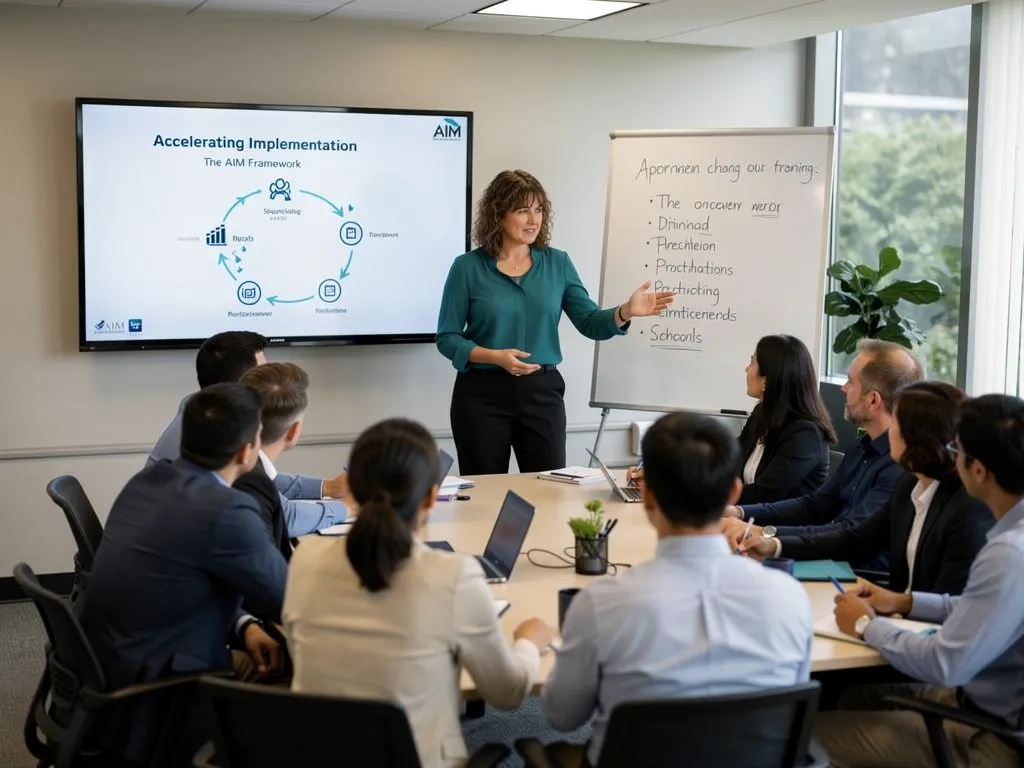
Certification is how a CoE stops being a bottleneck. A central group of five cannot personally support forty initiatives, so the multiplier is practitioners inside the business who are trained and certified to run the method themselves.
IMA Worldwide’s certification records from 1996 to 2021 cover 9,926 professionals accredited in AIM and 563 certified instructors, meaning organizations that teach the method internally rather than buying every class. Our longest-tenured client has sustained AIM capability through an internal Center of Excellence for more than 19 years, long after the consultants exited. That is the outcome a CoE is for, and it is the reason licensing AIM tends to matter more than any single engagement.
For individuals and teams, AIM change management certification is the entry point.
Frequently Asked Questions
What is an AI change management Center of Excellence?
It is a small internal group that owns how AI initiatives get adopted across a portfolio: the standard method, the scored diagnostics, sponsor coaching, quality governance, and the accumulated record of what has worked. It governs adoption rather than the technology itself, which is what separates it from an AI platform team or a governance committee.
How is an AI CoE different from an AI governance committee?
They answer different questions. A governance committee determines whether an AI system is safe, compliant, well-controlled, and appropriately used. A change CoE determines whether anyone has changed how they work because of it. Both are necessary and neither substitutes for the other. Staffing only the first and expecting adoption is a common and expensive mistake.
Does every large enterprise need a change management CoE?
No. A CoE is one structure for holding change capability, and that capability can live inside HR, the PMO, finance, or operational excellence instead. The case for a dedicated group is volume and coordination cost: dozens of initiatives across business units that do not otherwise share lessons. A handful of initiatives is usually better served by embedding the capability where change is already governed.
What metrics show an AI CoE is working?
Portfolio-level adoption rather than project delivery. Track the share of each target population consistently working the new way, manager reinforcement, and time to proficiency, then compare those across initiatives to see whether the CoE’s standards are improving outcomes over time. Activity measures such as licenses and logins cannot answer this.
How does AIM support an AI Center of Excellence?
The Accelerating Implementation Methodology, developed by Don Harrison, gives a CoE a common method and ten scored diagnostics so that every initiative is assessed the same way. It focuses on the conditions that determine adoption, including sponsorship, readiness, resistance, reinforcement, and change agent capacity, and it covers the period after go-live where AI value is captured or lost.
How long does it take to build internal AI change capability?
It depends on how much of the method the organization intends to own. The relevant benchmark is not how fast a CoE can be stood up but how long the capability lasts once it is: our longest-tenured client has run AIM through an internal CoE for more than 19 years without ongoing consulting support.
Is Your AI Portfolio Installed, or Implemented?

An enterprise can have AI deployed across a dozen business units while the behavior changes required to produce value remain incomplete. If you are deciding whether a Center of Excellence is the right structure, or trying to understand why adoption is stalling across a portfolio rather than a single project, IMA Worldwide can help.
For organizations: score your AI readiness across six dimensions, or start a conversation about your AI portfolio.
For change practitioners: explore AIM change management certification.
