

How to choose a change management training program starts with judging each provider on whether participants apply a method to a live initiative, keep reinforcing it after training, and show observable behavior change at work.
A brochure usually describes what a course contains and says little about what past participants did afterward, so the criteria, vendor questions, and scoring rubric below all ask for evidence of use on the job.
We wrote them for learning and development (L&D) and organization development leaders buying training for a group, and they apply equally to every provider you shortlist.
Key Takeaways
- Weight live application, reinforcement, and behavior measurement most heavily, and read a completion rate as a record that the course ran.
- Ask what participants practice on a live initiative and what plan they take back to it.
- Require a reinforcement plan and a schedule of behavior checks before you sign.
- Keep the organizational training decision separate from any individual's certification decision.
What Should a Training Program Change at Work?
A change management training program should change what participants do on their own initiatives, so the result you are buying is new behavior that a colleague can observe after the course ends. Agreeing on that result before you talk to providers gives every later criterion a purpose, because a provider can only be judged against the outcome you asked it to deliver.

What Is the Difference Between Knowledge, Skill, and Behavior?
The difference between knowledge, skill, and behavior lies in where the method gets used: knowledge means a participant can explain it, skill means they can apply it to a case a trainer reviews, and behavior means they work differently on their own change after the course. Holding a readiness check-in with the team before go-live is one example of behavior. A course built for knowledge can end with a passed exam and no change in daily work, so name the level you are buying.
How Will You Know the Training Changed Behavior?
You will know the training changed behavior when the observable behaviors you named before the course show up on the dates you agreed to check them. Pick two or three behaviors per role that a colleague could see, such as a manager raising the new process in every team meeting, and record a baseline for each one before the first session.
Adoption signals, such as how many people on each team now use the new process, show whether those behaviors are reaching the work, and our article on how to measure change adoption explains which signals are worth tracking.
Which Criteria Matter When You Compare Programs?
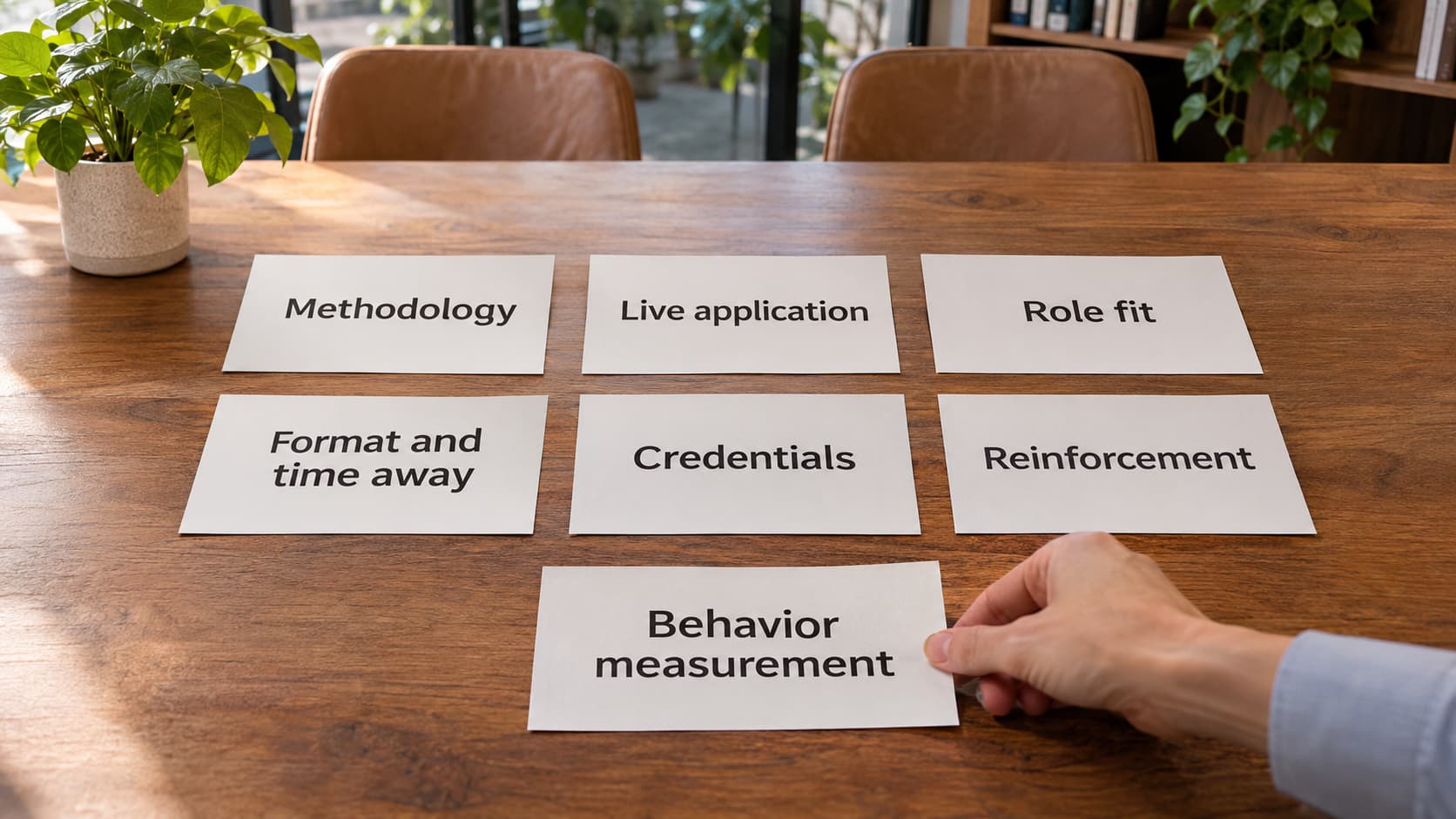
The change management training evaluation criteria that matter when you compare programs are methodology, live application, role fit, format and time away, credentials, reinforcement, and behavior measurement. Each one tests a different stage between the classroom and daily work, so a provider that is silent on any one of them leaves a gap you will have to fill yourself.
What Methodology Will Participants Use?
Methodology is the named change method a course teaches, and it matters because a shared method gives managers, project leads, and sponsors the same language and tools when they plan one change together. A survey of several models helps people recognize frameworks but may not give them enough depth to use one on a live initiative. Ask which method participants learn and whether they keep its templates afterward.
Will Participants Apply the Method to a Live Initiative?
Live application means participants work on a real change they are leading while the course runs, so they leave with a plan they can use as soon as they are back at work. With case studies alone, participants learn the method and can be left to translate it to their own initiative without help. The question for each provider is what work participants complete during the course and what they take back with them.
Does the Program Fit the Role?
Role fit means the program matches the job each person does in the change, because a manager leading a team, a project lead planning a rollout, and a full-time practitioner need different depth from the same method. Among those roles, managers lead their people through a change while living through it themselves, which is why our guide to training managers to lead change treats them as a separate audience.
Project leads need to plan adoption of what the project delivers, while practitioners need the full method. Sponsors need a working session on the actions only they can take, and HR or L&D partners need enough of the method to support managers.
What Time and Format Does Delivery Require?
The time and format a program requires cover its delivery mode, virtual or in person, plus the live hours, self-paced hours, and practice time between sessions that each participant spends. Managers plan their teams' calendars around that total, so the proposal should state it per person. Either mode can work, so judge the schedule by whether it leaves room to practice on the live initiative between sessions.
What Credential or Credit Does the Program Award?
A credential is the qualification a participant earns at the end of a program, and its value comes from who issues it and how it is earned. Ask whether participants earn it by exam or by applied work, whether it counts toward any professional credential, and whether it needs renewal, then get the answers in writing.
Credentials often matter most to full-time practitioners, and the guide to choosing CCMP certification training is a separate resource for evaluating an individual practitioner credential. The Certified Change Management Professional (CCMP) credential from the Association of Change Management Professionals (ACMP) is one example.
What Support Follows the Session?
The support that should follow the session is a defined reinforcement plan, such as follow-up coaching, a peer community, and guidance for participants' own managers on what to ask about and recognize. Reinforcement keeps participants using the method after training, because a new habit lasts when something in daily work, such as a manager's question, keeps calling for it.
How Will Behavior Be Measured?
Behavior measurement is the provider's method for showing that participants work differently after training, using evidence gathered on the job. A credible provider names the behaviors to watch for each role, explains who collects the evidence (colleague feedback, manager observation, or system usage data, for example), and reports results against your baseline. Request a measurement plan from a past program before you shortlist the provider.
What Should You Ask a Training Provider?
The questions to ask a change management training provider cover the seven criteria plus scale, and each one comes with a request for evidence so you can compare answers on the same basis. Use the table in four steps:
- Put the eight questions into your change management training RFP or send them ahead of each vendor call, so every provider answers the same set.
- Ask for the evidence in the third column, and note any answer that arrives as a description alone.
- Share the answers with the managers whose teams will attend, because they will carry the reinforcement afterward.
- Score each provider with the rubric below once every answer is in.
| Criterion | Question to ask | Evidence to request |
|---|---|---|
| Methodology | Which method do participants learn, and which tools and shared terms do they keep after the course? | The method's name and samples of the tools participants keep |
| Live application | What do participants practice on their own live initiative, and what do they leave with? | An anonymized plan that a past participant produced |
| Role fit | Which program would you recommend for a front-line manager, a project lead, and a sponsor, and why? | A separate program description for each role |
| Format and time away | How many live, self-paced, and practice hours does each participant spend? | A written total per participant |
| Credentials | What credential results, who issues it, and is it earned by exam or by applied work? | The issuing body's name and the current requirements in writing |
| Reinforcement | What support do participants and their managers get after the last session? | A written reinforcement plan with named tools or follow-up |
| Behavior measurement | How will we know that participants work differently after training? | Two or three observable behaviors per role, a baseline, an agreed check schedule, and the adoption signals to be reported |
| Scale | If this works for the first group, how can we train the next 200 people? Can we certify internal trainers? | The path to further groups and any internal trainer certification |
A provider that cannot supply the evidence for a row should score low on that criterion.
How Should You Score Training Providers?
You should score training providers by rating each one from 1 to 5 on the seven criteria, multiplying each score by a weight, and adding the results into one total. The weights below are our editorial suggestion with no research behind them, so adjust them to your situation, for example by raising credentials for a group of full-time practitioners.
Because live application, reinforcement, and measurement connect training most directly to behavior at work, we weight those three highest. Scale stays out of the rubric because it matters only after the first group shows results.
| Criterion | Suggested weight (adjust) | A score of 1 looks like | A score of 5 looks like |
|---|---|---|---|
| Methodology | 10% | No named method, or no tools kept after the course | A named method taught in depth, with tools participants keep |
| Live application | 20% | Case studies only | Participants build a plan for their own live initiative |
| Role fit | 10% | One course for every role | A distinct program for each role, with a reason for each |
| Format and time away | 10% | Total hours unclear | Total hours stated per participant, with practice time between sessions |
| Credentials | 10% | A credential claimed with no issuing body or requirements | Issuing body and requirements stated in writing |
| Reinforcement | 20% | No support after the last session | A written plan for participants and their managers |
| Behavior measurement | 20% | Attendance or satisfaction scores only | Named behaviors, a baseline, and agreed check dates |
Look closely at any provider that scores well on the 10% rows and poorly on the 20% rows, because its course may run on schedule while participants go back to working the way they did before.
Should You Choose Public Classes, Private Cohorts, or Licensing?
You should choose among public classes, private cohorts, and licensing by matching the option to how many people you need to train and how closely the training has to follow your own initiative. In practical terms, this is the in-house vs external change management training decision, because public classes and private cohorts use the provider's trainers while licensing puts the method in your own staff's hands. The same choice settles tailored vs off-the-shelf change management training, since a public class follows a set course and a private cohort can be shaped around your initiative.
Some organizations also build a course entirely in-house, in which their own team designs and delivers the method, exercises, and measures. That route suits an organization that already has practitioners with time for the work.
At IMA Worldwide, we offer all three provider paths using AIM (Accelerating Implementation Methodology), our change method. AIM describes a leader's part in a change in plain terms: what they say about it (Express), what they do themselves (Model), and what they reward (Reinforce).
When Does a Public Class Fit?
A public class fits when a small number of people need training, and the timing does not have to match a specific initiative, because each participant enrolls individually in a course that runs on its own dates. Our individual training programs include the ChangePro Workshop for managers and team leads, Introduction to AIM, and AIM Practitioner Certification, and participants in each bring a real change to work on.
When Does a Private Cohort Fit?
For a team working on the same change, a private cohort fits when the course has to be scheduled around that initiative, since the provider runs the program for your group only and can use your initiative as the working case. We run ChangePro and AIM Practitioner Certification for private teams, and our enterprise programs can be scheduled against a live initiative's timeline, in person or virtually. Ask any provider how much of the content it will adjust before you compare quotes.
When Does Licensing Fit?
Licensing fits when your organization expects to keep training people and wants its own staff to deliver the method, because a license gives internal trainers the right and the materials to teach it. When you license AIM, your trainers complete our Train-the-Trainer certification (the AIM Trainer path), which has AIM Practitioner Certification as its prerequisite.
That trained group can then anchor a Change Management Center of Excellence, an internal team that owns the method and keeps it consistent across projects. Our licensing path starts with a call, moves to a pilot cohort, and then certifies your internal trainers, so you can test the fit before your people take over delivery.
What Warning Signs Should You Look For?
The warning signs in choosing change management training are gaps in a proposal that leave you unable to tell whether participants will work differently afterward. Each sign below matches a low rubric score and comes with a step to take before the provider moves forward.
Does the Proposal Measure Only Attendance?
A proposal measures only attendance when its results section reports enrollment, completion, or satisfaction and names no behaviors to check once the course ends. Ask for one anonymized example of behavior evidence from a past client, then draft the measurement plan for your own program with the provider before you sign.
Is the Course the Same for Every Initiative and Every Role?
A course is the same for every initiative and every role when each exercise is a case study and one agenda covers managers, project leads, practitioners, and sponsors alike. Ask the provider to walk through how one module would change for a project lead compared with a front-line manager, and whether participants can bring their own initiative, because a vague answer to either places the provider at the low end of the rubric.
Does Support End at the Last Session?
A proposal shows that support ends at the last session when it lists no follow-up coaching and no guidance for participants' managers. Make a written reinforcement plan a condition of the contract, because participants who return to a team where nobody asks about the new habits have less reason to keep them.
Are the Time and Credential Details Missing?
Time and credential details are missing when a proposal counts only live hours, or promises a credential or continuing-education credit without naming the issuing body and the requirements to earn it. Ask for the hours as one written total per participant, and check any credential claim against the issuing body's own published requirements before it counts in your scoring.
Questions Buyers Ask About Choosing Training
How Much Does Change Management Training Cost?
The cost of change management training combines the provider's fee for the format you choose with each participant's time away from regular work, and both differ from one provider to the next. Ask every provider for its current fee and total hours per participant in writing, so you can compare both on the same basis.
Should Every Employee Get the Same Training?
Not every employee should get the same change management training, because managers, project leads, practitioners, and sponsors each play a different part in a change and need a different depth of the method.
How Soon Should Behavior Change Show After Training?
Behavior change should show by the check dates you and the provider agree on before training begins, and those dates should follow the pace of the change itself, such as a go-live or the first review of a new process.
What Is the Difference Between Training and Certification?
The difference between training and certification is that training builds the skills a role needs to lead change, while certification tests a person's ability to apply a method against a set standard and gives them a credential that moves with them from one employer to the next. Anyone picking a certification for their own career can start with our guide to choosing CCMP certification training.
What Should You Do After Choosing a Provider?
After choosing a change management training provider, record the scores and the evidence behind the decision, define the baseline behavior measures, and agree on the reinforcement plan before the first session, because each of these is harder to settle once training has started. If the budget still needs approval, our guide to making the case for the training budget covers that next step. If IMA Worldwide is on your shortlist, our training paths show where each program starts and who it is for.
Contact Us